Faculdade de Ciências Exatas e da Engenharia, Universidade da Madeira, Campus Universitário da Penteada, 9020-105, Funchal, Portugal.
Madeira Interactive Technologies Institute, Universidade da Madeira, Pólo Científico e Tecnológico da Madeira, Caminho da Penteada, 9020-105, Funchal, Portugal.
J Neuroeng Rehabil. 2021 Apr 14;18(1):62. doi: 10.1186/s12984-021-00853-z.
Serious games are promising for stroke rehabilitation, with studies showing a positive impact on reducing motor and cognitive deficits. However, most of the evidence is in the context of single-user rehabilitation, and little is known concerning the impact in multi-user settings. This study evaluates the impact that different game modes can have on engagement and social involvement during a two-user game. Specifically, we want to understand the benefits of game modalities based on competition, co-activation, and collaboration and analyze the influence of different motor and cognitive deficits and personality traits.
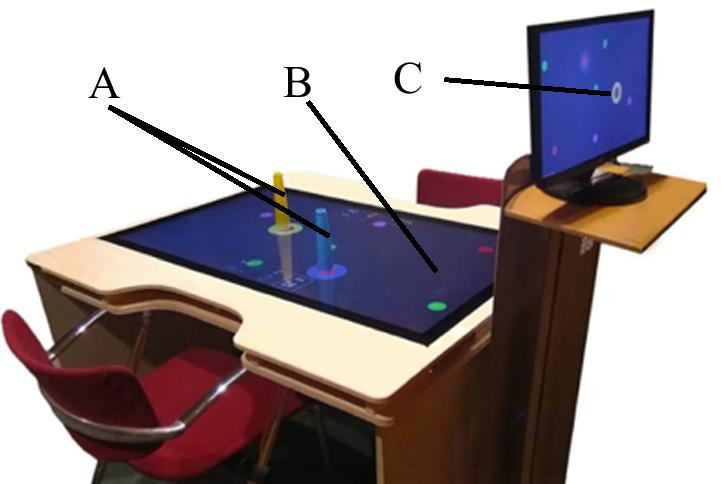
We developed a two-player setup-using tangible objects and a large screen interactive table-for upper limb rehabilitation purposes. We implemented a game that, while keeping the same basic mechanics, can be played in the three different modes (Competitive, Co-active, and Collaborative). We ran a within-person randomized study with 21 stroke survivors that were paired and played the game in its three versions. We used the Game Experience Questionnaire-Core Module to assess engagement and the Social Presence Module to assess Social Involvement. For personality, motor, and cognitive function, users answered the International Personality Item Pool (short version), Fugl-Meyer Assessment-Upper Extremity, Modified Ashworth Scale, and Montreal Cognitive Assessment, respectively.
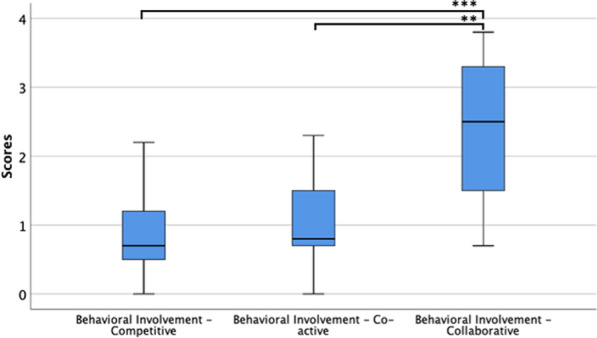
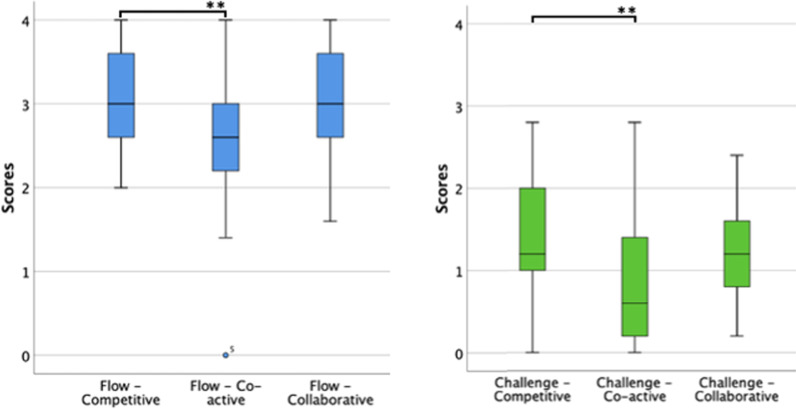
The Collaborative mode promoted significantly more Behavioral Involvement. The Competitive mode promoted more Flow and Challenge than the Co-active mode with participants with better cognitive performance, with low extraversion, or with higher motor skills. Participants with higher cognitive deficits reported more Competence with the Co-active mode.
Our results indicate that, for multi-user motor rehabilitation settings, the collaborative mode is the more appropriate gaming approach to promote social involvement, showing a high potential for increasing adherence and effectiveness of therapy. Additionally, we show that a player's motor and cognitive ability and personality should be considered when designing personalized tasks for multiplayer settings.
严肃游戏在中风康复方面具有广阔的应用前景,研究表明其对减少运动和认知缺陷有积极影响。然而,大多数证据都来自单人康复环境,对于多人环境下的影响知之甚少。本研究评估了不同游戏模式在双人游戏中对参与度和社交互动的影响。具体而言,我们希望了解基于竞争、共同激活和协作的游戏模式的优势,并分析不同运动和认知缺陷以及个性特征的影响。
我们开发了一种基于有形物体和大型互动桌的双人上肢康复游戏设置。我们实现了一个游戏,在保持基本机制相同的情况下,可以在三种不同模式(竞争、共同激活和协作)下进行。我们对 21 名中风幸存者进行了个体内随机研究,他们配对并以三种版本玩游戏。我们使用游戏体验问卷核心模块评估参与度,使用社交存在感模块评估社交互动。对于个性、运动和认知功能,用户分别回答国际人格项目池(短版)、Fugl-Meyer 上肢评估、改良 Ashworth 量表和蒙特利尔认知评估。
协作模式显著提高了行为参与度。竞争模式比共同激活模式更能促进流畅感和挑战感,且在认知表现更好、外向性较低或运动技能较高的参与者中更为明显。认知缺陷较高的参与者在共同激活模式下报告了更高的能力感。
我们的研究结果表明,对于多人运动康复环境,协作模式是促进社交参与的更合适的游戏方法,具有提高治疗依从性和效果的巨大潜力。此外,我们还表明,在为多人设置设计个性化任务时,应考虑玩家的运动和认知能力以及个性特征。