School of Medicine, Medical Sciences and Nutrition, University of Aberdeen, Aberdeen, UK.
Head and Neck Oncology Unit, Aberdeen Royal Infirmary (NHS Grampian), Aberdeen, UK.
Int J Comput Assist Radiol Surg. 2021 Jun;16(6):955-966. doi: 10.1007/s11548-021-02354-9. Epub 2021 Apr 15.
Emerging holographic headsets can be used to register patient-specific virtual models obtained from medical scans with the patient's body. Maximising accuracy of the virtual models' inclination angle and position (ideally, ≤ 2° and ≤ 2 mm, respectively, as in currently approved navigation systems) is vital for this application to be useful. This study investigated the accuracy with which a holographic headset registers virtual models with real-world features based on the position and size of image markers.
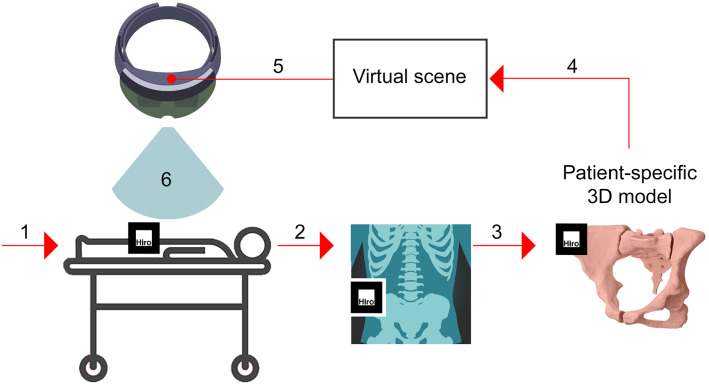
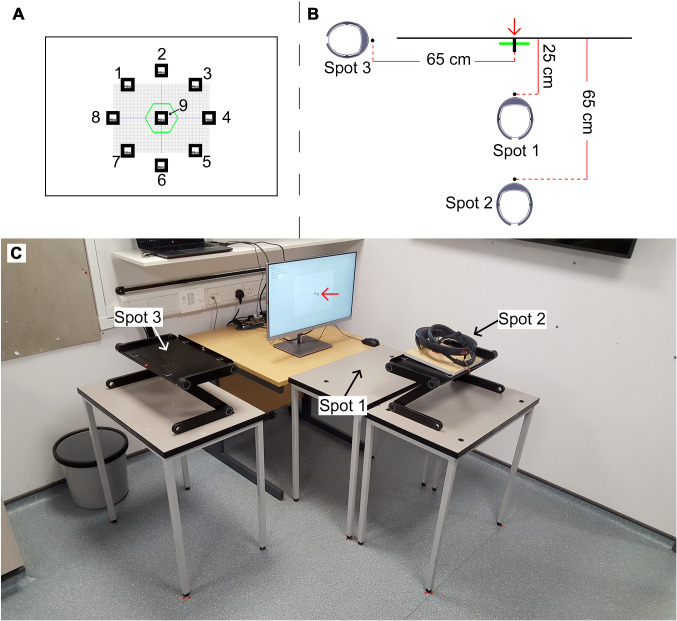
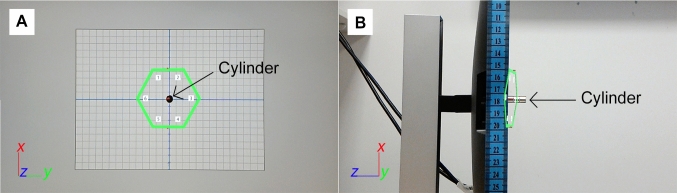
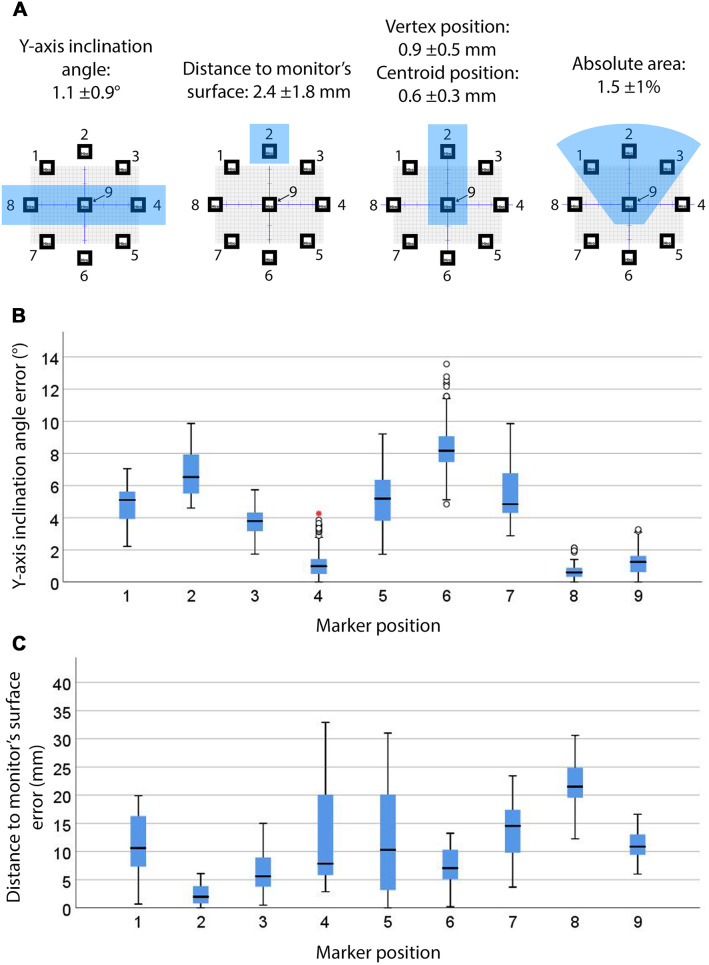
HoloLens and the image-pattern-recognition tool Vuforia Engine™ were used to overlay a 5-cm-radius virtual hexagon on a monitor's surface in a predefined position. The headset's camera detection of an image marker (displayed on the monitor) triggered the rendering of the virtual hexagon on the headset's lenses. 4 × 4, 8 × 8 and 12 × 12 cm image markers displayed at nine different positions were used. In total, the position and dimensions of 114 virtual hexagons were measured on photographs captured by the headset's camera.
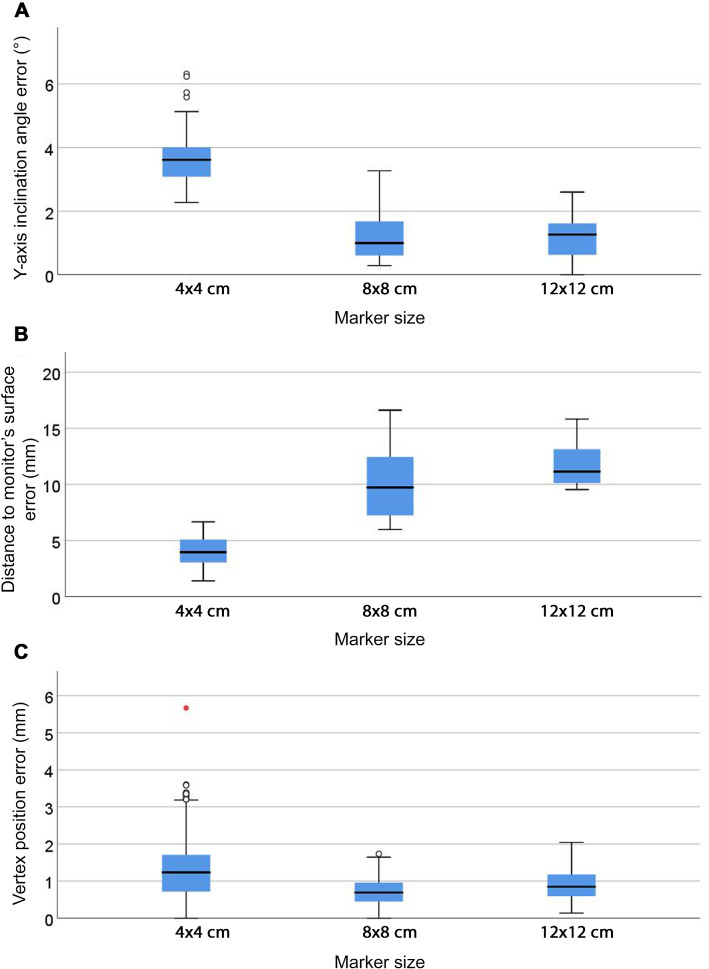
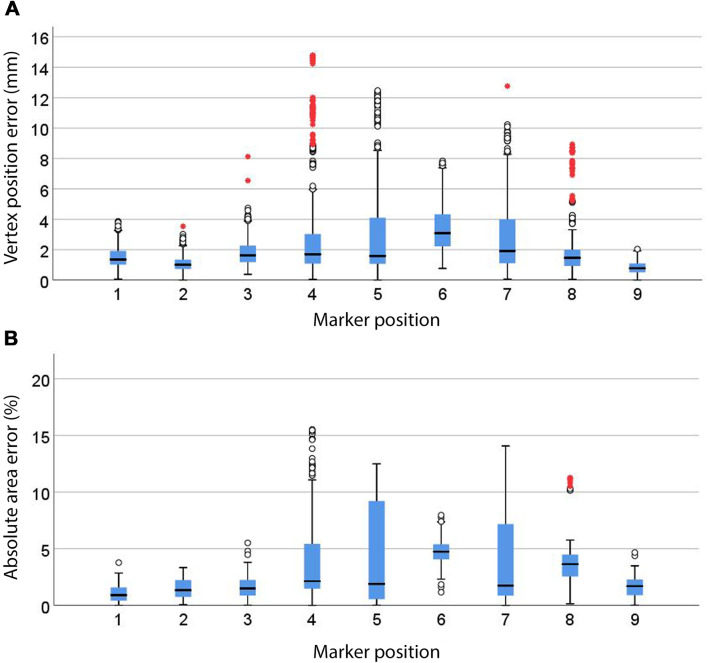
Some image marker positions and the smallest image marker (4 × 4 cm) led to larger errors in the perceived dimensions of the virtual models than other image marker positions and larger markers (8 × 8 and 12 × 12 cm). ≤ 2° and ≤ 2 mm errors were found in 70.7% and 76% of cases, respectively.
Errors obtained in a non-negligible percentage of cases are not acceptable for certain surgical tasks (e.g. the identification of correct trajectories of surgical instruments). Achieving sufficient accuracy with image marker sizes that meet surgical needs and regardless of image marker position remains a challenge.
新兴的全息耳机可用于将从医学扫描中获得的患者特定虚拟模型与患者的身体进行注册。为了使该应用程序有用,最大程度地提高虚拟模型倾斜角和位置的准确性(理想情况下,分别为≤2°和≤2mm,与目前批准的导航系统一样)至关重要。本研究调查了全息耳机根据图像标记的位置和大小来注册具有真实世界特征的虚拟模型的准确性。
使用 HoloLens 和图像模式识别工具 Vuforia Engine™将一个 5 厘米半径的虚拟六边形叠加到显示器表面的预设位置。耳机的摄像头检测到图像标记(显示在显示器上)会触发虚拟六边形在耳机镜头上的呈现。使用了 9 个不同位置显示的 4×4、8×8 和 12×12 厘米图像标记。总共在通过耳机摄像头拍摄的照片上测量了 114 个虚拟六边形的位置和尺寸。
某些图像标记位置和最小的图像标记(4×4 厘米)导致虚拟模型的感知尺寸的误差大于其他图像标记位置和更大的标记(8×8 和 12×12 厘米)。在 70.7%和 76%的情况下,分别发现误差≤2°和≤2mm。
在相当大的百分比的情况下获得的误差对于某些手术任务(例如,识别手术器械的正确轨迹)是不可接受的。无论图像标记位置如何,使用满足手术需求的图像标记大小并实现足够的准确性仍然是一个挑战。