Isaksson Martina, Ghaderi Ata, Wolf-Arehult Martina, Ramklint Mia
Department of Neuroscience, Psychiatry, Uppsala University, Entrance 10, Floor 3B, SE-751 85, Uppsala, Sweden.
Division of Psychology, Department of Clinical Neuroscience, Karolinska Institutet, SE-171 77, Stockholm, Sweden.
J Eat Disord. 2021 Apr 16;9(1):47. doi: 10.1186/s40337-021-00400-0.
Personality has been suggested to be an important factor in understanding onset, maintenance, and recovery from eating disorders (ED). The objective of the current study was to evaluate personality style in different ED diagnostic groups as classified in the Diagnostic and Statistical Manual of Mental Disorders, Fifth edition (DSM-5).
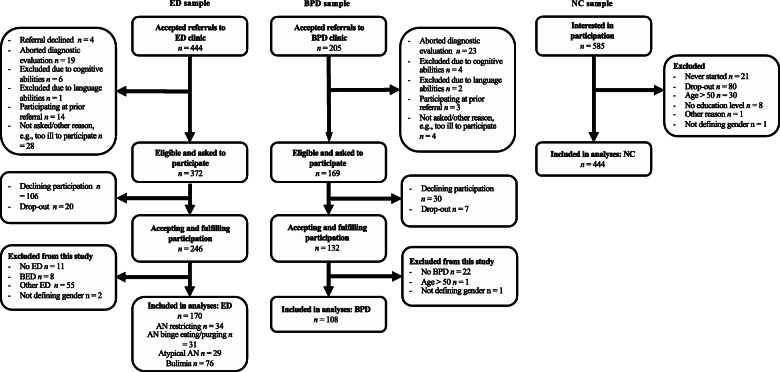
The overcontrolled, undercontrolled, and resilient personality styles were compared in four groups of patients with EDs: anorexia nervosa restricting (ANr) (n = 34), anorexia nervosa binge eating/purging (ANbp) (n = 31), atypical anorexia nervosa (AAN) (n = 29), and bulimia nervosa (BN) (n = 76). These groups were compared with a group of patients with borderline personality disorder (BPD) (n = 108), and a non-clinical group (NC) (n = 444). Patient data were collected at two outpatient clinics in Uppsala, Sweden. NC control data were collected through convenience sampling. Participants filled out questionnaires assessing personality style.
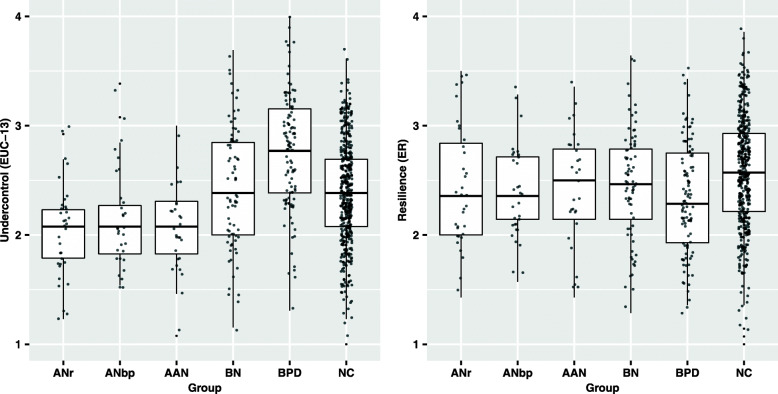
The main findings were more pronounced overcontrol reported by the ANr and AAN groups compared with the BN, BPD, and NC groups, and no significant difference in resilience between the ED and the NC groups. Considerable variability of over- and undercontrol was also found within each group.
The results replicate previous findings when EDs are classified according to current diagnostic criteria (DSM-5). Taking personality styles into account may improve our understanding of certain characteristics in EDs, such as social deficits and rigidity that are attributed to poor treatment outcome.
人格被认为是理解饮食失调(ED)的发病、维持和康复的一个重要因素。本研究的目的是评估《精神疾病诊断与统计手册》第五版(DSM-5)中分类的不同ED诊断组的人格风格。
比较了四组饮食失调患者的过度控制、控制不足和弹性人格风格:神经性厌食症限制型(ANr)(n = 34)、神经性厌食症暴饮暴食/清除型(ANbp)(n = 31)、非典型神经性厌食症(AAN)(n = 29)和神经性贪食症(BN)(n = 76)。将这些组与一组边缘性人格障碍(BPD)患者(n = 108)和一个非临床组(NC)(n = 444)进行比较。患者数据在瑞典乌普萨拉的两个门诊诊所收集。NC对照组数据通过便利抽样收集。参与者填写了评估人格风格的问卷。
主要发现是,与BN、BPD和NC组相比,ANr组和AAN组报告的过度控制更为明显,并且ED组和NC组之间的弹性没有显著差异。在每组中还发现了过度控制和控制不足的相当大的变异性。
当根据当前诊断标准(DSM-5)对饮食失调进行分类时,结果重复了先前的发现。考虑人格风格可能会提高我们对饮食失调中某些特征的理解,例如归因于治疗效果不佳的社交缺陷和僵化。