Contreras-Barraza Nicolás, Espinosa-Cristia Juan Felipe, Salazar-Sepulveda Guido, Vega-Muñoz Alejandro, Ariza-Montes Antonio
Facultad de Economía y Negocios, Universidad Andres Bello, Viña del Mar, Chile.
Departamento de Ingeniería Industrial - Facultad de Ingeniería, Universidad Católica de la Santísima Concepción, Concepción, Chile.
Front Psychol. 2021 Mar 31;12:641465. doi: 10.3389/fpsyg.2021.641465. eCollection 2021.
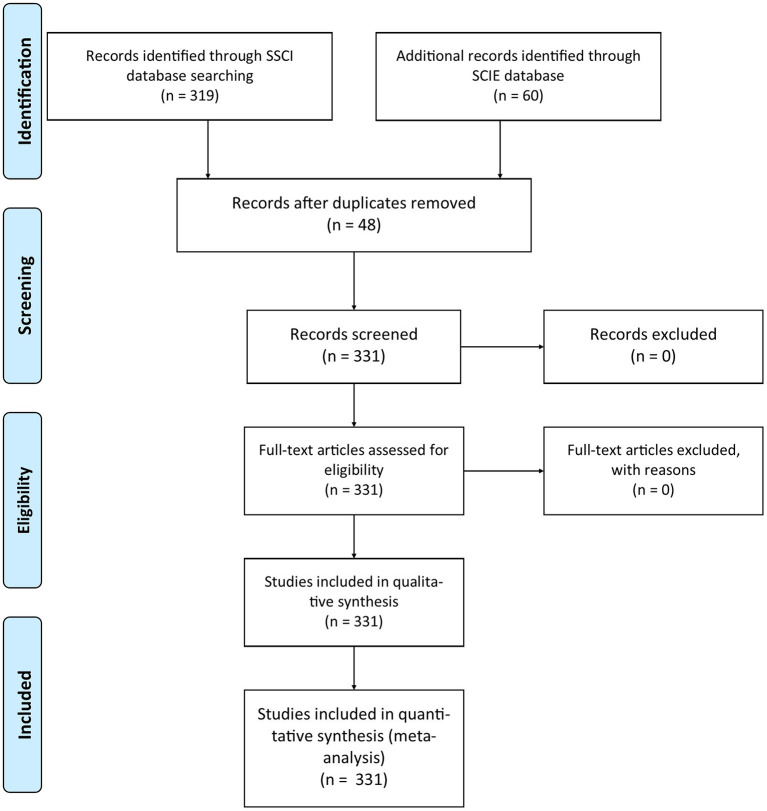
This article presents a scientometric study regarding entrepreneurship and its relationship with wellbeing. The study presents a systematic review and measures impact and relational character to identify the relevance of countries, research organizations, and authors in the field of entrepreneurial wellbeing. The study poses the following research questions: What is the nature of the evolution of scientific knowledge in the entrepreneurial wellbeing field? What is the nature of the concentration in terms of geographical distribution and co-authorship level of knowledge production in the entrepreneurial wellbeing field? What are the knowledge trends in knowledge production for entrepreneurial wellbeing literature? The contribution of this research is two-fold. First, in terms of methodology, it contributes study into the use of a more robust approach to search for the scientometric trends about entrepreneurship wellbeing in addition to the PRISMA review tools and the PICOS eligibility criteria. Secondly, the study presents research updates in the search for results for the last 2 years of knowledge production. This upgrade is particularly important in a research field that presents exponential growth, where 2019 and 2020 presented almost double the amount of knowledge production compared to 2017 and 2018.
本文呈现了一项关于创业及其与幸福感关系的科学计量学研究。该研究进行了系统综述,并衡量了影响力和关联性特征,以确定创业幸福感领域中各国、研究机构及作者的相关性。该研究提出了以下研究问题:创业幸福感领域科学知识的演变本质是什么?创业幸福感领域知识生产在地理分布和共同作者水平方面的集中性质是什么?创业幸福感文献的知识生产有哪些知识趋势?本研究的贡献有两方面。首先,在方法论方面,除了PRISMA综述工具和PICOS纳入标准外,它还为采用更稳健的方法来探寻创业幸福感的科学计量学趋势的研究做出了贡献。其次,该研究展示了过去两年知识生产成果搜索中的研究更新情况。在一个呈现指数增长的研究领域中,这一更新尤为重要,与2017年和2018年相比,2019年和2020年的知识产量几乎翻了一番。