Inria, Montpellier, France.
LIRMM, Univ Montpellier, CNRS, Montpellier, France.
PLoS Comput Biol. 2021 Apr 19;17(4):e1008856. doi: 10.1371/journal.pcbi.1008856. eCollection 2021 Apr.
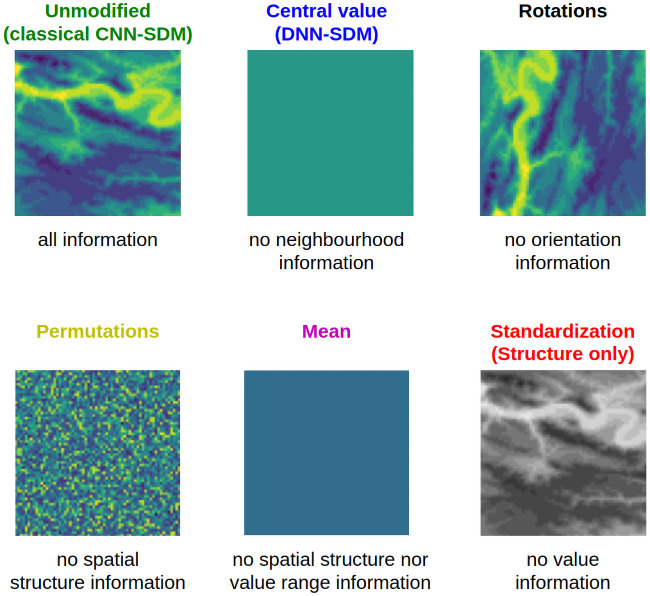
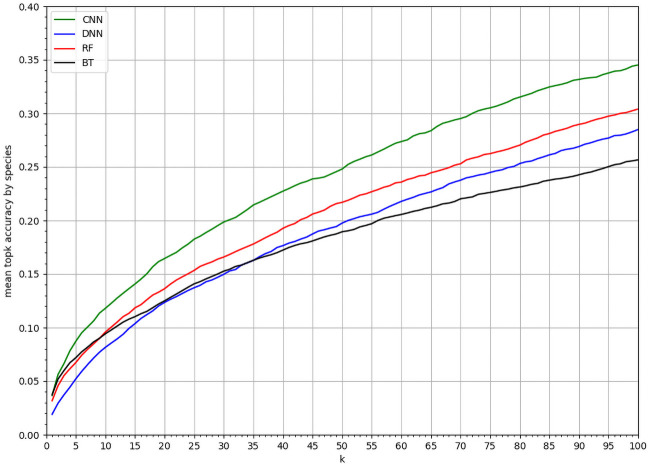
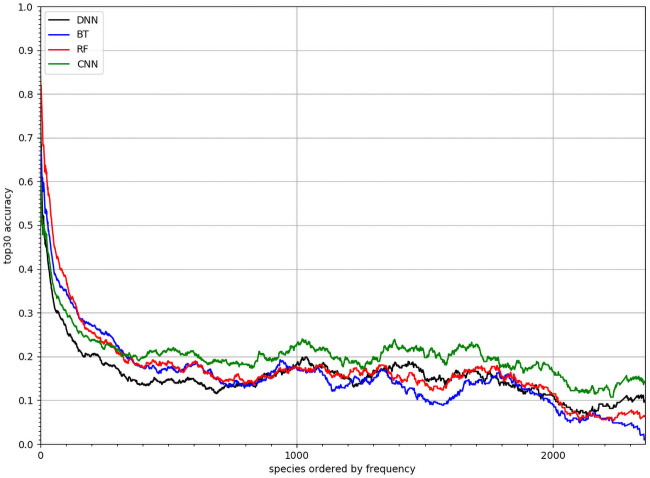
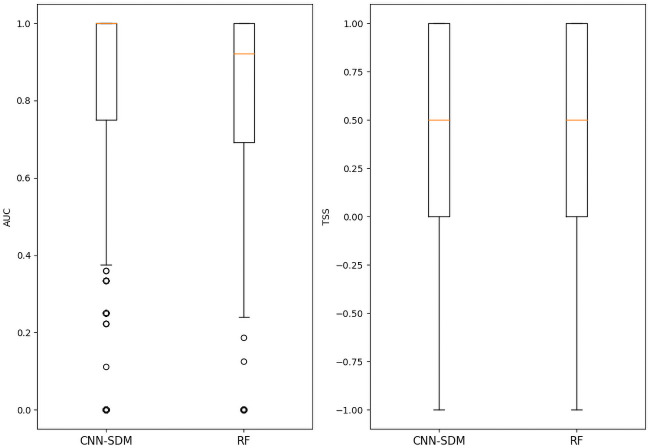
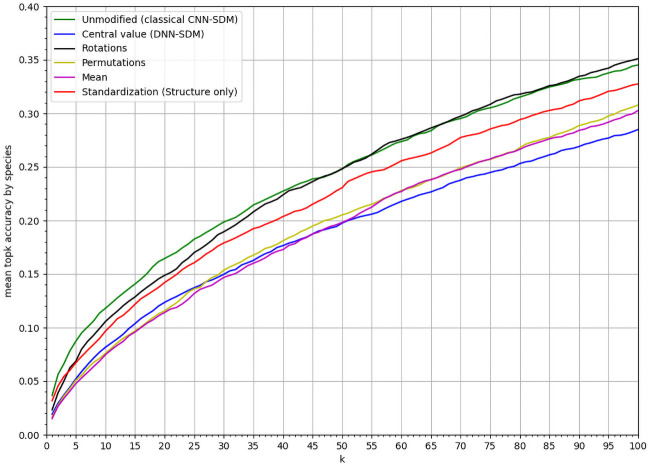
Convolutional Neural Networks (CNNs) are statistical models suited for learning complex visual patterns. In the context of Species Distribution Models (SDM) and in line with predictions of landscape ecology and island biogeography, CNN could grasp how local landscape structure affects prediction of species occurrence in SDMs. The prediction can thus reflect the signatures of entangled ecological processes. Although previous machine-learning based SDMs can learn complex influences of environmental predictors, they cannot acknowledge the influence of environmental structure in local landscapes (hence denoted "punctual models"). In this study, we applied CNNs to a large dataset of plant occurrences in France (GBIF), on a large taxonomical scale, to predict ranked relative probability of species (by joint learning) to any geographical position. We examined the way local environmental landscapes improve prediction by performing alternative CNN models deprived of information on landscape heterogeneity and structure ("ablation experiments"). We found that the landscape structure around location crucially contributed to improve predictive performance of CNN-SDMs. CNN models can classify the predicted distributions of many species, as other joint modelling approaches, but they further prove efficient in identifying the influence of local environmental landscapes. CNN can then represent signatures of spatially structured environmental drivers. The prediction gain is noticeable for rare species, which open promising perspectives for biodiversity monitoring and conservation strategies. Therefore, the approach is of both theoretical and practical interest. We discuss the way to test hypotheses on the patterns learnt by CNN, which should be essential for further interpretation of the ecological processes at play.
卷积神经网络(CNN)是一种适合学习复杂视觉模式的统计模型。在物种分布模型(SDM)的背景下,以及与景观生态学和岛屿生物地理学的预测一致,CNN 可以掌握局部景观结构如何影响 SDM 中物种出现的预测。因此,预测可以反映纠缠的生态过程的特征。虽然以前基于机器学习的 SDM 可以学习环境预测因子的复杂影响,但它们无法承认局部景观中环境结构的影响(因此称为“点状模型”)。在这项研究中,我们将 CNN 应用于法国(GBIF)的大型植物出现数据集,以较大的分类学规模预测物种在任何地理位置的相对概率排名(通过联合学习)。我们通过执行缺乏景观异质性和结构信息的替代 CNN 模型(“消融实验”)来检查局部环境景观改善预测的方式。我们发现,位置周围的景观结构对提高 CNN-SDM 的预测性能至关重要。CNN 模型可以像其他联合建模方法一样对许多物种的预测分布进行分类,但它们进一步证明在识别局部环境景观的影响方面非常有效。CNN 可以表示空间结构环境驱动因素的特征。对于稀有物种来说,预测增益是显著的,这为生物多样性监测和保护策略开辟了有前景的前景。因此,该方法具有理论和实际意义。我们讨论了测试关于 CNN 学习模式的假设的方法,这对于进一步解释所涉及的生态过程至关重要。