Health Management and Economics Research Center, School of Health Management and Information Sciences, Iran University of Medical Sciences, Tehran, Iran.
Maternal, Fetal and Neonatal Research Center, Tehran University of Medical Sciences, Tehran, Iran.
BMC Med Inform Decis Mak. 2021 Apr 19;21(1):131. doi: 10.1186/s12911-021-01497-8.
Prediction of neonatal deaths in NICUs is important for benchmarking and evaluating healthcare services in NICUs. Application of machine learning techniques can improve physicians' ability to predict the neonatal deaths. The aim of this study was to present a neonatal death risk prediction model using machine learning techniques.
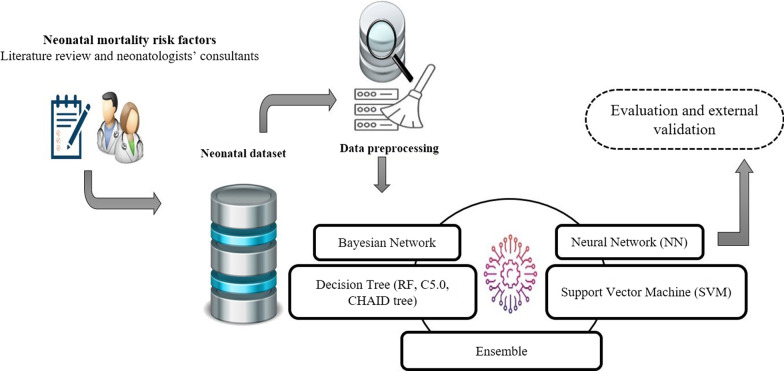
This study was conducted in Tehran, Iran in two phases. Initially, important risk factors in neonatal death were identified and then several machine learning models including Artificial Neural Network (ANN), decision tree (Random Forest (RF), C5.0 and CHART tree), Support Vector Machine (SVM), Bayesian Network and Ensemble models were developed. Finally, we prospectively applied these models to predict neonatal death in a NICU and followed up the neonates to compare the outcomes of these neonates with real outcomes.
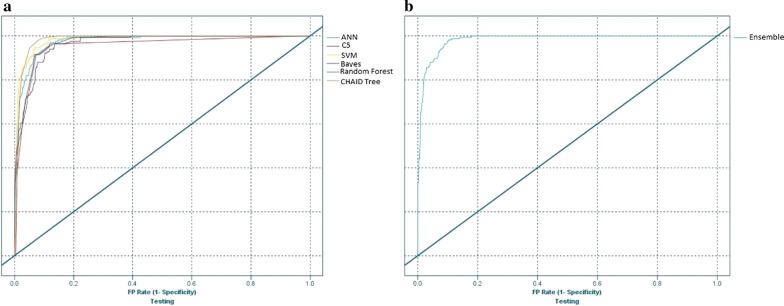
17 factors were considered important in neonatal mortality prediction. The highest Area Under the Curve (AUC) was achieved for the SVM and Ensemble models with 0.98. The best precision and specificity were 0.98 and 0.94, respectively for the RF model. The highest accuracy, sensitivity and F-score were achieved for the SVM model with 0.94, 0.95 and 0.96, respectively. The best performance of models in prospective evaluation was for the ANN, C5.0 and CHAID tree models.
Using the developed machine learning models can help physicians predict the neonatal deaths in NICUs.
预测新生儿重症监护病房(NICU)的新生儿死亡对于基准测试和评估 NICU 的医疗保健服务非常重要。应用机器学习技术可以提高医生预测新生儿死亡的能力。本研究的目的是使用机器学习技术构建新生儿死亡风险预测模型。
本研究分两个阶段在伊朗德黑兰进行。首先,确定新生儿死亡的重要危险因素,然后开发几种机器学习模型,包括人工神经网络(ANN)、决策树(随机森林(RF)、C5.0 和 CHART 树)、支持向量机(SVM)、贝叶斯网络和集成模型。最后,我们前瞻性地将这些模型应用于预测 NICU 中的新生儿死亡,并对这些新生儿进行随访,将这些新生儿的结局与实际结局进行比较。
17 个因素被认为对新生儿死亡率预测很重要。SVM 和集成模型的曲线下面积(AUC)最高,为 0.98。RF 模型的最佳精度和特异性分别为 0.98 和 0.94。SVM 模型的最佳准确性、敏感性和 F 分数分别为 0.94、0.95 和 0.96。ANN、C5.0 和 CHAID 树模型在前瞻性评估中的表现最好。
使用开发的机器学习模型可以帮助医生预测 NICU 中的新生儿死亡。