Department of Anaesthesiology and Pain Medicine, University of Ottawa, Ottawa, Ontario, Canada.
Clinical Epidemiology Program, The Ottawa Hospital Research Institute, Ottawa, Ontario, Canada.
PLoS One. 2021 Apr 22;16(4):e0249576. doi: 10.1371/journal.pone.0249576. eCollection 2021.
Effective teamwork is critical for safe, high-quality care in the operating room (OR); however, teamwork interventions have not consistently resulted in the expected gains for patient safety or surgical culture. In order to optimize OR teamwork in a targeted and evidence-based manner, it is first necessary to conduct a comprehensive, theory-informed assessment of barriers and enablers from an interprofessional perspective.
This qualitative study was informed by the Theoretical Domains Framework (TDF). Volunteer, purposive and snowball sampling were conducted primarily across four sites in Ontario, Canada and continued until saturation was reached. Interviews were recorded, transcribed, and de-identified. Directed content analysis was conducted in duplicate using the TDF as the initial coding framework. Codes were then refined whereby similar codes were grouped into larger categories of meaning within each TDF domain, resulting in a list of domain-specific barriers and enablers.
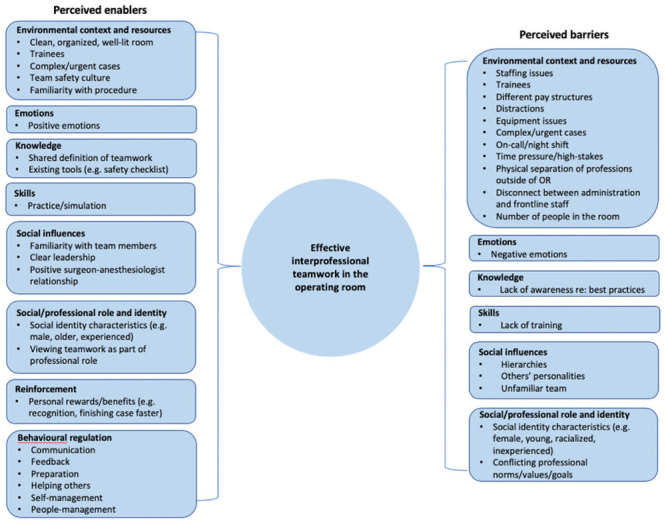
A total of 66 OR healthcare professionals participated in the study (19 Registered Nurses, two Registered Practical Nurses, 17 anaesthesiologists, 26 surgeons, two perfusionists). The most frequently identified teamwork enablers included people management, shared definition of teamwork, communication strategies, positive emotions, familiarity with team members, and alignment of teamwork with professional role. The most frequently identified teamwork barriers included others' personalities, gender, hierarchies, resource issues, lack of knowledge of best practices for teamwork, negative emotions, conflicting norms and perceptions across professions, being unfamiliar with team members, and on-call/night shifts.
We identified key factors influencing OR teamwork from an interprofessional perspective using a theoretically informed and systematic approach. Our findings reveal important targets for future interventions and may ultimately increase their effectiveness. Specifically, achieving optimal teamwork in the OR may require a multi-level intervention that addresses individual, team and systems-level factors with particular attention to complex social and professional hierarchies.
有效的团队合作对于手术室(OR)的安全、高质量护理至关重要;然而,团队合作干预并未始终如预期那样提高患者安全或手术文化。为了以有针对性和循证的方式优化 OR 团队合作,首先有必要从跨专业的角度对障碍和促进因素进行全面、有理论依据的评估。
本定性研究以理论领域框架(TDF)为依据。志愿者、有目的和滚雪球抽样主要在加拿大安大略省的四个地点进行,并持续到达到饱和为止。采访进行了录音、转录和去识别。使用 TDF 作为初始编码框架对定向内容分析进行了重复分析。然后对代码进行了细化,即将相似的代码归入每个 TDF 域内的更大类别,从而得出特定于域的障碍和促进因素列表。
共有 66 名 OR 医疗保健专业人员参与了研究(19 名注册护士、2 名注册实习护士、17 名麻醉师、26 名外科医生、2 名灌注师)。最常被识别的团队合作促进因素包括人员管理、团队定义的共享、沟通策略、积极情绪、熟悉团队成员以及团队合作与专业角色的一致性。最常被识别的团队合作障碍包括他人的个性、性别、等级制度、资源问题、缺乏最佳团队合作实践知识、负面情绪、跨专业的规范和观念冲突、不熟悉团队成员以及轮班/夜班。
我们使用理论依据和系统方法从跨专业角度确定了影响 OR 团队合作的关键因素。我们的研究结果揭示了未来干预的重要目标,最终可能会提高它们的有效性。具体来说,要在 OR 中实现最佳的团队合作,可能需要采取多层次的干预措施,特别关注个人、团队和系统层面的因素,以及复杂的社会和专业等级制度。