Department of Computer Science, UiT The Arctic University of Norway, Tromsø, Norway.
School of Sport Sciences, Faculty of Health Sciences, UiT The Arctic University of Norway, Tromsø, Norway.
Sci Rep. 2021 Apr 23;11(1):8832. doi: 10.1038/s41598-021-87757-z.
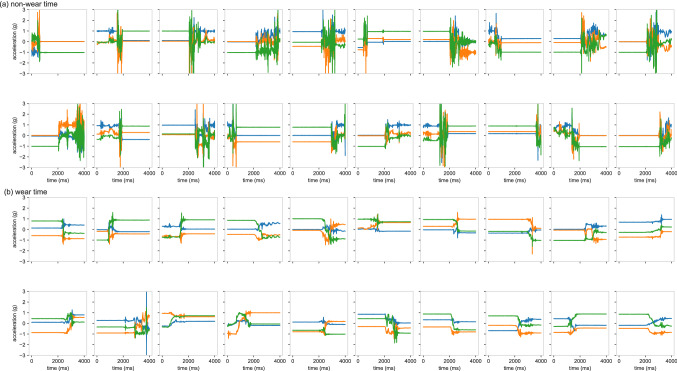
To date, non-wear detection algorithms commonly employ a 30, 60, or even 90 mins interval or window in which acceleration values need to be below a threshold value. A major drawback of such intervals is that they need to be long enough to prevent false positives (type I errors), while short enough to prevent false negatives (type II errors), which limits detecting both short and longer episodes of non-wear time. In this paper, we propose a novel non-wear detection algorithm that eliminates the need for an interval. Rather than inspecting acceleration within intervals, we explore acceleration right before and right after an episode of non-wear time. We trained a deep convolutional neural network that was able to infer non-wear time by detecting when the accelerometer was removed and when it was placed back on again. We evaluate our algorithm against several baseline and existing non-wear algorithms, and our algorithm achieves a perfect precision, a recall of 0.9962, and an F1 score of 0.9981, outperforming all evaluated algorithms. Although our algorithm was developed using patterns learned from a hip-worn accelerometer, we propose algorithmic steps that can easily be applied to a wrist-worn accelerometer and a retrained classification model.
迄今为止,非佩戴检测算法通常采用 30、60 甚至 90 分钟的间隔或窗口,在此期间,加速度值需要低于阈值。这种间隔的一个主要缺点是,它们需要足够长以防止假阳性(I 类错误),同时又要足够短以防止假阴性(II 类错误),这限制了对短时间和长时间非佩戴时间的检测。在本文中,我们提出了一种新颖的非佩戴检测算法,该算法无需间隔。我们不是在间隔内检查加速度,而是在非佩戴时间前后的时间段内探索加速度。我们训练了一个深度卷积神经网络,该网络能够通过检测何时卸下加速度计以及何时重新放置来推断非佩戴时间。我们将我们的算法与几种基线和现有非佩戴算法进行了评估,我们的算法达到了完美的精度,召回率为 0.9962,F1 得分为 0.9981,优于所有评估的算法。尽管我们的算法是使用从佩戴在臀部的加速度计中学到的模式开发的,但我们提出了可以轻松应用于佩戴在手腕上的加速度计和重新训练的分类模型的算法步骤。