Department of Kinesiology and Health Sciences, Faculty of Health, University of Waterloo, 200 University Ave, Waterloo, ON, N2L 3G1, Canada.
BMC Med Res Methodol. 2022 May 20;22(1):147. doi: 10.1186/s12874-022-01633-6.
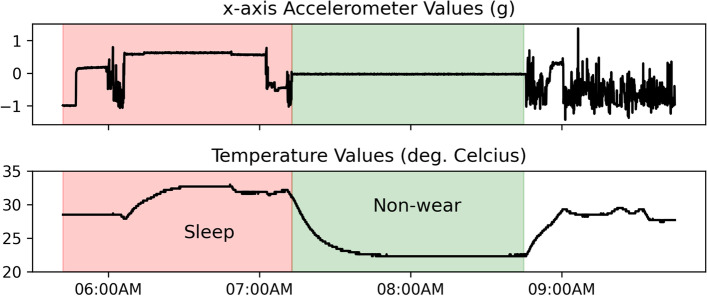
Accelerometery is commonly used to estimate physical activity, sleep, and sedentary behavior. In free-living conditions, periods of device removal (non-wear) can lead to misclassification of behavior with consequences for research outcomes and clinical decision making. Common methods for non-wear detection are limited by data transformations (e.g., activity counts) or algorithm parameters such as minimum durations or absolute temperature thresholds that risk over- or under-estimating non-wear time. This study aimed to advance non-wear detection methods by integrating a 'rate-of-change' criterion for temperature into a combined temperature-acceleration algorithm.
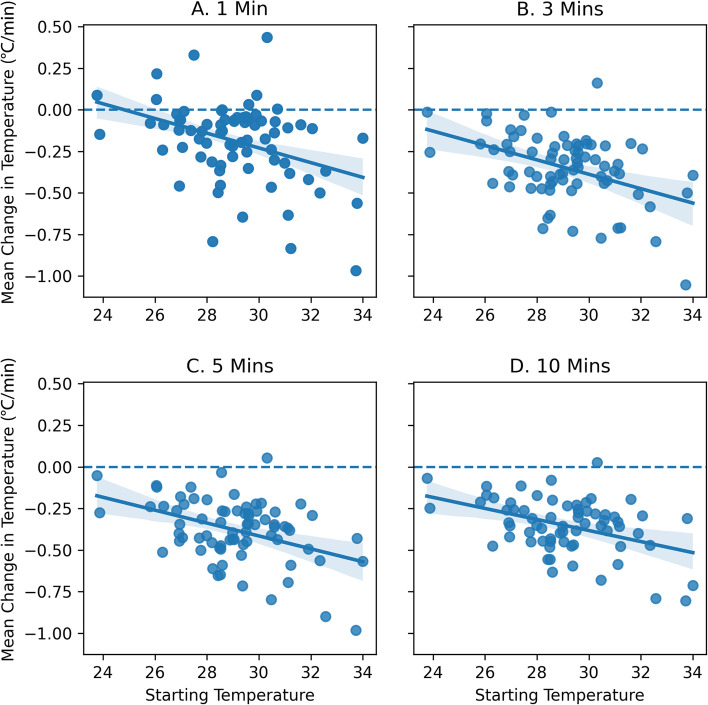
Data were from 39 participants with neurodegenerative disease (36% female; age: 45-83 years) who wore a tri-axial accelerometer (GENEActiv) on their wrist 24-h per day for 7-days as part of a multi-sensor protocol. The reference dataset was derived from visual inspection conducted by two expert analysts. Linear regression was used to establish temperature rate-of-change as a criterion for non-wear detection. A classification and regression tree (CART) decision tree classifier determined optimal parameters separately for non-wear start and end detection. Classifiers were trained using data from 15 participants (38.5%). Outputs from the CART analysis were supplemented based on edge cases and published parameters.
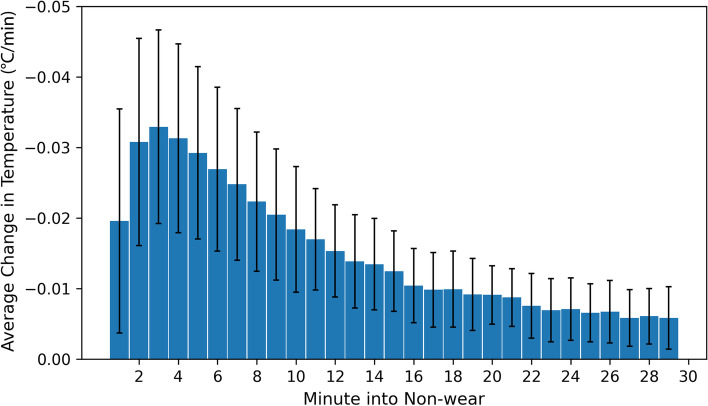
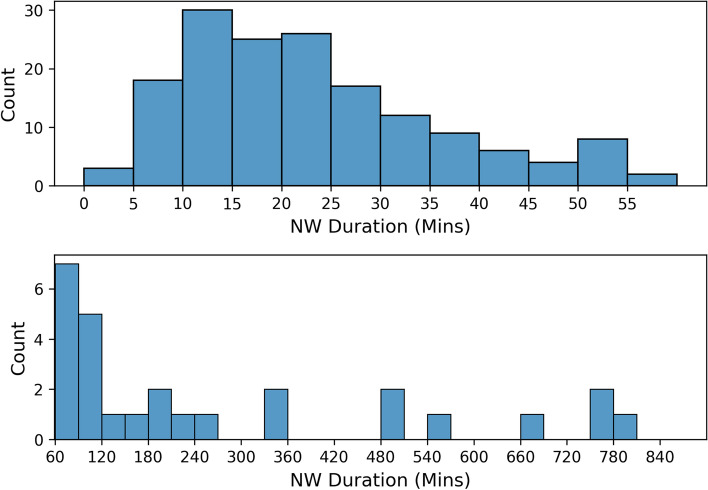
The dataset included 186 non-wear periods (85.5% < 60 min). Temperature rate-of-change over the first five minutes of non-wear was - 0.40 ± 0.17 °C/minute and 0.36 ± 0.21 °C/minute for the first five minutes following device donning. Performance of the DETACH (DEvice Temperature and Accelerometer CHange) algorithm was improved compared to existing algorithms with recall of 0.942 (95% CI 0.883 to 1.0), precision of 0.942 (95% CI 0.844 to 1.0), F1-Score of 0.942 (95% CI 0.880 to 1.0) and accuracy of 0.996 (0.994-1.000).
The DETACH algorithm accurately detected non-wear intervals as short as five minutes; improving non-wear classification relative to current interval-based methods. Using temperature rate-of-change combined with acceleration results in a robust algorithm appropriate for use across different temperature ranges and settings. The ability to detect short non-wear periods is particularly relevant to free-living scenarios where brief but frequent removals occur, and for clinical application where misclassification of behavior may have important implications for healthcare decision-making.
加速度计常用于估计身体活动、睡眠和久坐行为。在自由生活条件下,设备移除(非佩戴)的时间段可能导致行为分类错误,从而影响研究结果和临床决策。常用的非佩戴检测方法受到数据转换(例如,活动计数)或算法参数的限制,例如最小持续时间或绝对温度阈值,这些参数可能会导致非佩戴时间的过度或低估。本研究旨在通过将“变化率”标准纳入温度与加速度的综合算法,来改进非佩戴检测方法。
数据来自 39 名患有神经退行性疾病的参与者(36%为女性;年龄:45-83 岁),他们在手腕上佩戴三轴加速度计(GENEActiv),每天 24 小时佩戴 7 天,作为多传感器方案的一部分。参考数据集来自两位专家分析人员的目视检查。使用线性回归建立温度变化率作为非佩戴检测的标准。分类和回归树(CART)决策树分类器分别为非佩戴开始和结束检测确定最佳参数。使用来自 15 名参与者(38.5%)的数据训练分类器。CART 分析的输出结果基于边缘情况和已发布的参数进行补充。
数据集包括 186 个非佩戴时间段(85.5% < 60 分钟)。在非佩戴的前 5 分钟内,温度变化率为 -0.40 ± 0.17°C/分钟,在设备佩戴后的前 5 分钟内,温度变化率为 0.36 ± 0.21°C/分钟。与现有的算法相比,DETACH(设备温度和加速度变化)算法的性能得到了提高,召回率为 0.942(95%置信区间 0.883 至 1.0),精度为 0.942(95%置信区间 0.844 至 1.0),F1-评分为 0.942(95%置信区间 0.880 至 1.0),准确率为 0.996(0.994-1.000)。
DETACH 算法可以准确检测到最短 5 分钟的非佩戴间隔;与当前基于间隔的方法相比,提高了非佩戴的分类准确性。使用温度变化率与加速度相结合,得到了一种稳健的算法,适用于不同温度范围和环境。检测短暂非佩戴期的能力对于自由生活场景尤其相关,在这些场景中,短暂但频繁的移除情况较为常见,对于临床应用,行为分类错误可能对医疗保健决策产生重要影响。