Luongo Giorgio, Azzolin Luca, Schuler Steffen, Rivolta Massimo W, Almeida Tiago P, Martínez Juan P, Soriano Diogo C, Luik Armin, Müller-Edenborn Björn, Jadidi Amir, Dössel Olaf, Sassi Roberto, Laguna Pablo, Loewe Axel
Institute of Biomedical Engineering, Karlsruhe Institute of Technology, Karlsruhe, Germany.
Dipartimento di Informatica, Università degli Studi di Milano, Milan, Italy.
Cardiovasc Digit Health J. 2021 Apr;2(2):126-136. doi: 10.1016/j.cvdhj.2021.03.002.
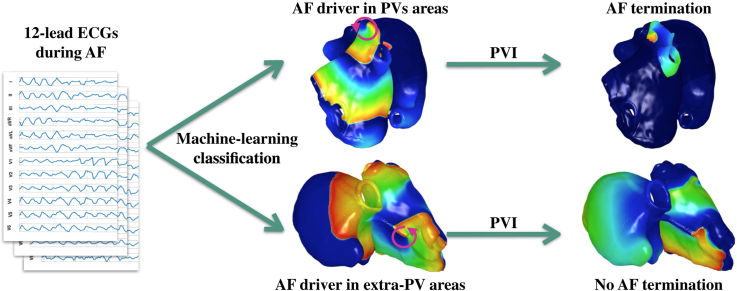
Atrial fibrillation (AF) is the most common supraventricular arrhythmia, characterized by disorganized atrial electrical activity, maintained by localized arrhythmogenic atrial drivers. Pulmonary vein isolation (PVI) allows to exclude PV-related drivers. However, PVI is less effective in patients with additional extra-PV arrhythmogenic drivers.
To discriminate whether AF drivers are located near the PVs vs extra-PV regions using the noninvasive 12-lead electrocardiogram (ECG) in a computational and clinical framework, and to computationally predict the acute success of PVI in these cohorts of data.
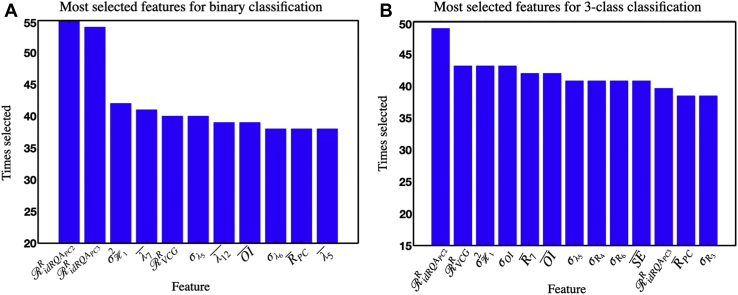
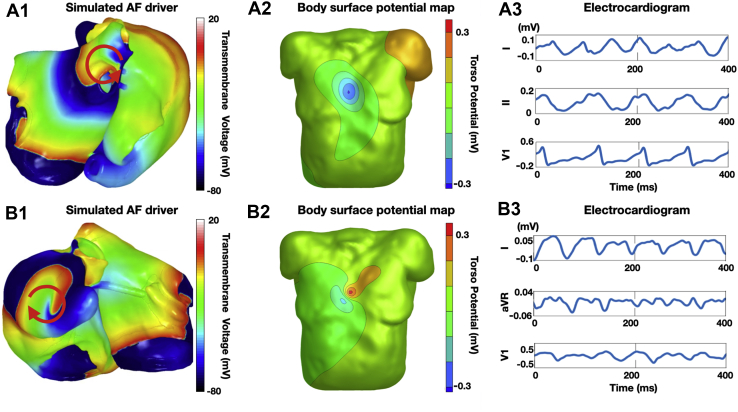
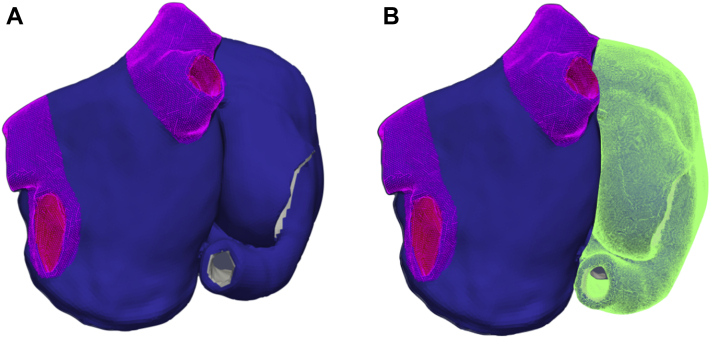
AF drivers were induced in 2 computerized atrial models and combined with 8 torso models, resulting in 1128 12-lead ECGs (80 ECGs with AF drivers located in the PVs and 1048 in extra-PV areas). A total of 103 features were extracted from the signals. Binary decision tree classifier was trained on the simulated data and evaluated using hold-out cross-validation. The PVs were subsequently isolated in the models to assess PVI success. Finally, the classifier was tested on a clinical dataset (46 patients: 23 PV-dependent AF and 23 with additional extra-PV sources).
The classifier yielded 82.6% specificity and 73.9% sensitivity for detecting PV drivers on the clinical data. Consistency analysis on the 46 patients resulted in 93.5% results match. Applying PVI on the simulated AF cases terminated AF in 100% of the cases in the PV class.
Machine learning-based classification of 12-lead-ECG allows discrimination between patients with PV drivers vs those with extra-PV drivers of AF. The novel algorithm may aid to identify patients with high acute success rates to PVI.
心房颤动(AF)是最常见的室上性心律失常,其特征是心房电活动紊乱,由局部致心律失常的心房驱动因素维持。肺静脉隔离(PVI)可排除与肺静脉相关的驱动因素。然而,PVI对存在额外肺静脉外致心律失常驱动因素的患者效果较差。
在计算和临床框架中,使用无创12导联心电图(ECG)区分AF驱动因素是位于肺静脉附近还是肺静脉外区域,并在这些数据队列中通过计算预测PVI的急性成功率。
在2个计算机化心房模型中诱导AF驱动因素,并与8个躯干模型相结合,生成1128份12导联ECG(80份AF驱动因素位于肺静脉的ECG和1048份位于肺静脉外区域的ECG)。从信号中总共提取了103个特征。二元决策树分类器在模拟数据上进行训练,并使用留出法交叉验证进行评估。随后在模型中隔离肺静脉以评估PVI的成功率。最后,该分类器在一个临床数据集(46例患者:23例肺静脉依赖性AF和23例伴有额外肺静脉外来源的患者)上进行测试。
该分类器在临床数据上检测肺静脉驱动因素的特异性为82.6%,敏感性为73.9%。对46例患者的一致性分析结果匹配率为93.5%。在模拟的AF病例上应用PVI可使肺静脉类病例中的AF在100%的情况下终止。
基于机器学习的12导联ECG分类可区分AF的肺静脉驱动因素患者与肺静脉外驱动因素患者。这种新算法可能有助于识别PVI急性成功率高的患者。