eHealth Research-Group, Department of Strategic Medical Development and Quality Management, University of Tuebingen, Hoppe-Seyler-Str. 6, 72076, Tuebingen, Germany.
Institute for Healthcare and Public Management, University of Hohenheim, Hohenheim, Stuttgart, Germany.
Sci Rep. 2021 Apr 27;11(1):9037. doi: 10.1038/s41598-021-88447-6.
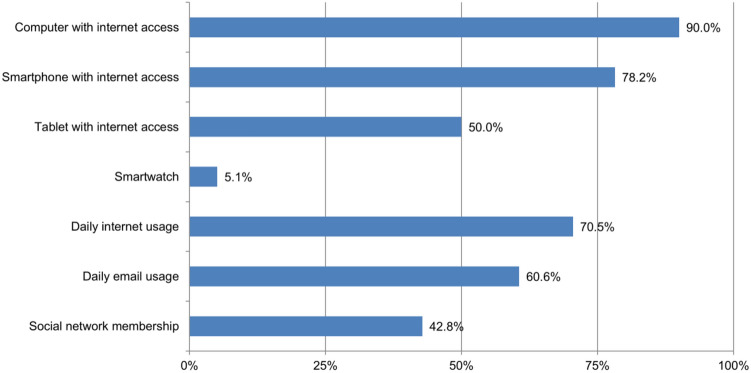
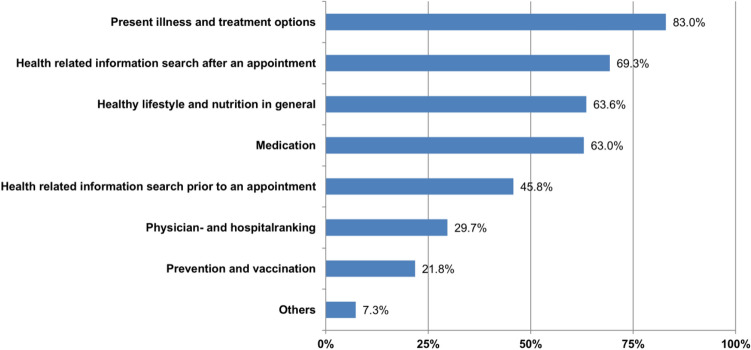
Situations like the COVID-19 pandemic urgently require the implementation of eHealth for vulnerable patient populations. Here we quantitatively evaluate use and potential of modern information and communication technology (ICT) in solid organ transplant (SOT) recipients. We conducted a structured, questionnaire-based, cross-sectional study that was addressed to patients after kidney, liver, pancreas, or combined transplantation. We focused on: sociodemographic data, present use of digital technologies in daily life and for health reasons, patients' eHealth literacy, and their overall attitude towards eHealth. A total of 234 patients completed the questionnaire. Most of the patients (90%) have a web-enabled computer, 78.2% have a smartphone, and 71.8% regularly search the internet for health-related information. Sixty-eight percent would like to receive discharge summaries online, and 54% would like to chat online with their physicians. Even though ICT use in daily life was age-related, no significant difference could be shown for health reasons or the type of transplanted organ. Modern ICT use is predominantly accepted for health reasons by SOT recipients. Regardless of the transplanted organ, a deeper integration of eHealth has potential for improving cross-sectoral care. To successfully implement eHealth technologies in cross-sectoral care future research should include online physician-patient communication, data security, data safety, and the aspects of quality and safety of care.
在像 COVID-19 大流行这样的情况下,迫切需要为弱势患者群体实施电子医疗。在这里,我们定量评估了现代信息和通信技术(ICT)在实体器官移植(SOT)受者中的使用情况和潜力。我们进行了一项结构化的、基于问卷的、横断面研究,该研究针对的是肾、肝、胰或联合移植后的患者。我们重点关注:社会人口统计学数据、目前在日常生活和健康方面使用数字技术的情况、患者的电子健康素养以及他们对电子健康的总体态度。共有 234 名患者完成了问卷。大多数患者(90%)拥有可上网的计算机,78.2%拥有智能手机,71.8%定期在互联网上搜索健康相关信息。68%的患者希望在线接收出院小结,54%的患者希望与医生在线聊天。尽管日常生活中的 ICT 使用与年龄有关,但在健康原因或移植器官类型方面没有显示出显著差异。现代 ICT 主要因其对健康的益处而被 SOT 受者所接受。无论移植的器官如何,电子医疗的深度融合都有可能改善跨部门护理。为了在跨部门护理中成功实施电子医疗技术,未来的研究应包括在线医患沟通、数据安全、数据安全以及护理质量和安全方面。