Hejazi Maryam, Tong Wei, Ibbotson Michael R, Prawer Steven, Garrett David J
School of Physics, The University of Melbourne, Parkville, VIC, Australia.
National Vision Research Institute, The Australian College of Optometry, Carlton, VIC, Australia.
Front Neurosci. 2021 Apr 12;15:658703. doi: 10.3389/fnins.2021.658703. eCollection 2021.
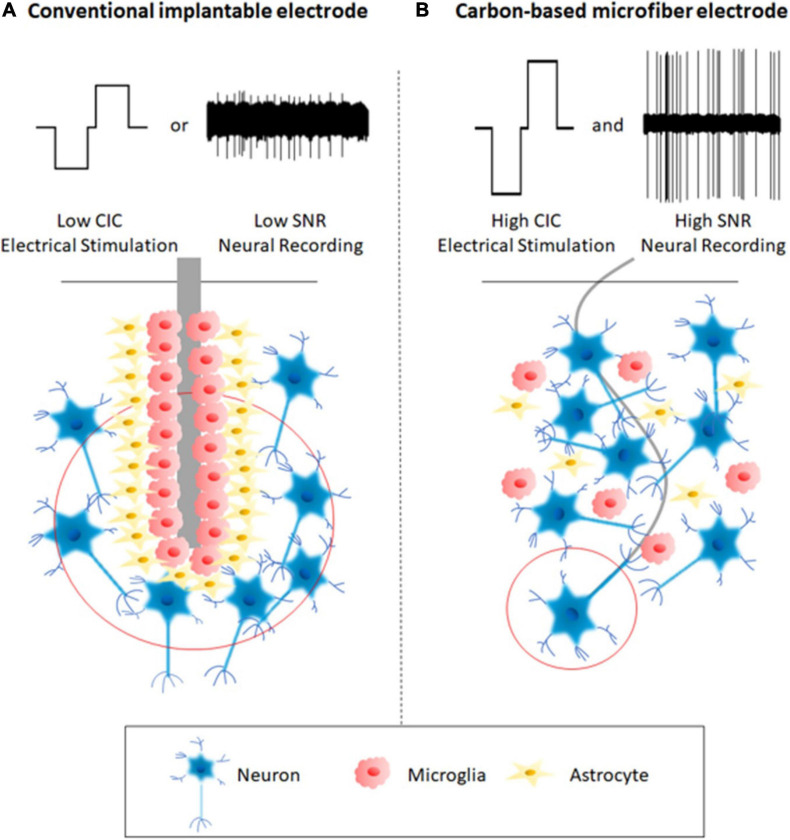
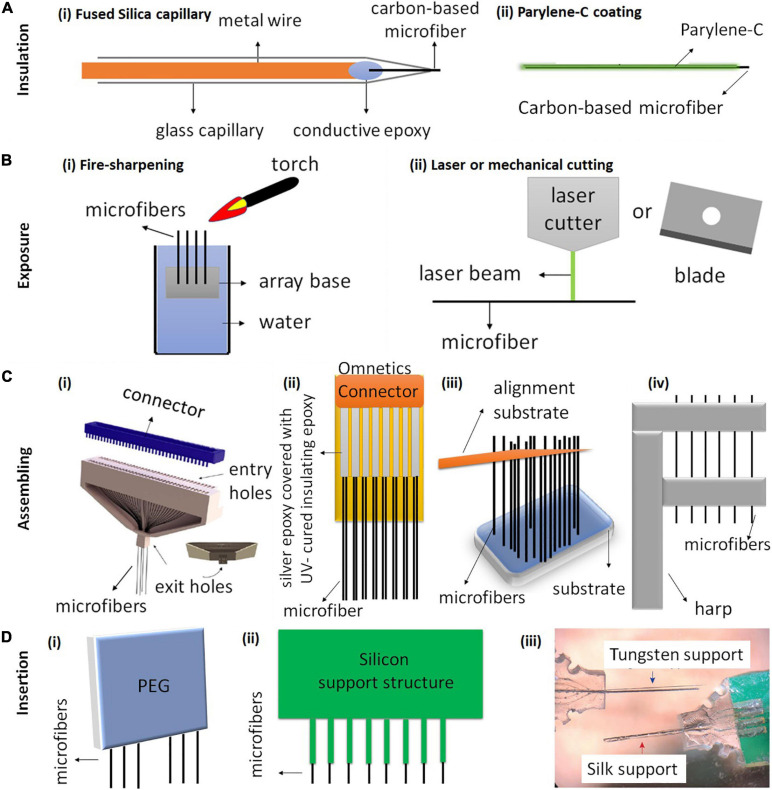
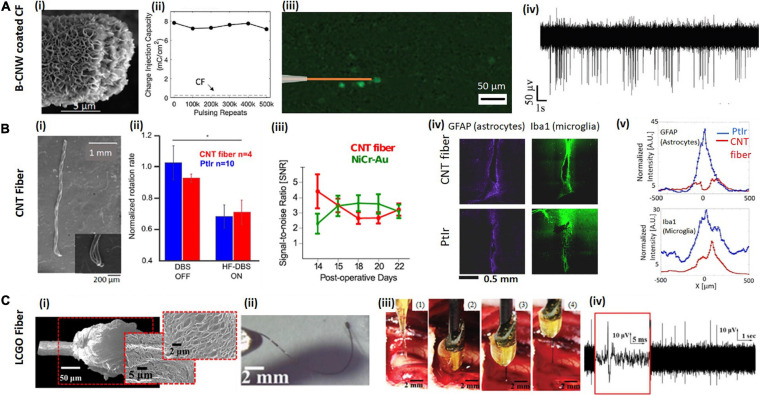
Neural interfacing devices using penetrating microelectrode arrays have emerged as an important tool in both neuroscience research and medical applications. These implantable microelectrode arrays enable communication between man-made devices and the nervous system by detecting and/or evoking neuronal activities. Recent years have seen rapid development of electrodes fabricated using flexible, ultrathin carbon-based microfibers. Compared to electrodes fabricated using rigid materials and larger cross-sections, these microfiber electrodes have been shown to reduce foreign body responses after implantation, with improved signal-to-noise ratio for neural recording and enhanced resolution for neural stimulation. Here, we review recent progress of carbon-based microfiber electrodes in terms of material composition and fabrication technology. The remaining challenges and future directions for development of these arrays will also be discussed. Overall, these microfiber electrodes are expected to improve the longevity and reliability of neural interfacing devices.
使用穿透式微电极阵列的神经接口装置已成为神经科学研究和医学应用中的重要工具。这些可植入的微电极阵列通过检测和/或激发神经元活动,实现人造装置与神经系统之间的通信。近年来,采用柔性超薄碳基微纤维制造的电极发展迅速。与使用刚性材料和较大横截面制造的电极相比,这些微纤维电极已被证明可减少植入后的异物反应,提高神经记录的信噪比,并增强神经刺激的分辨率。在此,我们从材料组成和制造技术方面综述碳基微纤维电极的最新进展。还将讨论这些阵列开发中剩余的挑战和未来方向。总体而言,这些微纤维电极有望提高神经接口装置的寿命和可靠性。