Tsai Jen-Pi, Hsu Bang-Gee
School of Medicine, Tzu Chi University, Hualien, Taiwan.
Division of Nephrology, Department of Internal Medicine, Dalin Tzu Chi Hospital, Buddhist Tzu Chi Medical Foundation, Chiayi, Taiwan.
Tzu Chi Med J. 2020 Sep 16;33(2):115-121. doi: 10.4103/tcmj.tcmj_44_20. eCollection 2021 Apr-Jun.
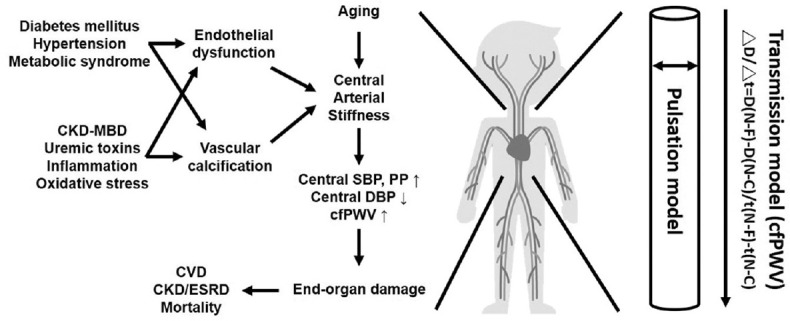
Apart from the result of multiple diseases as well as aging, arterial stiffness (AS) predicts cardiovascular disease (CVD), especially in patients with chronic kidney disease (CKD). Patients with CKD have high CVD prevalence, and an extraordinarily high risk for CVD might be related to nontraditional risk factors, including AS. The mechanism of AS development could be attributed to oxidative stress, inflammation, uremic milieu (e.g., uremic toxins), vascular calcification, and cumulative effects of traditional cardiovascular risk factors on arteries such as diabetes mellitus or hypertension. There were a variety of non-invasive techniques to measure AS. One of these techniques is carotid-femoral pulse wave velocity, which is the reference measurement of AS and is related to long-term CVD outcomes. AS progression has corresponding medical treatments with modest beneficial results. This review briefly discusses the risk factors, measurements, and treatments associated with AS.
除多种疾病及衰老的结果外,动脉僵硬度(AS)可预测心血管疾病(CVD),尤其是在慢性肾脏病(CKD)患者中。CKD患者的CVD患病率很高,而CVD的极高风险可能与包括AS在内的非传统风险因素有关。AS发展的机制可归因于氧化应激、炎症、尿毒症环境(如尿毒症毒素)、血管钙化以及传统心血管风险因素(如糖尿病或高血压)对动脉的累积影响。有多种非侵入性技术可用于测量AS。其中一种技术是颈股脉搏波速度,它是AS的参考测量指标,与长期CVD结局相关。AS进展有相应的医学治疗方法,效果适度有益。本综述简要讨论了与AS相关的风险因素、测量方法和治疗方法。