Zhao Xingli, Xu Zilu, Xiao Lang, Shi Tuo, Xiao Haoran, Wang Yeqin, Li Yanzhao, Xue Fangchao, Zeng Wen
Department of Cell Biology, Third Military Medical University, Chongqing, China.
State Key Laboratory of Trauma, Burn and Combined Injury, Chongqing, China.
Front Bioeng Biotechnol. 2021 Apr 12;9:637048. doi: 10.3389/fbioe.2021.637048. eCollection 2021.
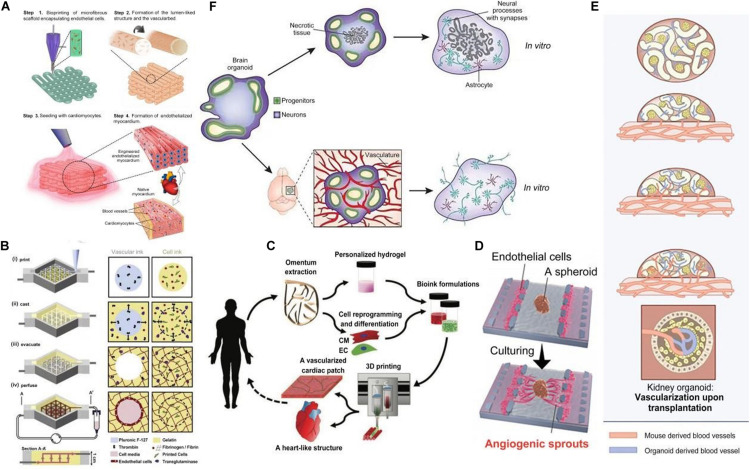
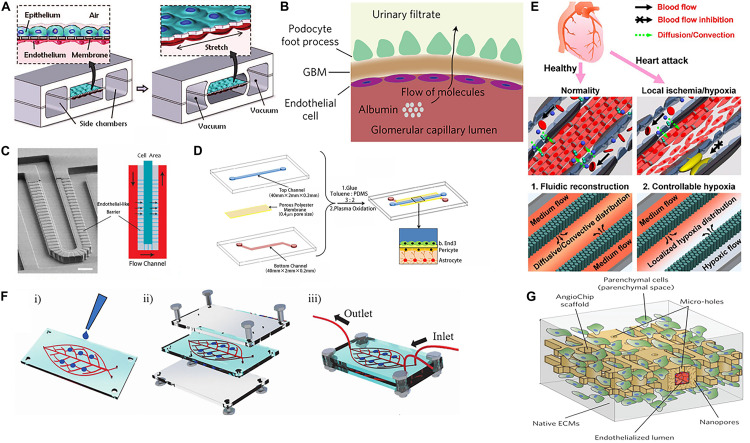
The use of human cells for the construction of 3D organ models based on cell self-assembly and engineering design has recently increased in popularity in the field of biological science. Although the organoids are able to simulate the structures and functions of organs , the 3D models have difficulty in forming a complex vascular network that can recreate the interaction between tissue and vascular systems. Therefore, organoids are unable to survive, due to the lack of oxygen and nutrients, as well as the accumulation of metabolic waste. Organoids-on-a-chip provides a more controllable and favorable design platform for co-culture of different cells and tissue types in organoid systems, overcoming some of the limitations present in organoid culture. However, the majority of them has vascular networks that are not adequately elaborate to simulate signal communications between bionic microenvironment (e.g., fluid shear force) and multiple organs. Here, we will review the technological progress of the vascularization in organoids and organoids-on-a-chip and the development of intravital 3D and 4D bioprinting as a new way for vascularization, which can aid in further study on tissue or organ development, disease research and regenerative medicine.
基于细胞自组装和工程设计使用人类细胞构建3D器官模型,近来在生物科学领域越来越受欢迎。尽管类器官能够模拟器官的结构和功能,但这些3D模型在形成能够重现组织与血管系统之间相互作用的复杂血管网络方面存在困难。因此,由于缺乏氧气和营养物质以及代谢废物的积累,类器官无法存活。芯片上类器官为在类器官系统中共同培养不同细胞和组织类型提供了一个更可控且有利的设计平台,克服了类器官培养中存在的一些局限性。然而,它们中的大多数具有的血管网络不够精细,无法模拟仿生微环境(如流体剪切力)与多个器官之间的信号通信。在此,我们将综述类器官和芯片上类器官血管化的技术进展,以及活体3D和4D生物打印作为一种新的血管化方式的发展,这有助于进一步开展组织或器官发育、疾病研究和再生医学方面的研究。