Cambridge Institute for Medical Research, Department of Clinical Biochemistry, University of Cambridge, Cambridge Biomedical Campus, The Keith Peters Building, Hills Road, Cambridge CB2 0XY, UK.
J Cell Sci. 2021 Apr 1;134(7). doi: 10.1242/jcs.226084. Epub 2021 Apr 13.
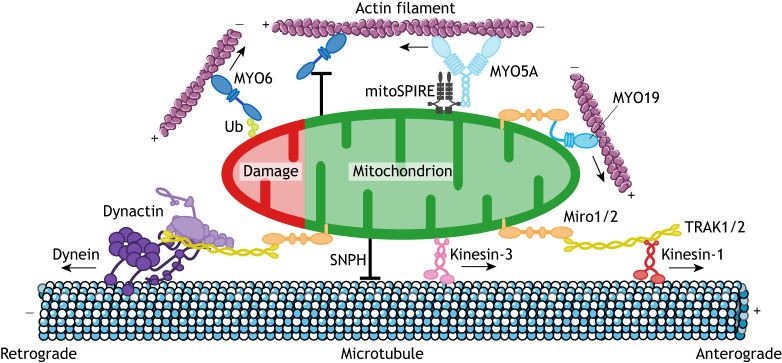
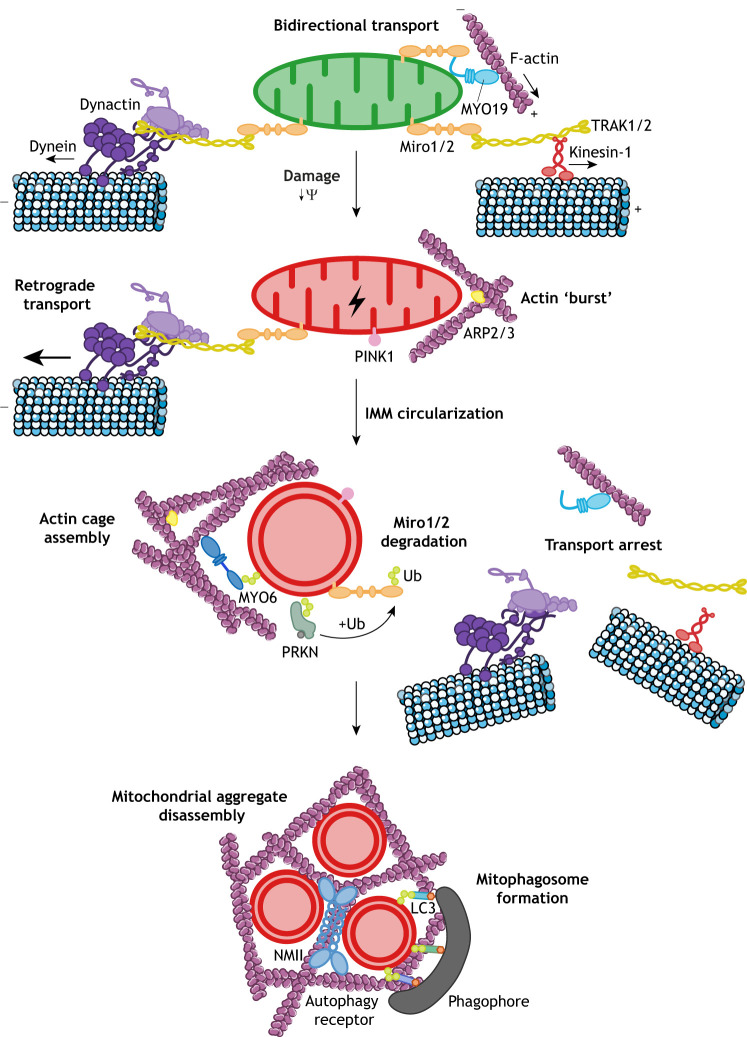
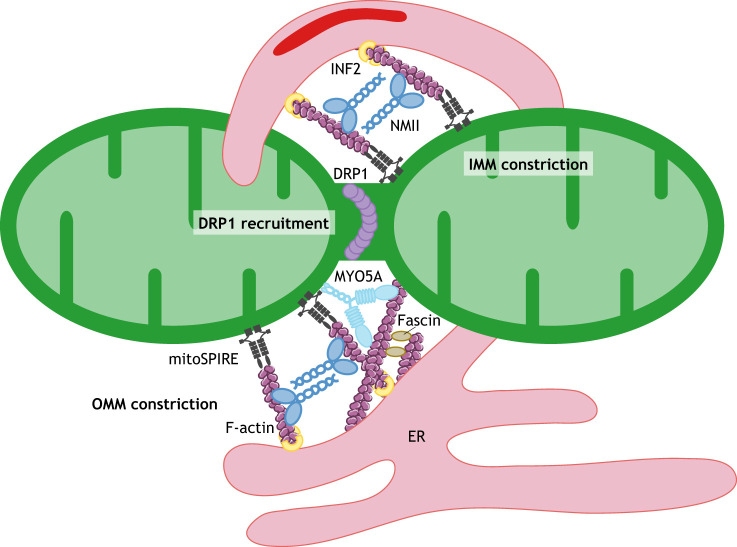
Mitochondria are multifunctional organelles that not only produce energy for the cell, but are also important for cell signalling, apoptosis and many biosynthetic pathways. In most cell types, they form highly dynamic networks that are constantly remodelled through fission and fusion events, repositioned by motor-dependent transport and degraded when they become dysfunctional. Motor proteins and their tracks are key regulators of mitochondrial homeostasis, and in this Review, we discuss the diverse functions of the three classes of motor proteins associated with mitochondria - the actin-based myosins, as well as the microtubule-based kinesins and dynein. In addition, Miro and TRAK proteins act as adaptors that link kinesin-1 and dynein, as well as myosin of class XIX (MYO19), to mitochondria and coordinate microtubule- and actin-based motor activities. Here, we highlight the roles of motor proteins and motor-linked track dynamics in the transporting and docking of mitochondria, and emphasize their adaptations in specialized cells. Finally, we discuss how motor-cargo complexes mediate changes in mitochondrial morphology through fission and fusion, and how they modulate the turnover of damaged organelles via quality control pathways, such as mitophagy. Understanding the importance of motor proteins for mitochondrial homeostasis will help to elucidate the molecular basis of a number of human diseases.
线粒体是多功能细胞器,不仅为细胞产生能量,而且对细胞信号转导、细胞凋亡和许多生物合成途径也很重要。在大多数细胞类型中,它们形成高度动态的网络,通过裂变和融合事件不断重塑,通过依赖于马达的运输重新定位,并在功能失调时被降解。马达蛋白及其轨道是线粒体动态平衡的关键调节剂,在这篇综述中,我们讨论了与线粒体相关的三类马达蛋白的不同功能 - 基于肌动蛋白的肌球蛋白,以及基于微管的驱动蛋白和动力蛋白。此外,Miro 和 TRAK 蛋白作为衔接蛋白,将驱动蛋白-1 和动力蛋白以及肌球蛋白 XIX (MYO19)与线粒体连接起来,并协调微管和肌动蛋白依赖的马达活动。在这里,我们强调了马达蛋白和马达相关轨道动力学在线粒体运输和对接中的作用,并强调了它们在专门细胞中的适应性。最后,我们讨论了马达货物复合物如何通过裂变和融合来调节线粒体形态的变化,以及它们如何通过质量控制途径(如线粒体自噬)来调节受损细胞器的周转。了解马达蛋白对于线粒体动态平衡的重要性将有助于阐明许多人类疾病的分子基础。