Instituto de Investigaciones Biomédicas "Alberto Sols" (CSIC-UAM), Arturo Duperier 4, 28029 Madrid, Spain.
Department of Biochemistry, Universidad Autónoma de Madrid e Instituto de Investigaciones Biomédicas "Alberto Sols" (CSIC-UAM), Arturo Duperier 4, 28029 Madrid, Spain.
Int J Mol Sci. 2021 Apr 9;22(8):3903. doi: 10.3390/ijms22083903.
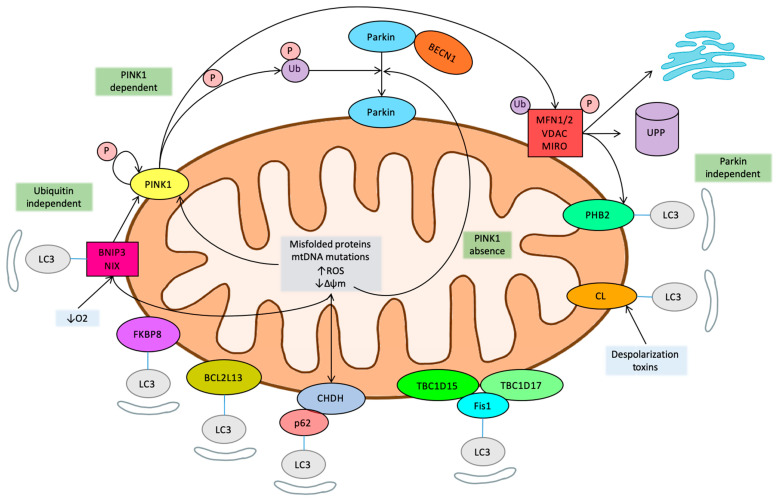
Mitophagy is a selective autophagic process, essential for cellular homeostasis, that eliminates dysfunctional mitochondria. Activated by inner membrane depolarization, it plays an important role during development and is fundamental in highly differentiated post-mitotic cells that are highly dependent on aerobic metabolism, such as neurons, muscle cells, and hepatocytes. Both defective and excessive mitophagy have been proposed to contribute to age-related neurodegenerative diseases, such as Parkinson's and Alzheimer's diseases, metabolic diseases, vascular complications of diabetes, myocardial injury, muscle dystrophy, and liver disease, among others. Pharmacological or dietary interventions that restore mitophagy homeostasis and facilitate the elimination of irreversibly damaged mitochondria, thus, could serve as potential therapies in several chronic diseases. However, despite extraordinary advances in this field, mainly derived from in vitro and preclinical animal models, human applications based on the regulation of mitochondrial quality in patients have not yet been approved. In this review, we summarize the key selective mitochondrial autophagy pathways and their role in prevalent chronic human diseases and highlight the potential use of specific interventions.
自噬是一种选择性的自噬过程,对于细胞内稳态至关重要,它可以消除功能失调的线粒体。自噬通过内膜去极化而被激活,在发育过程中发挥着重要作用,并且在高度依赖需氧代谢的高度分化的有丝分裂后细胞中是基本的,如神经元、肌肉细胞和肝细胞。缺陷和过度的自噬都被认为与年龄相关的神经退行性疾病有关,如帕金森病和阿尔茨海默病、代谢疾病、糖尿病的血管并发症、心肌损伤、肌肉营养不良和肝脏疾病等。恢复自噬平衡并促进不可逆损伤线粒体的清除的药理学或饮食干预,因此,可以作为几种慢性疾病的潜在治疗方法。然而,尽管该领域取得了非凡的进展,主要来自体外和临床前动物模型,但基于调节患者线粒体质量的人类应用尚未得到批准。在这篇综述中,我们总结了关键的选择性线粒体自噬途径及其在常见慢性人类疾病中的作用,并强调了特定干预措施的潜在用途。