Ciolacu Diana Elena, Nicu Raluca, Ciolacu Florin
Department of Natural Polymers, Bioactive and Biocompatible Materials, "Petru Poni" Institute of Macromolecular Chemistry, 700487 Iasi, Romania.
Department of Natural and Synthetic Polymers, "Gheorghe Asachi" Technical University of Iasi, 700050 Iasi, Romania.
Biomedicines. 2022 May 8;10(5):1095. doi: 10.3390/biomedicines10051095.
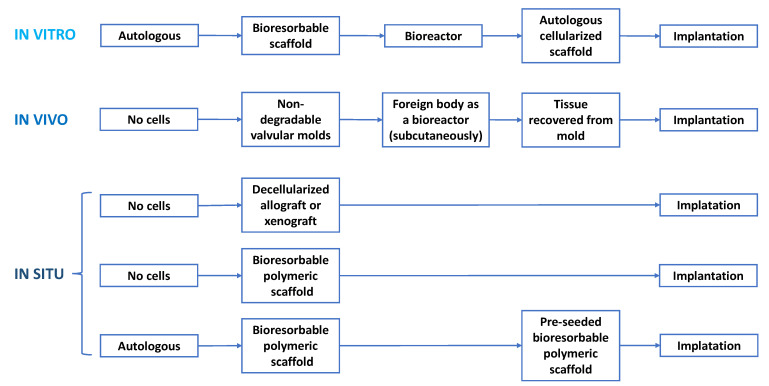
In the history of biomedicine and biomedical devices, heart valve manufacturing techniques have undergone a spectacular evolution. However, important limitations in the development and use of these devices are known and heart valve tissue engineering has proven to be the solution to the problems faced by mechanical and prosthetic valves. The new generation of heart valves developed by tissue engineering has the ability to repair, reshape and regenerate cardiac tissue. Achieving a sustainable and functional tissue-engineered heart valve (TEHV) requires deep understanding of the complex interactions that occur among valve cells, the extracellular matrix (ECM) and the mechanical environment. Starting from this idea, the review presents a comprehensive overview related not only to the structural components of the heart valve, such as cells sources, potential materials and scaffolds fabrication, but also to the advances in the development of heart valve replacements. The focus of the review is on the recent achievements concerning the utilization of natural polymers (polysaccharides and proteins) in TEHV; thus, their extensive presentation is provided. In addition, the technological progresses in heart valve tissue engineering (HVTE) are shown, with several inherent challenges and limitations. The available strategies to design, validate and remodel heart valves are discussed in depth by a comparative analysis of in vitro, in vivo (pre-clinical models) and in situ (clinical translation) tissue engineering studies.
在生物医学和生物医学设备的历史中,心脏瓣膜制造技术经历了惊人的发展。然而,这些设备在开发和使用中存在重要局限性,心脏瓣膜组织工程已被证明是解决机械瓣膜和人工瓣膜所面临问题的方法。组织工程开发的新一代心脏瓣膜具有修复、重塑和再生心脏组织的能力。要实现可持续且功能正常的组织工程心脏瓣膜(TEHV),需要深入了解瓣膜细胞、细胞外基质(ECM)和机械环境之间发生的复杂相互作用。基于这一理念,本综述不仅全面概述了心脏瓣膜的结构组成部分,如细胞来源、潜在材料和支架制造,还介绍了心脏瓣膜置换术的发展进展。综述的重点是近期在TEHV中利用天然聚合物(多糖和蛋白质)的成果;因此,对其进行了广泛介绍。此外,还展示了心脏瓣膜组织工程(HVTE)的技术进步,以及一些固有的挑战和局限性。通过对体外、体内(临床前模型)和原位(临床转化)组织工程研究的比较分析,深入讨论了设计、验证和重塑心脏瓣膜的可用策略。