Benartzi Shlomo, Beshears John, Milkman Katherine L, Sunstein Cass R, Thaler Richard H, Shankar Maya, Tucker-Ray Will, Congdon William J, Galing Steven
1 Anderson School of Management, University of California, Los Angeles.
2 Harvard Business School, Harvard University.
Psychol Sci. 2017 Aug;28(8):1041-1055. doi: 10.1177/0956797617702501. Epub 2017 Jun 5.
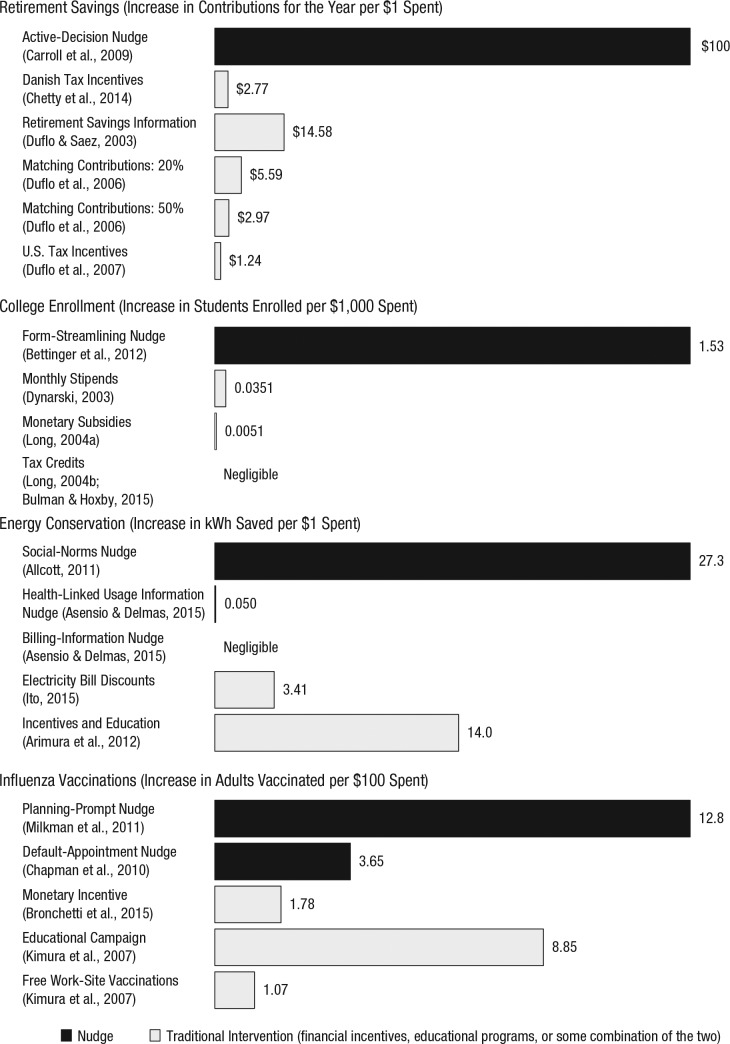
Governments are increasingly adopting behavioral science techniques for changing individual behavior in pursuit of policy objectives. The types of "nudge" interventions that governments are now adopting alter people's decisions without coercion or significant changes to economic incentives. We calculated ratios of impact to cost for nudge interventions and for traditional policy tools, such as tax incentives and other financial inducements, and we found that nudge interventions often compare favorably with traditional interventions. We conclude that nudging is a valuable approach that should be used more often in conjunction with traditional policies, but more calculations are needed to determine the relative effectiveness of nudging.
各国政府越来越多地采用行为科学技术来改变个人行为,以实现政策目标。政府目前采用的“助推”干预措施类型在不强制或不对经济激励措施进行重大改变的情况下改变人们的决策。我们计算了助推干预措施与传统政策工具(如税收激励和其他财政诱因)的影响成本比,发现助推干预措施往往比传统干预措施更具优势。我们得出结论,助推是一种有价值的方法,应更频繁地与传统政策结合使用,但需要更多计算来确定助推的相对有效性。