Department of Pharmacy, UiT the Arctic University of Norway, Tromsoe, Norway.
Faculty of Health and Life Sciences, Department of Health and Caring Science, Linnæus University, Kalmar, Sweden.
PLoS One. 2021 Apr 30;16(4):e0250898. doi: 10.1371/journal.pone.0250898. eCollection 2021.
An expected future increase in older adults will demand changes in health care delivery, making development, implementation and evaluation of new health care models essential. The rationale for political decision-making concerning the implementation and application of interventions in health care should include cost estimations, specifically those involving clinical interventions. To provide such data knowledge of time spent on the intervention is imperative. Time and motion methodology is suitable to quantify health care personnel's time distribution.
To investigate the time distribution for pharmacists conducting a randomized controlled trial (RCT) implementing a clinical intervention.
The setting was an RCT with a 5-step pharmacist-intervention in collaboration with the interdisciplinary team in a geriatric ward. Two pharmacists were involved in the trial during the observation period. Pharmacist activities, classified as RCT-tasks (intervention or administrative), non-RCT tasks and social/breaks, were recorded applying the Work Observation Method By Activity Timing methodology, enabling recording of predefined work tasks as well as interruptions and multitasking. One observer collected data over eight weeks.
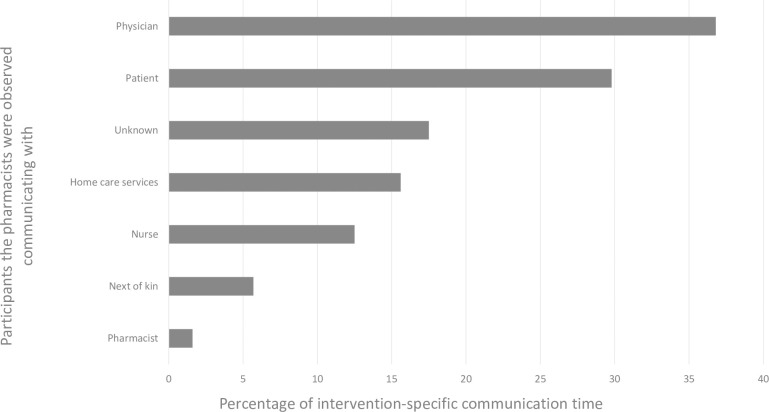
In total, 109.1 hours were observed resulting in 110.2 hours total task time, including multitasking. RCT tasks comprised 85.4% of the total observed time, and nearly 60% of the RCT time was spent on intervention tasks. Medication reviews was the most time consuming task, accounting for 32% of the observed time. The clinical pharmacists spent 14% of the intervention time communicating verbally, mainly with patients and healthcare professionals.
During the RCT, the clinical pharmacists spent about half their time performing the actual intervention. Consequently, costs for providing such a clinical pharmacist service should reflect actual time spent; otherwise, we may risk overestimating theoretical costs.
预计未来老年人数量将增加,这将要求医疗保健服务发生变化,因此制定、实施和评估新的医疗保健模式至关重要。关于医疗保健干预措施的实施和应用的政治决策的基本原理应包括成本估算,特别是涉及临床干预措施的成本估算。为了提供此类数据,必须了解干预措施所花费的时间。时间和动作方法适用于量化医疗保健人员的时间分配。
调查从事随机对照试验(RCT)实施临床干预的药剂师的时间分配。
该研究是在老年病房与跨学科团队合作进行的 5 步药剂师干预 RCT 中进行的。在观察期间,有 2 名药剂师参与了试验。应用工作观察法通过活动定时方法记录药剂师的活动,将其分类为 RCT 任务(干预或行政)、非 RCT 任务和社会/休息,该方法能够记录预定义的工作任务以及中断和多任务处理。一名观察员在八周内收集数据。
共观察到 109.1 小时,总任务时间为 110.2 小时,包括多任务处理。RCT 任务占总观察时间的 85.4%,RCT 时间的近 60%用于干预任务。药物审查是最耗时的任务,占观察时间的 32%。临床药剂师在干预期间花费 14%的时间进行口头交流,主要是与患者和医疗保健专业人员进行交流。
在 RCT 期间,临床药剂师大约一半的时间用于执行实际的干预措施。因此,提供此类临床药剂师服务的成本应反映实际花费的时间;否则,我们可能会有高估理论成本的风险。