Sadeghi Mahdiar, Greene James M, Sontag Eduardo D
Department of Electrical and Computer Engineering, Northeastern University, Boston, MA, United States.
Department of Mathematics, Clarkson University, Potsdam, NY, United States.
Annu Rev Control. 2021;51:426-440. doi: 10.1016/j.arcontrol.2021.04.004. Epub 2021 Apr 23.
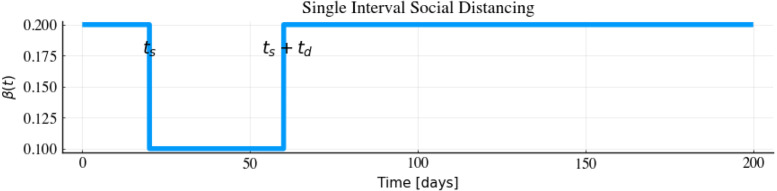
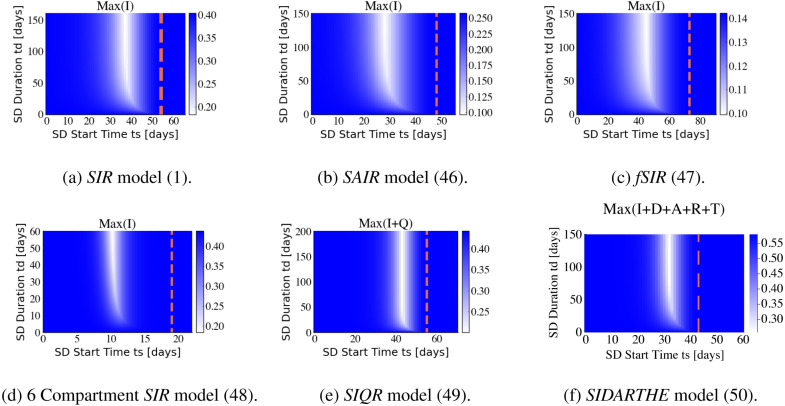
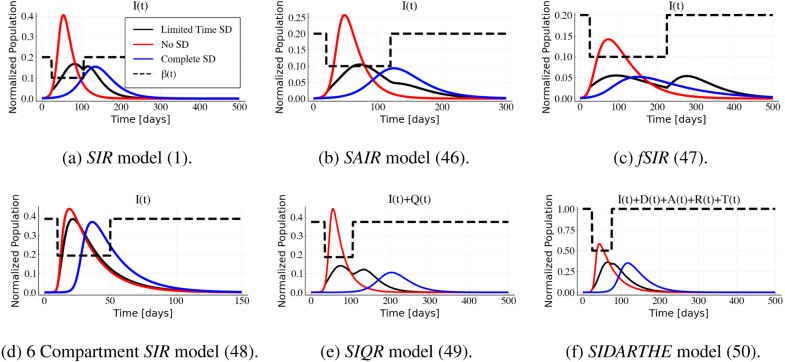
Social distancing as a form of nonpharmaceutical intervention has been enacted in many countries as a form of mitigating the spread of COVID-19. There has been a large interest in mathematical modeling to aid in the prediction of both the total infected population and virus-related deaths, as well as to aid government agencies in decision making. As the virus continues to spread, there are both economic and sociological incentives to minimize time spent with strict distancing mandates enforced, and/or to adopt periodically relaxed distancing protocols, which allow for scheduled economic activity. The main objective of this study is to reduce the disease burden in a population, here measured as the peak of the infected population, while simultaneously minimizing the length of time the population is socially distanced, utilizing both a single period of social distancing as well as periodic relaxation. We derive a linear relationship among the optimal start time and duration of a single interval of social distancing from an approximation of the classic epidemic model. Furthermore, we see a sharp phase transition region in start times for a single pulse of distancing, where the peak of the infected population changes rapidly; notably, this transition occurs well one would intuitively expect. By numerical investigation of more sophisticated epidemiological models designed specifically to describe the COVID-19 pandemic, we see that all share remarkably similar dynamic characteristics when contact rates are subject to periodic or one-shot changes, and hence lead us to conclude that these features are in epidemic models. On the other hand, the nonlinearity of epidemic models leads to non-monotone behavior of the peak of infected population under periodic relaxation of social distancing policies. This observation led us to hypothesize that an additional single interval social distancing at a can significantly decrease the infected peak of periodic policies, and we verified this improvement numerically. While synchronous quarantine and social distancing mandates across populations effectively minimize the spread of an epidemic over the world, relaxation decisions should not be enacted at the same time for different populations.
社交距离作为一种非药物干预形式,已在许多国家实施,以减轻新冠病毒疾病(COVID-19)的传播。人们对数学建模产生了浓厚兴趣,以帮助预测总感染人数和与病毒相关的死亡人数,并协助政府机构进行决策。随着病毒持续传播,存在经济和社会学方面的诱因,促使人们尽量减少严格社交距离规定实施的时间,和/或采用定期放宽的社交距离方案,从而允许有计划的经济活动。本研究的主要目标是减轻人群中的疾病负担,这里以感染人群峰值来衡量,同时尽量缩短人群保持社交距离的时间,采用单次社交距离措施以及定期放宽措施。我们从经典流行病模型的近似中推导出单次社交距离间隔的最优开始时间和持续时间之间的线性关系。此外,我们在单次社交距离脉冲的开始时间中看到一个急剧的相变区域,其中感染人群峰值变化迅速;值得注意的是,这种转变发生的情况与人们直观预期的情况大不相同。通过对专门设计用于描述新冠疫情的更复杂流行病学模型进行数值研究,我们发现当接触率受到周期性或一次性变化影响时,所有模型都具有非常相似的动态特征,因此使我们得出结论,这些特征在流行病模型中是普遍存在的。另一方面,流行病模型的非线性导致在社交距离政策定期放宽的情况下,感染人群峰值出现非单调行为。这一观察结果使我们推测,在特定时刻额外进行一次单次社交距离措施可以显著降低周期性政策下的感染峰值,并且我们通过数值验证了这种改善。虽然全球同步实施检疫和社交距离规定能有效减少疫情传播,但不同人群不应同时做出放宽规定的决策。