Dias Neto David, Nunes da Silva Ana, Roberto Magda Sofia, Lubenko Jelena, Constantinou Marios, Nicolaou Christiana, Lamnisos Demetris, Papacostas Savvas, Höfer Stefan, Presti Giovambattista, Squatrito Valeria, Vasiliou Vasilis S, McHugh Louise, Monestès Jean-Louis, Baban Adriana, Alvarez-Galvez Javier, Paez-Blarrina Marisa, Montesinos Francisco, Valdivia-Salas Sonsoles, Ori Dorottya, Lappalainen Raimo, Kleszcz Bartosz, Gloster Andrew, Karekla Maria, Kassianos Angelos P
ISPA - Instituto Universitário, Lisboa, Portugal.
Applied Psychology Research Center Capabilities & Inclusion, Lisboa, Portugal.
Front Psychol. 2021 Apr 14;12:640955. doi: 10.3389/fpsyg.2021.640955. eCollection 2021.
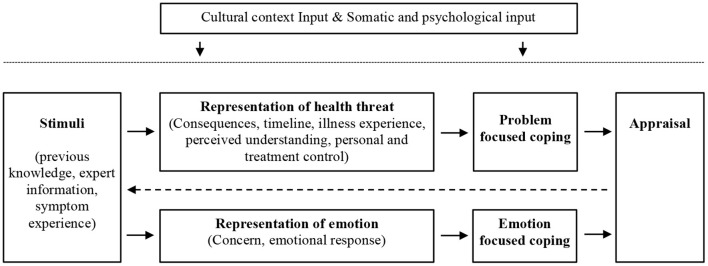
Illness perceptions (IP) are important predictors of emotional and behavioral responses in many diseases. The current study aims to investigate the COVID-19-related IP throughout Europe. The specific goals are to understand the temporal development, identify predictors (within demographics and contact with COVID-19) and examine the impacts of IP on perceived stress and preventive behaviors. This was a time-series-cross-section study of 7,032 participants from 16 European countries using multilevel modeling from April to June 2020. IP were measured with the Brief Illness Perception Questionnaire. Temporal patterns were observed considering the date of participation and the date recoded to account the epidemiological evolution of each country. The outcomes considered were perceived stress and COVID-19 preventive behaviors. There were significant trends, over time, for several IP, suggesting a small decrease in negativity in the perception of COVID-19 in the community. Age, gender, and education level related to some, but not all, IP. Considering the self-regulation model, perceptions consistently predicted general stress and were less consistently related to preventive behaviors. Country showed no effect in the predictive model, suggesting that national differences may have little relevance for IP, in this context. The present study provides a comprehensive picture of COVID-19 IP in Europe in an early stage of the pandemic. The results shed light on the process of IP formation with implications for health-related outcomes and their evolution.
疾病认知(IP)是许多疾病中情绪和行为反应的重要预测指标。本研究旨在调查整个欧洲与新冠病毒病相关的疾病认知情况。具体目标是了解其随时间的发展变化,确定预测因素(在人口统计学特征以及与新冠病毒病接触情况方面),并考察疾病认知对感知压力和预防行为的影响。这是一项对来自16个欧洲国家的7032名参与者进行的时间序列横断面研究,采用多层次模型,研究时间为2020年4月至6月。使用简短疾病认知问卷对疾病认知进行测量。考虑到参与日期以及为反映每个国家的流行病学演变而重新编码的日期,观察时间模式。所考虑的结果变量为感知压力和新冠病毒病预防行为。随着时间推移,几种疾病认知存在显著趋势,表明社区对新冠病毒病的认知负面程度略有下降。年龄、性别和教育水平与部分而非全部疾病认知相关。考虑自我调节模型,疾病认知始终能预测总体压力,但与预防行为的相关性则不太稳定。在预测模型中,国家因素未显示出影响,这表明在此背景下,国家差异可能与疾病认知关系不大。本研究全面呈现了疫情早期欧洲对新冠病毒病的疾病认知情况。研究结果揭示了疾病认知的形成过程,对健康相关结果及其演变具有启示意义。