Global Health and Population, Harvard TH Chan School of Public Health, Boston, Massachusetts, USA
Global Health and Population, Harvard TH Chan School of Public Health, Boston, Massachusetts, USA.
BMJ Open. 2021 May 4;11(5):e049089. doi: 10.1136/bmjopen-2021-049089.
To provide a comprehensive description of demographic, clinical and radiographic characteristics; treatment and case outcomes; and risk factors associated with in-hospital death of patients hospitalised with COVID-19 in Brazil.
Retrospective cohort study of hospitalised patients diagnosed with COVID-19.
Data from all hospitals across Brazil.
522 167 hospitalised patients in Brazil by 14 December 2020 with severe acute respiratory illness, and a confirmed diagnosis for COVID-19.
Prevalence of symptoms and comorbidities was compared by clinical outcomes and intensive care unit (ICU) admission status. Survival was assessed using Kaplan Meier survival estimates. Risk factors associated with in-hospital death were evaluated with multivariable Cox proportional hazards regression.
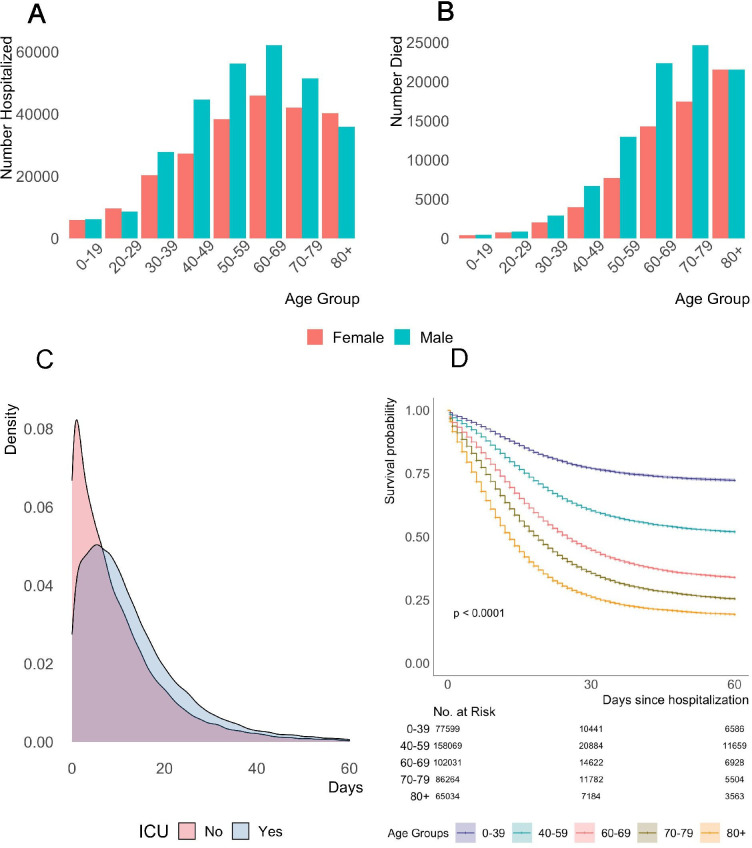
Of the 522 167 patients included in this study, 56.7% were discharged, 0.002% died of other causes, 30.7% died of causes associated with COVID-19 and 10.2% remained hospitalised. The median age of patients was 61 years (IQR, 47-73), and of non-survivors 71 years (IQR, 60-80); 292 570 patients (56.0%) were men. At least one comorbidity was present in 64.5% of patients and in 76.8% of non-survivors. From illness onset, the median times to hospital and ICU admission were 6 days (IQR, 3-9) and 7 days (IQR, 3-10), respectively; 15 days (IQR, 9-24) to death and 15 days (IQR, 11-20) to hospital discharge. Risk factors for in-hospital death included old age, Black/Brown ethnoracial self-classification, ICU admission, being male, living in the North and Northeast regions and various comorbidities. Age had the highest HRs of 5.51 (95% CI: 4.91 to 6.18) for patients≥80, compared with those ≤20.
Characteristics of patients and risk factors for in-hospital mortality highlight inequities of COVID-19 outcomes in Brazil. As the pandemic continues to unfold, targeted policies that address those inequities are needed to mitigate the unequal burden of COVID-19.
全面描述巴西 COVID-19 住院患者的人口统计学、临床和影像学特征、治疗方法和病例结局,以及与住院期间死亡相关的危险因素。
对 COVID-19 住院患者进行回顾性队列研究。
巴西所有医院的数据。
2020 年 12 月 14 日,巴西共有 522167 例因严重急性呼吸道疾病和 COVID-19 确诊而住院的患者。
根据临床结局和重症监护病房(ICU)入院情况比较症状和合并症的发生率。采用 Kaplan-Meier 生存估计评估生存率。采用多变量 Cox 比例风险回归评估与住院期间死亡相关的危险因素。
在这项研究中,共有 522167 例患者,56.7%出院,0.002%死于其他原因,30.7%死于与 COVID-19 相关的原因,10.2%仍住院。患者的中位年龄为 61 岁(IQR,47-73),非幸存者的中位年龄为 71 岁(IQR,60-80);292570 例(56.0%)为男性。至少有 1 种合并症的患者占 64.5%,非幸存者占 76.8%。从发病到住院和 ICU 入院的中位时间分别为 6 天(IQR,3-9)和 7 天(IQR,3-10);到死亡的中位时间为 15 天(IQR,9-24),到出院的中位时间为 15 天(IQR,11-20)。住院期间死亡的危险因素包括年龄较大、黑/棕人种自我分类、入住 ICU、男性、居住在北部和东北部地区以及各种合并症。年龄≥80 岁的患者 HR 最高,为 5.51(95%CI:4.91-6.18),而年龄≤20 岁的患者 HR 最低。
患者特征和住院死亡率的危险因素突出了巴西 COVID-19 结局的不平等。随着大流行的继续发展,需要采取有针对性的政策来解决这些不平等问题,以减轻 COVID-19 带来的不平等负担。