Department of Environmental Medicine and Public Health, Icahn School of Medicine at Mount Sinai, New York, NY, USA.
The Bronx High School of Science, Bronx, NY, USA.
J Expo Sci Environ Epidemiol. 2021 May;31(3):525-537. doi: 10.1038/s41370-021-00329-1. Epub 2021 May 4.
Neighborhood characteristics have been linked to community incidence of COVID-19, but the modifying effect of age has not been examined.
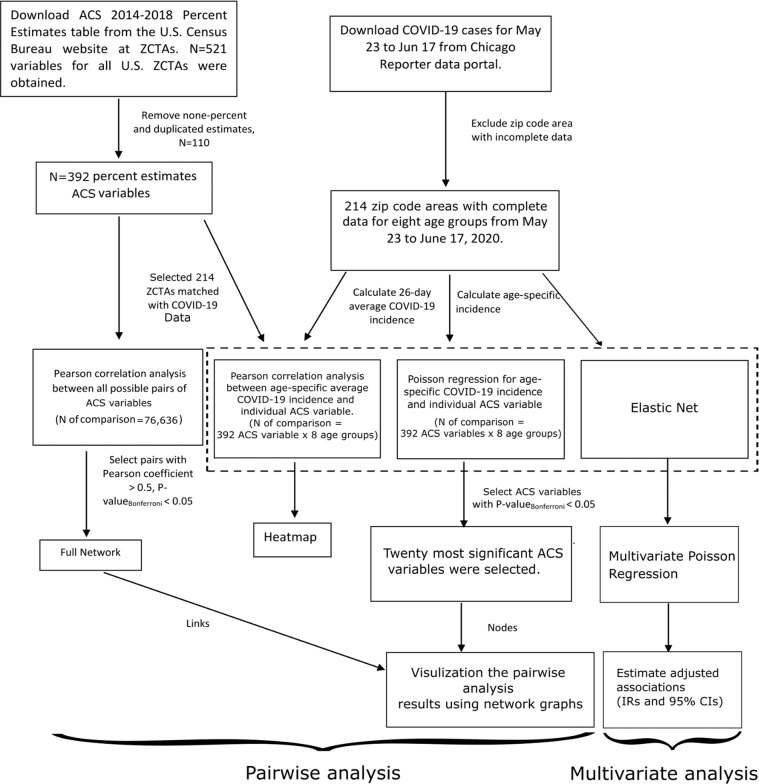
We adapted a neighborhood-wide analysis study (NWAS) design to systematically examine associations between neighborhood characteristics and COVID-19 incidence among different age groups.
The number of daily cumulative cases of COVID-19 by zip code area in Illinois has been made publicly available by the Illinois Department of Public Health. The number of COVID-19 cases was reported for eight age groups (under 20, 20-29, 30-39, 40-49, 50-59, 60-69, 70-79, and 80+). We reviewed this data published from May 23 through June 17, 2020 with complete data for all eight age groups and linked the data to neighborhood characteristics measured by the American Community Survey (ACS). Geographic age-specific cumulative incidence (cases per 1000 people) of COVID-19 was calculated by dividing the number of daily cumulative cases by the population of the same age group at each zip code area. The association between individual characteristics and COVID-19 incidence was examined using Poisson regression models.
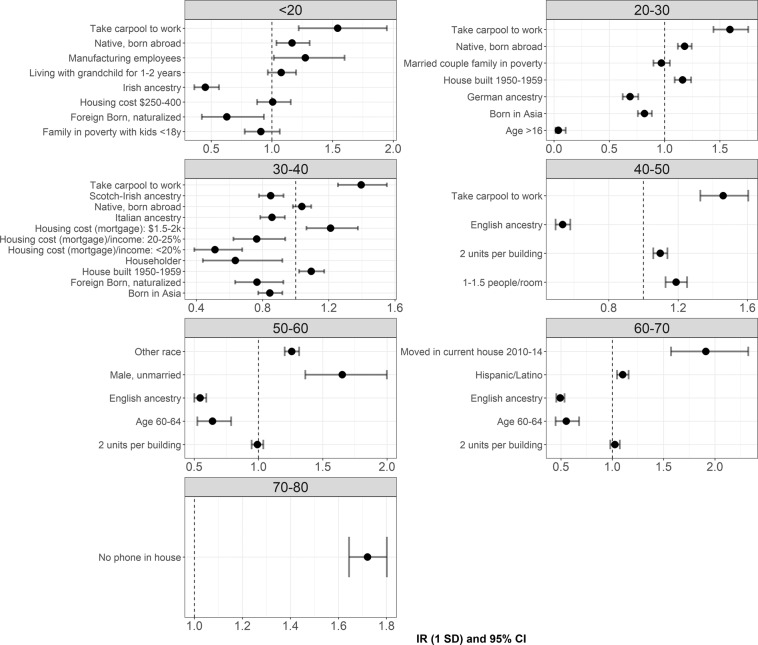
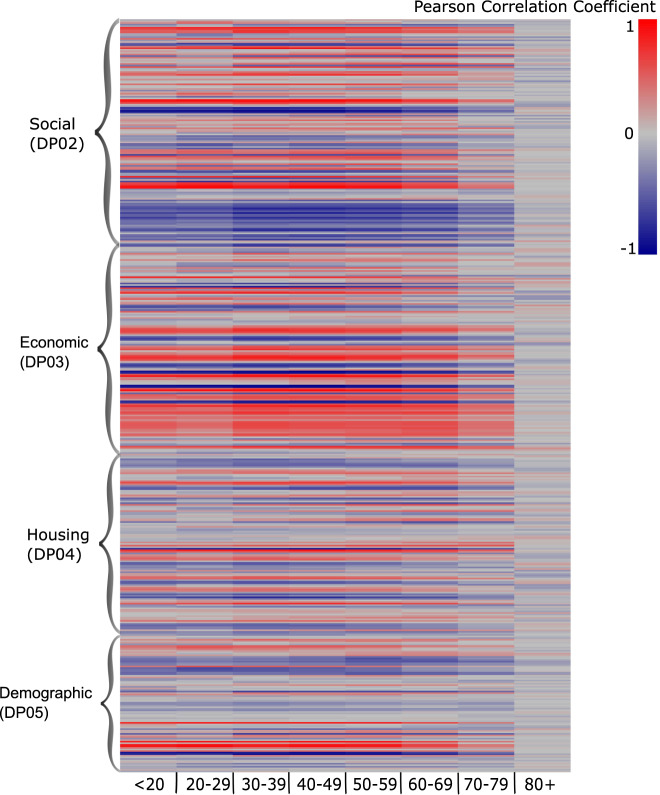
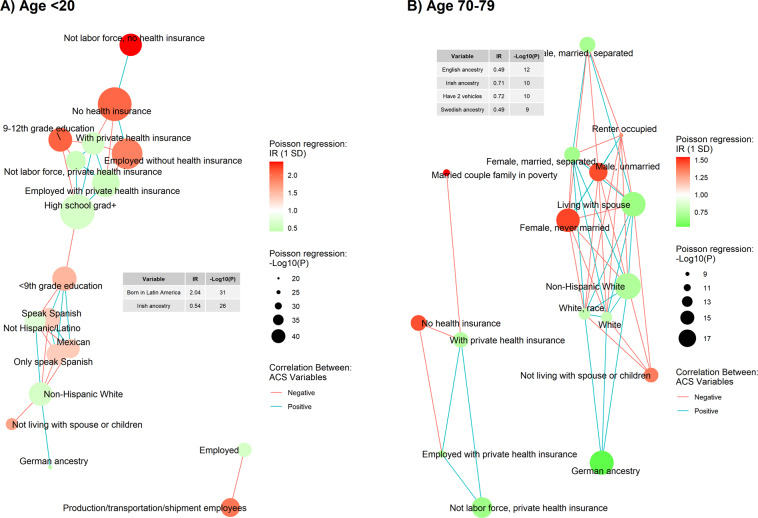
At the zip code level, neighborhood socioeconomic status was a more important risk factor of COVID-19 incidence in children and working-age adults than in seniors. Social demographics and housing conditions were important risk factors of COVID-19 incidence in older age groups. We additionally observed significant associations between transportation-related variables and COVID-19 incidences in multiple age groups.
We concluded that age modified the association between neighborhood characteristics and COVID-19 incidence.
社区特征与 COVID-19 的社区发病率有关,但年龄的调节作用尚未得到检验。
我们采用了一种全邻里分析研究(NWAS)设计,系统地研究了邻里特征与不同年龄组 COVID-19 发病率之间的关系。
伊利诺伊州公共卫生部公开提供了伊利诺伊州邮政编码区域内每日累计 COVID-19 病例数。COVID-19 病例数按年龄组(<20 岁、20-29 岁、30-39 岁、40-49 岁、50-59 岁、60-69 岁、70-79 岁和 80 岁以上)报告。我们查阅了 2020 年 5 月 23 日至 6 月 17 日公布的数据,这些数据涵盖了所有八个年龄组,并且将数据与美国社区调查(ACS)测量的邻里特征相关联。按年龄组计算的地理特定年龄 COVID-19 累计发病率(每 1000 人病例数)是通过将每日累计病例数除以每个邮政编码区域同一年龄组的人口数得出的。采用泊松回归模型检验个体特征与 COVID-19 发病率之间的关系。
在邮政编码层面,邻里社会经济地位对儿童和劳动年龄成年人的 COVID-19 发病率的风险因素比老年人更为重要。社会人口统计学和住房条件是老年人 COVID-19 发病率的重要风险因素。我们还观察到,与交通相关的变量与多个年龄组的 COVID-19 发病率之间存在显著关联。
我们的结论是,年龄改变了邻里特征与 COVID-19 发病率之间的关联。