Hubrecht Institute-KNAW and University Medical Center Utrecht, Utrecht, Netherlands.
Department of Pediatric Cardiology, Division of Pediatrics, University Medical Center Utrecht, Utrecht, Netherlands.
Cell Mol Life Sci. 2021 Jun;78(12):5107-5122. doi: 10.1007/s00018-021-03831-9. Epub 2021 May 5.
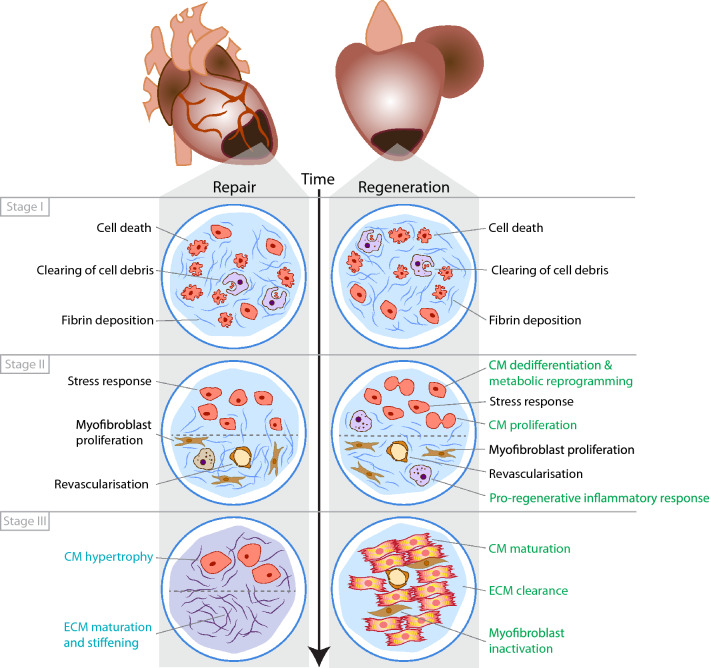
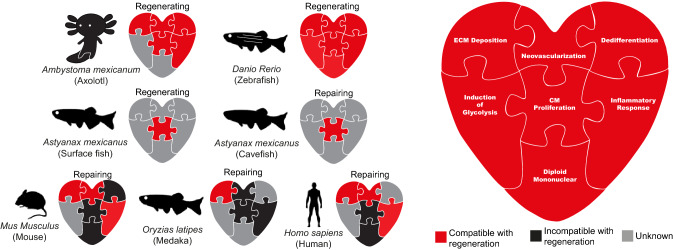
Cardiac regeneration is the outcome of the highly regulated interplay of multiple processes, including the inflammatory response, cardiomyocyte dedifferentiation and proliferation, neovascularization and extracellular matrix turnover. Species-specific traits affect these injury-induced processes, resulting in a wide variety of cardiac regenerative potential between species. Indeed, while mammals are generally considered poor regenerators, certain amphibian and fish species like the zebrafish display robust regenerative capacity post heart injury. The species-specific traits underlying these differential injury responses are poorly understood. In this review, we will compare the injury induced processes of the mammalian and zebrafish heart, describing where these processes overlap and diverge. Additionally, by examining multiple species across the animal kingdom, we will highlight particular traits that either positively or negatively affect heart regeneration. Last, we will discuss the possibility of overcoming regeneration-limiting traits to induce heart regeneration in mammals.
心脏再生是多种过程高度调控相互作用的结果,包括炎症反应、心肌细胞去分化和增殖、新生血管形成和细胞外基质更新。物种特异性特征影响这些损伤诱导过程,导致不同物种之间的心脏再生潜力存在很大差异。事实上,哺乳动物通常被认为是再生能力较差的动物,但某些两栖动物和鱼类,如斑马鱼,在心损伤后表现出强大的再生能力。这些不同的损伤反应背后的物种特异性特征还知之甚少。在这篇综述中,我们将比较哺乳动物和斑马鱼心脏的损伤诱导过程,描述这些过程的重叠和分歧之处。此外,通过研究动物王国中的多个物种,我们将强调那些对心脏再生有积极或消极影响的特定特征。最后,我们将讨论克服再生限制特征以诱导哺乳动物心脏再生的可能性。