Department of Epidemiology, Colorado School of Public Health, University of Colorado Denver Anschutz Medical Campus, Aurora, Colorado, USA.
Lifecourse Epidemiology of Adiposity and Diabetes (LEAD) Center, University of Colorado Denver Anschutz Medical Campus, Aurora, Colorado, USA.
Obes Rev. 2021 Jun;22 Suppl 3(Suppl 3):e13245. doi: 10.1111/obr.13245. Epub 2021 May 5.
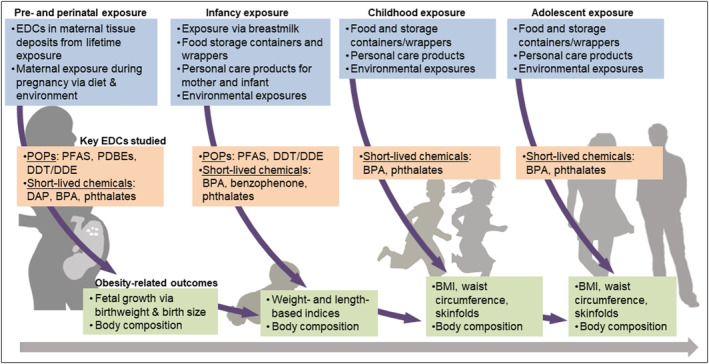
Following a 2019 workshop led by the Center for Global Health Studies at the Fogarty International Center on the topic of childhood obesity prevention and research synergies transpiring from cross-border collaborations, we convened a group of experts in the United States and Latin America to conduct a narrative review of the epidemiological literature on the role of obesogenic endocrine disrupting chemicals (EDCs) in the etiology of childhood obesity among Latino youth in the United States and Latin America. In addition to summarizing and synthesizing results from research on this topic published within the last decade, we place the findings within a lifecourse biobehavioral framework to aid in identification of unique exposure-outcome relationships driven by both biological and behavioral research, identify inconsistencies and deficiencies in current literature, and discuss the role of policy regulations, all with the goal of identifying viable avenues for prevention of early life obesity in Latino/Hispanic populations.
在 2019 年,福格蒂国际中心全球健康研究中心举办了一次关于儿童肥胖预防和跨境合作产生的研究协同作用的研讨会,之后我们召集了一组美国和拉丁美洲的专家,对肥胖相关内分泌干扰化学物质 (EDCs) 在美籍拉丁裔青年儿童肥胖病因学中的作用的流行病学文献进行叙述性综述。除了总结和综合过去十年中关于这一主题的研究结果外,我们还将这些发现置于生命历程生物行为框架内,以帮助确定由生物和行为研究驱动的独特暴露-结果关系,识别当前文献中的不一致和缺陷,并讨论政策法规的作用,所有这些都是为了确定预防拉丁裔/西班牙裔人群早期肥胖的可行途径。