First Faculty of Medicine, Institute of Physiology, Charles University, Prague, Czechia.
First Faculty of Medicine, Institute of Pathological Physiology, Charles University, Prague, Czechia.
Front Endocrinol (Lausanne). 2021 Apr 19;12:613983. doi: 10.3389/fendo.2021.613983. eCollection 2021.
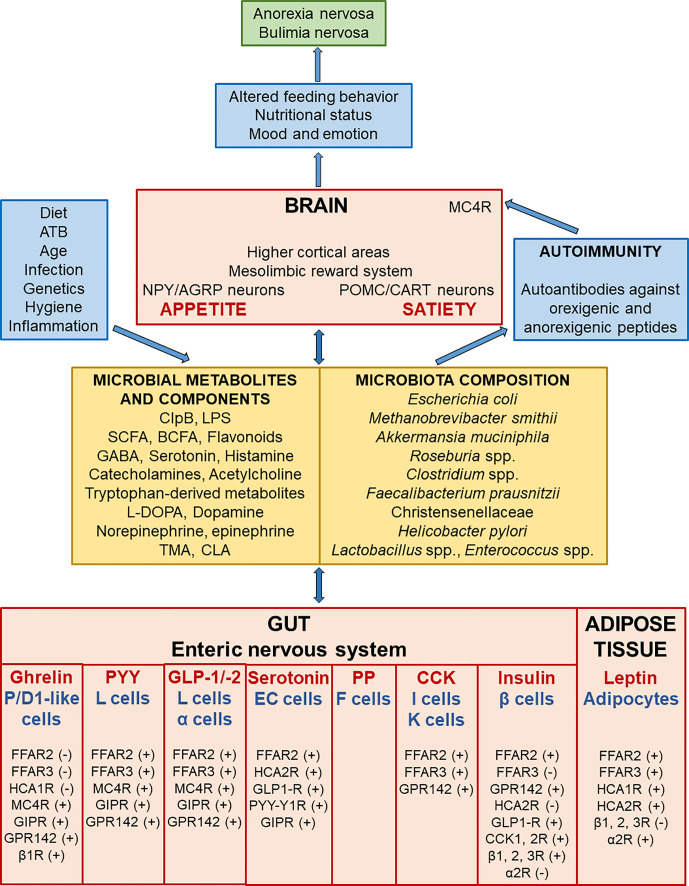
The equilibrium and reciprocal actions among appetite-stimulating (orexigenic) and appetite-suppressing (anorexigenic) signals synthesized in the gut, brain, microbiome and adipose tissue (AT), seems to play a pivotal role in the regulation of food intake and feeding behavior, anxiety, and depression. A dysregulation of mechanisms controlling the energy balance may result in eating disorders such as anorexia nervosa (AN) and bulimia nervosa (BN). AN is a psychiatric disease defined by chronic self-induced extreme dietary restriction leading to an extremely low body weight and adiposity. BN is defined as out-of-control binge eating, which is compensated by self-induced vomiting, fasting, or excessive exercise. Certain gut microbiota-related compounds, like bacterial chaperone protein caseinolytic protease B (ClpB) and food-derived antigens were recently described to trigger the production of autoantibodies cross-reacting with appetite-regulating hormones and neurotransmitters. Gut microbiome may be a potential manipulator for AT and energy homeostasis. Thus, the regulation of appetite, emotion, mood, and nutritional status is also under the control of neuroimmunoendocrine mechanisms by secretion of autoantibodies directed against neuropeptides, neuroactive metabolites, and peptides. In AN and BN, altered cholinergic, dopaminergic, adrenergic, and serotonergic relays may lead to abnormal AT, gut, and brain hormone secretion. The present review summarizes updated knowledge regarding the gut dysbiosis, gut-barrier permeability, short-chain fatty acids (SCFA), fecal microbial transplantation (FMT), blood-brain barrier permeability, and autoantibodies within the ghrelin and melanocortin systems in eating disorders. We expect that the new knowledge may be used for the development of a novel preventive and therapeutic approach for treatment of AN and BN.
在肠道、大脑、微生物组和脂肪组织(AT)中合成的食欲刺激(食欲)和食欲抑制(厌食)信号之间的平衡和相互作用,似乎在调节食物摄入和进食行为、焦虑和抑郁方面起着关键作用。控制能量平衡的机制失调可能导致饮食失调,如神经性厌食症(AN)和神经性贪食症(BN)。AN 是一种精神疾病,其特征是慢性自我诱导的极端饮食限制导致极低的体重和肥胖。BN 定义为无法控制的暴食,通过自我诱导的呕吐、禁食或过度运动来补偿。最近描述了某些与肠道微生物群相关的化合物,如细菌伴侣蛋白酪蛋白水解酶 B(ClpB)和食物衍生抗原,可触发与调节食欲的激素和神经递质交叉反应的自身抗体的产生。肠道微生物组可能是 AT 和能量平衡的潜在调节剂。因此,食欲、情绪、情绪和营养状况的调节也受神经免疫内分泌机制的控制,这些机制通过分泌针对神经肽、神经活性代谢物和肽的自身抗体来实现。在 AN 和 BN 中,改变的胆碱能、多巴胺能、肾上腺素能和 5-羟色胺能中继可能导致异常的 AT、肠道和大脑激素分泌。本综述总结了有关饮食失调症中肠道菌群失调、肠道屏障通透性、短链脂肪酸(SCFA)、粪便微生物移植(FMT)、血脑屏障通透性和胃饥饿素和黑色素皮质素系统内自身抗体的最新知识。我们期望这些新知识可用于开发治疗 AN 和 BN 的新型预防和治疗方法。