Maksimenko O G, Fursenko D V, Belova E V, Georgiev P G
Institute of Gene Biology RAS, Moscow, 119334 Russia.
Center for Precision Genome Editing and Genetic Technologies for Biomedicine, Institute of Gene Biology RAS, Moscow, 119334 Russia.
Acta Naturae. 2021 Jan-Mar;13(1):31-46. doi: 10.32607/actanaturae.11206.
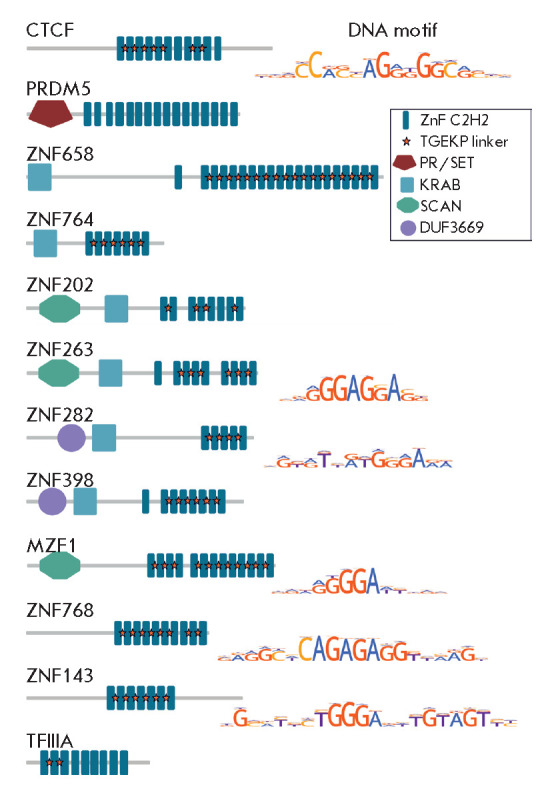
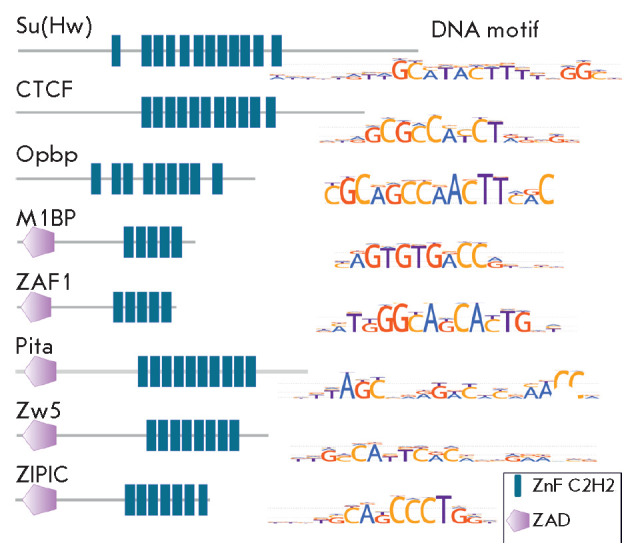
In mammals, most of the boundaries of topologically associating domains and all well-studied insulators are rich in binding sites for the CTCF protein. According to existing experimental data, CTCF is a key factor in the organization of the architecture of mammalian chromosomes. A characteristic feature of the CTCF is that the central part of the protein contains a cluster consisting of eleven domains of C2H2-type zinc fingers, five of which specifically bind to a long DNA sequence conserved in most animals. The class of transcription factors that carry a cluster of C2H2-type zinc fingers consisting of five or more domains (C2H2 proteins) is widely represented in all groups of animals. The functions of most C2H2 proteins still remain unknown. This review presents data on the structure and possible functions of these proteins, using the example of the vertebrate CTCF protein and several well- characterized C2H2 proteins in Drosophila and mammals.
在哺乳动物中,拓扑相关结构域的大多数边界以及所有经过充分研究的绝缘子都富含CCCTC结合因子(CTCF)蛋白的结合位点。根据现有实验数据,CTCF是哺乳动物染色体结构组织中的关键因素。CTCF的一个特征是,该蛋白的中央部分包含一个由11个C2H2型锌指结构域组成的簇,其中5个锌指结构域特异性结合大多数动物中保守的长DNA序列。携带由5个或更多结构域组成的C2H2型锌指簇的转录因子类别(C2H2蛋白)在所有动物类群中广泛存在。大多数C2H2蛋白的功能仍然未知。本综述以脊椎动物CTCF蛋白以及果蝇和哺乳动物中几种特征明确的C2H2蛋白为例,介绍了这些蛋白的结构和可能的功能数据。