Kishore Kamal, Jaswal Vidushi, Kulkarni Vinay, De Dipankar
Department of Biostatistics, Post Graduate Institute of Medical Education and Research (PGIMER), Chandigarh, India.
Department of Psychology, MCM DAV College for Women, Chandigarh, India.
Indian Dermatol Online J. 2021 Mar 2;12(2):266-275. doi: 10.4103/idoj.IDOJ_674_20. eCollection 2021 Mar-Apr.
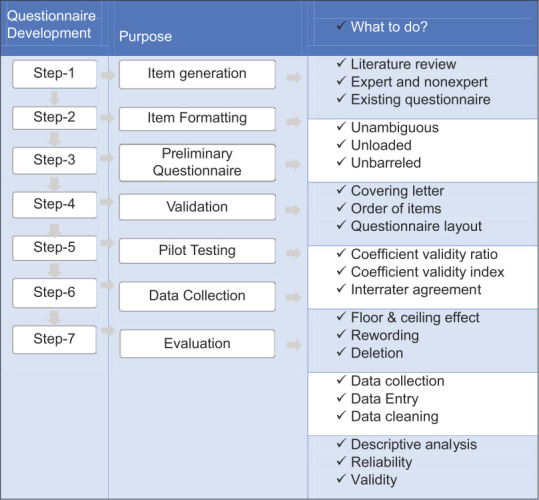
Life expectancy is gradually increasing due to continuously improving medical and nonmedical interventions. The increasing life expectancy is desirable but brings in issues such as impairment of quality of life, disease perception, cognitive health, and mental health. Thus, questionnaire building and data collection through the questionnaires have become an active area of research. However, questionnaire development can be challenging and suboptimal in the absence of careful planning and user-friendly literature guide. Keeping in mind the intricacies of constructing a questionnaire, researchers need to carefully plan, document, and follow systematic steps to build a reliable and valid questionnaire. Additionally, questionnaire development is technical, jargon-filled, and is not a part of most of the graduate and postgraduate training. Therefore, this article is an attempt to initiate an understanding of the complexities of the questionnaire fundamentals, technical challenges, and sequential flow of steps to build a reliable and valid questionnaire.
由于医疗和非医疗干预措施的不断改进,预期寿命正在逐渐增加。预期寿命的增加是令人期望的,但也带来了诸如生活质量受损、疾病认知、认知健康和心理健康等问题。因此,通过问卷进行问卷构建和数据收集已成为一个活跃的研究领域。然而,在缺乏精心规划和用户友好的文献指南的情况下,问卷开发可能具有挑战性且不够理想。考虑到构建问卷的复杂性,研究人员需要仔细规划、记录并遵循系统步骤来构建可靠且有效的问卷。此外,问卷开发具有技术性、充斥着行话,并且不是大多数研究生和研究生培训的一部分。因此,本文旨在帮助读者了解问卷基本原理的复杂性、技术挑战以及构建可靠且有效问卷的步骤顺序流程。