Department of Epidemiology, School of Public Health, Cheeloo College of Medicine, Shandong University, 44 West Wenhua Road, Jinan, People's Republic of China.
State Key Laboratory of Pathogen and Biosecurity, Beijing Institute of Microbiology and Epidemiology, 20 Dong-Da Street, Fengtai District, Beijing, 100071, People's Republic of China.
Infect Dis Poverty. 2021 May 8;10(1):66. doi: 10.1186/s40249-021-00853-0.
The ongoing transmission of the Middle East respiratory syndrome coronavirus (MERS-CoV) in the Middle East and its expansion to other regions are raising concerns of a potential pandemic. An in-depth analysis about both population and molecular epidemiology of this pathogen is needed.
MERS cases reported globally as of June 2020 were collected mainly from World Health Organization official reports, supplemented by other reliable sources. Determinants for case fatality and spatial diffusion of MERS were assessed with Logistic regressions and Cox proportional hazard models, respectively. Phylogenetic and phylogeographic analyses were performed to examine the evolution and migration history of MERS-CoV.
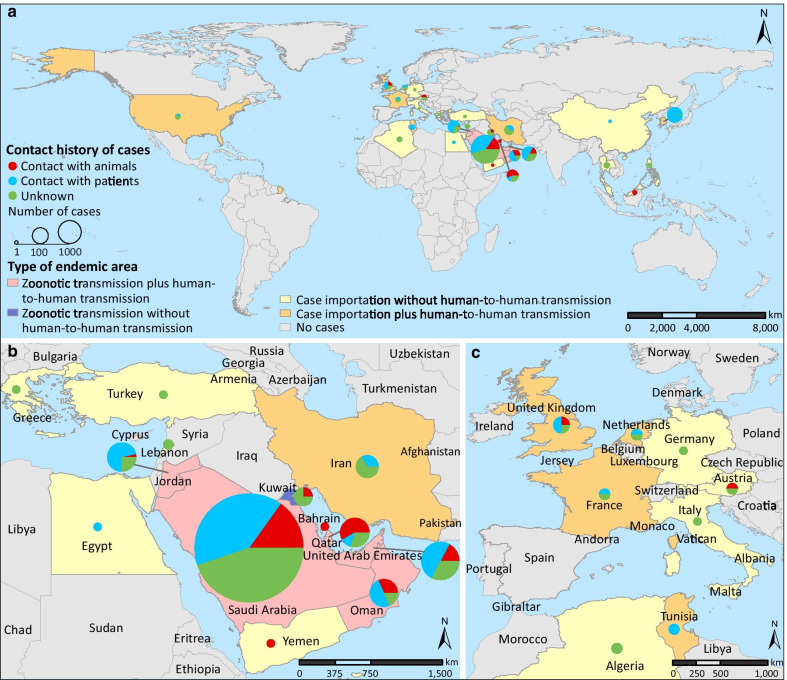
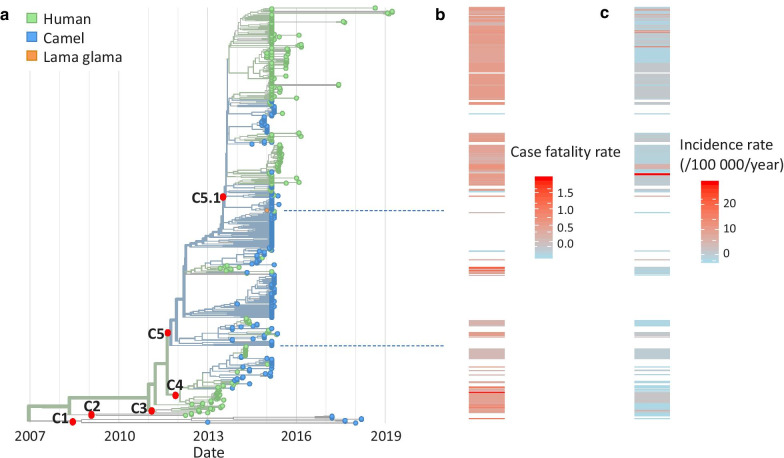
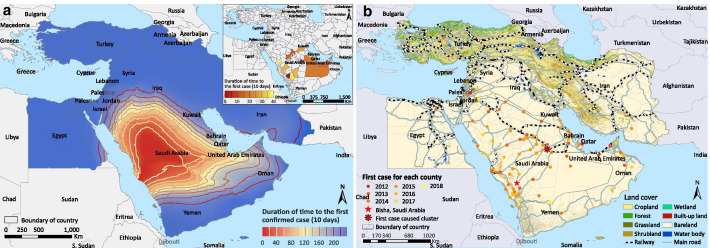
A total of 2562 confirmed MERS cases with 150 case clusters were reported with a case fatality rate of 32.7% (95% CI: 30.9‒34.6%). Saudi Arabia accounted for 83.6% of the cases. Age of ≥ 65 years old, underlying conditions and ≥ 5 days delay in diagnosis were independent risk factors for death. However, a history of animal contact was associated with a higher risk (adjusted OR = 2.97, 95% CI: 1.10-7.98) among female cases < 65 years but with a lower risk (adjusted OR = 0.31, 95% CI: 0.18-0.51) among male cases ≥ 65 years old. Diffusion of the disease was fastest from its origin in Saudi Arabia to the east, and was primarily driven by the transportation network. The most recent sub-clade C5.1 (since 2013) was associated with non-synonymous mutations and a higher mortality rate. Phylogeographic analyses pointed to Riyadh of Saudi Arabia and Abu Dhabi of the United Arab Emirates as the hubs for both local and international spread of MERS-CoV.
MERS-CoV remains primarily locally transmitted in the Middle East, with opportunistic exportation to other continents and a potential of causing transmission clusters of human cases. Animal contact is associated with a higher risk of death, but the association differs by age and sex. Transportation network is the leading driver for the spatial diffusion of the disease. These findings how this pathogen spread are helpful for targeting public health surveillance and interventions to control endemics and to prevent a potential pandemic.
中东呼吸综合征冠状病毒(MERS-CoV)在中东持续传播,并扩展至其他地区,引发了对潜在大流行的担忧。目前需要对该病原体的人群和分子流行病学进行深入分析。
我们主要从世界卫生组织的官方报告中收集截至 2020 年 6 月全球报告的 MERS 病例,并辅以其他可靠来源。使用 Logistic 回归和 Cox 比例风险模型分别评估 MERS 的病死率和空间扩散决定因素。进行系统发育和系统地理学分析以检验 MERS-CoV 的进化和迁移历史。
共报告了 2562 例确诊的 MERS 病例,其中有 150 例病例聚集,病死率为 32.7%(95%CI:30.9‒34.6%)。沙特阿拉伯占病例的 83.6%。年龄≥65 岁、基础疾病和≥5 天的诊断延迟是死亡的独立危险因素。然而,动物接触史与女性病例(年龄<65 岁)的死亡风险增加相关(调整后的 OR=2.97,95%CI:1.10-7.98),但与男性病例(年龄≥65 岁)的死亡风险降低相关(调整后的 OR=0.31,95%CI:0.18-0.51)。疾病的扩散速度最快的是从其起源地沙特阿拉伯向东扩散,主要是由交通网络驱动的。最近的子谱系 C5.1(自 2013 年以来)与非同义突变和更高的死亡率相关。系统地理学分析表明,沙特阿拉伯的利雅得和阿拉伯联合酋长国的阿布扎比是 MERS-CoV 本地和国际传播的中心。
MERS-CoV 仍主要在中东地区局部传播,偶尔会向其他大陆输出,并有可能引起人类病例的传播集群。动物接触与更高的死亡风险相关,但这种关联因年龄和性别而异。交通网络是疾病空间扩散的主要驱动因素。这些发现有助于确定该病原体的传播方式,以便有针对性地开展公共卫生监测和干预措施,以控制地方性流行并防止潜在的大流行。