Park Sangwook, Garcia-Esparza Angel T, Abroshan Hadi, Abraham Baxter, Vinson John, Gallo Alessandro, Nordlund Dennis, Park Joonsuk, Kim Taeho Roy, Vallez Lauren, Alonso-Mori Roberto, Sokaras Dimosthenis, Zheng Xiaolin
Department of Mechanical Engineering Stanford University Stanford CA 94305 USA.
Department of Mechanical Engineering Seoul National University Seoul 08826 South Korea.
Adv Sci (Weinh). 2021 Mar 1;8(9):2002768. doi: 10.1002/advs.202002768. eCollection 2021 May.
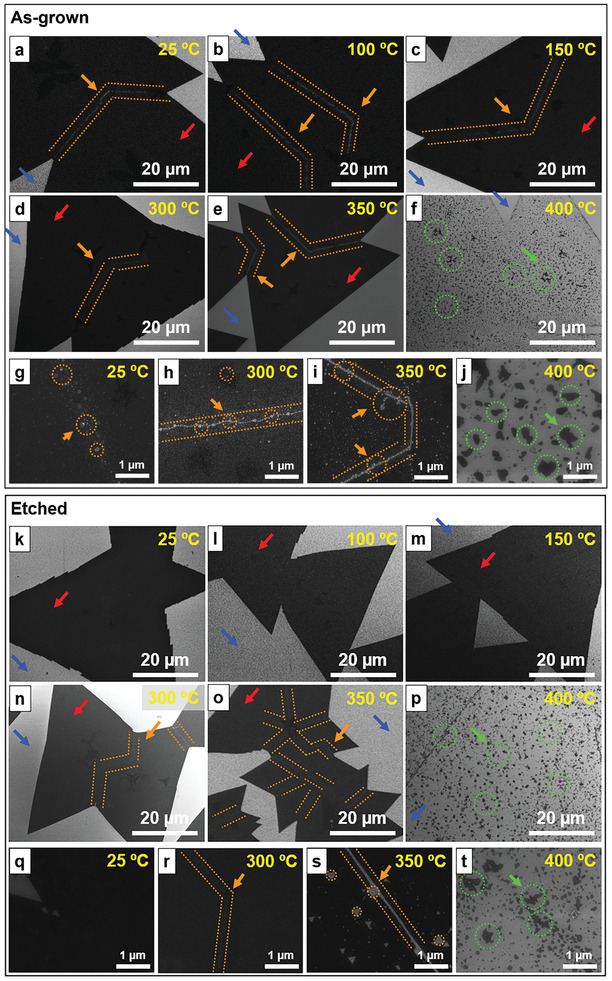
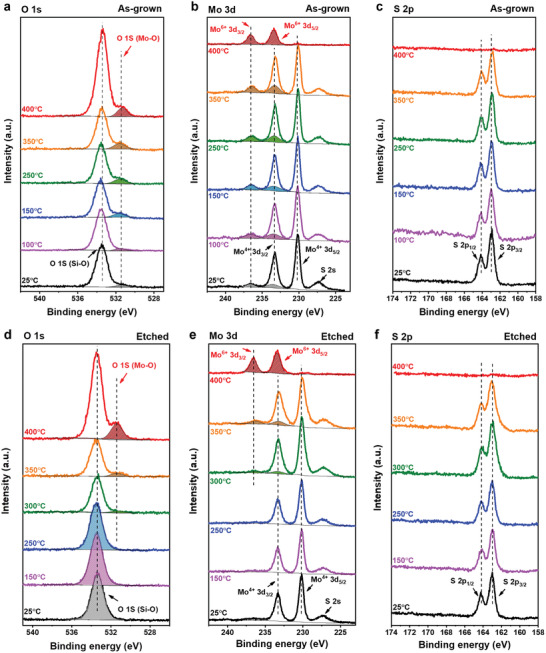
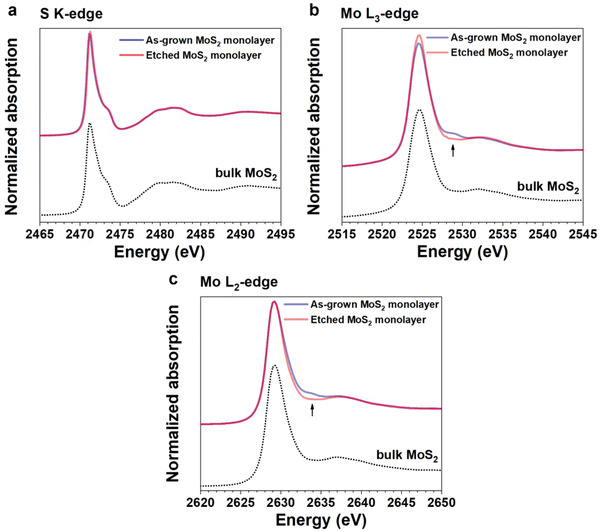
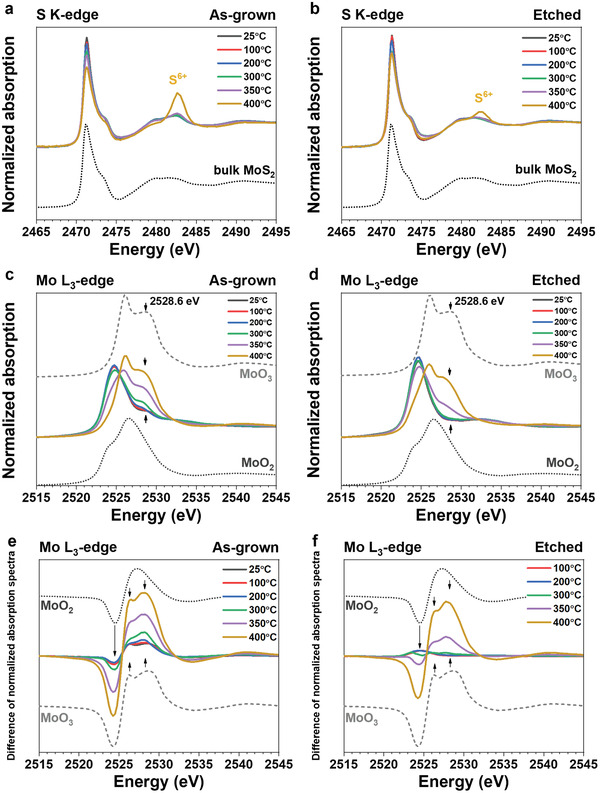
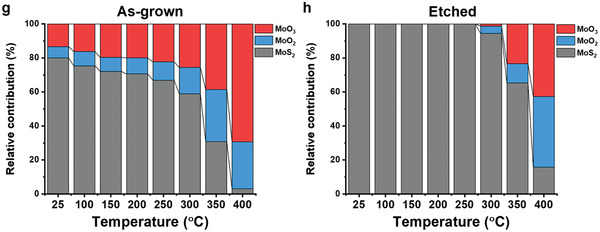
Monolayer MoS is a promising semiconductor to overcome the physical dimension limits of microelectronic devices. Understanding the thermochemical stability of MoS is essential since these devices generate heat and are susceptible to oxidative environments. Herein, the promoting effect of molybdenum oxides (MoO ) particles on the thermal oxidation of MoS monolayers is shown by employing operando X-ray absorption spectroscopy, ex situ scanning electron microscopy and X-ray photoelectron spectroscopy. The study demonstrates that chemical vapor deposition-grown MoS monolayers contain intrinsic MoO and are quickly oxidized at 100 °C (3 vol% O/He), in contrast to previously reported oxidation thresholds (e.g., 250 °C, ≤ 1 h in the air). Otherwise, removing MoO increases the thermal oxidation onset temperature of monolayer MoS to 300 °C. These results indicate that MoO promote oxidation. An oxide-free lattice is critical to the long-term stability of monolayer MoS in state-of-the-art 2D electronic, optical, and catalytic applications.
单层二硫化钼是一种很有前景的半导体材料,有望克服微电子器件的物理尺寸限制。了解二硫化钼的热化学稳定性至关重要,因为这些器件会产生热量,并且易受氧化环境的影响。在此,通过采用原位X射线吸收光谱、非原位扫描电子显微镜和X射线光电子能谱,展示了氧化钼(MoO )颗粒对二硫化钼单层热氧化的促进作用。该研究表明,化学气相沉积生长的二硫化钼单层含有本征MoO ,并且在100°C(3 vol% O/He)下会迅速氧化,这与先前报道的氧化阈值(例如,在空气中250°C,≤1小时)形成对比。否则,去除MoO 会将单层二硫化钼的热氧化起始温度提高到300°C。这些结果表明MoO 促进氧化。在先进的二维电子、光学和催化应用中,无氧化物晶格对于单层二硫化钼的长期稳定性至关重要。