Instituto de Investigaciones Biomédicas en Retrovirus y SIDA, Facultad de Medicina. UBA-CONICET, Paraguay 2155, C1121ABG CABA, Argentina.
Departamento de Medicina, Hospital General de Niños Pedro de Elizalde. Av. Montes de Oca 40, CABA C1270, Argentina.
EBioMedicine. 2021 May;67:103357. doi: 10.1016/j.ebiom.2021.103357. Epub 2021 May 9.
Perhaps reflecting that children with COVID-19 rarely exhibit severe respiratory symptoms and often remain asymptomatic, little attention has been paid to explore the immune response in pediatric COVID-19. Here, we analyzed the phenotype and function of circulating neutrophils from children with COVID-19.
An observational study including 182 children with COVID-19, 21 children with multisystem inflammatory syndrome (MIS-C), and 40 healthy children was performed in Buenos Aires, Argentina. Neutrophil phenotype was analyzed by flow cytometry in blood samples. Cytokine production, plasma levels of IgG antibodies directed to the spike protein of SARS-CoV-2 and citrullinated histone H3 were measured by ELISA. Cell-free DNA was quantified by fluorometry.
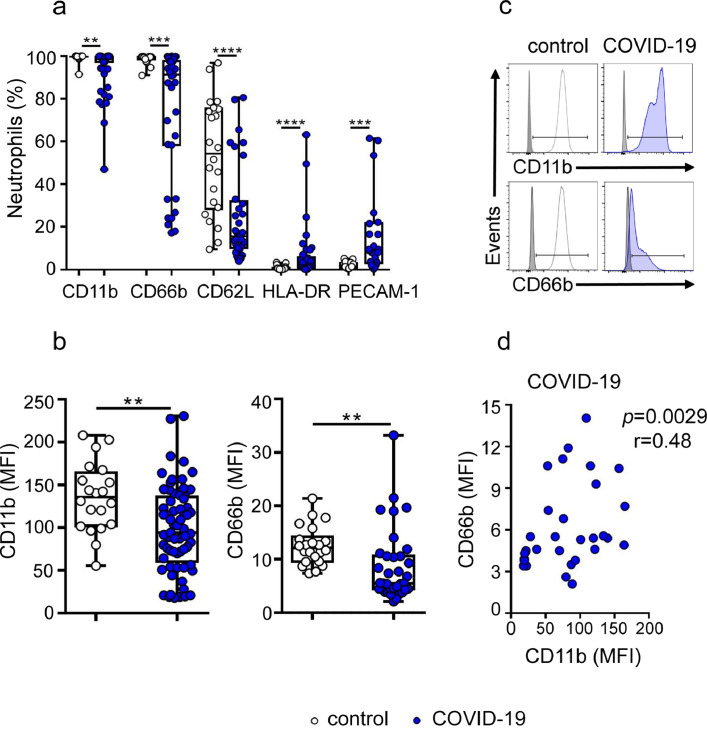
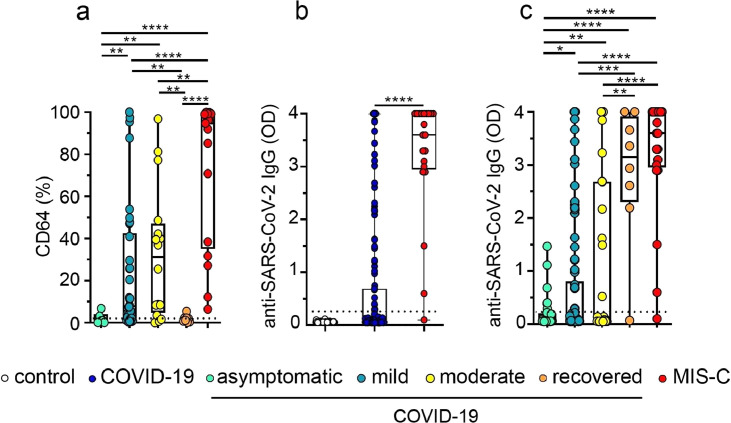
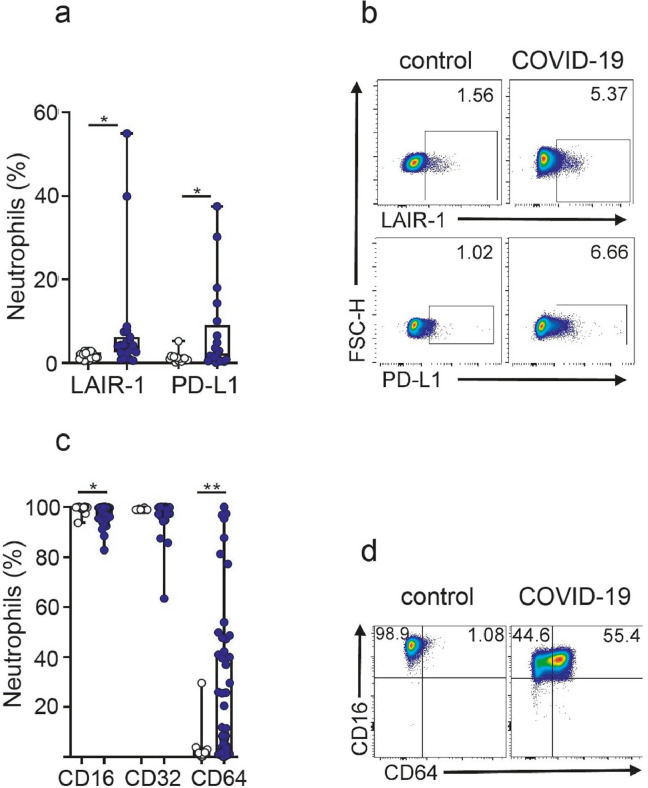
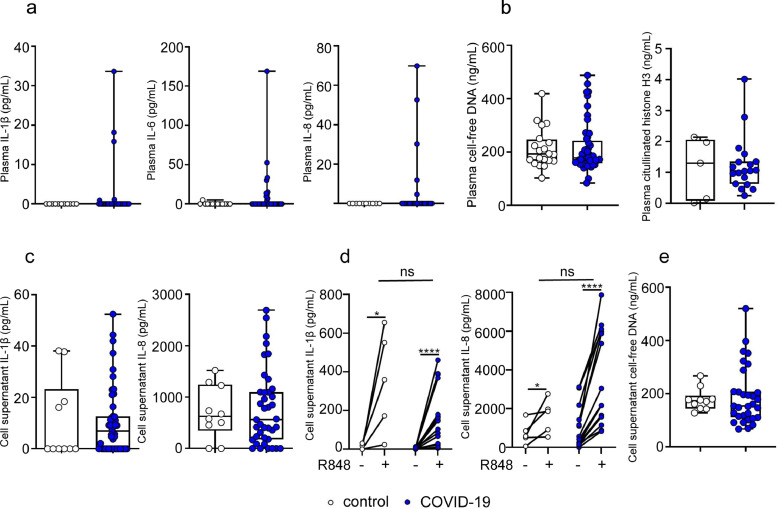
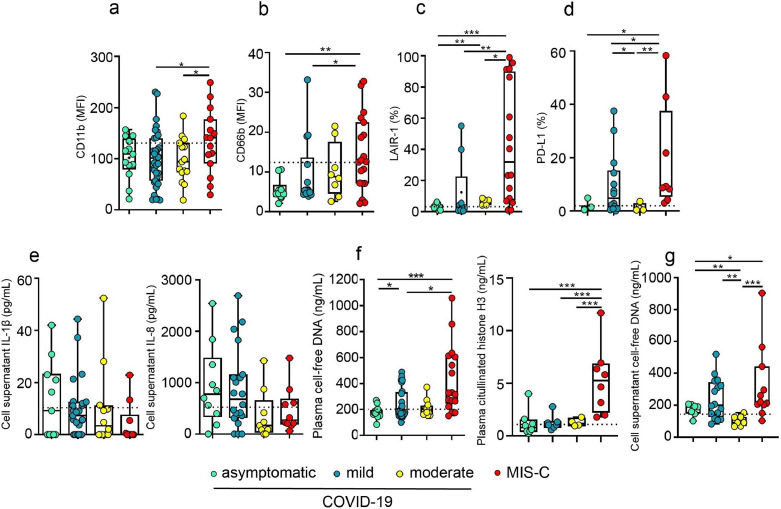
Compared with healthy controls, neutrophils from children with COVID-19 showed a lower expression of CD11b, CD66b, and L-selectin but a higher expression of the activation markers HLA-DR, CD64 and PECAM-1 and the inhibitory receptors LAIR-1 and PD-L1. No differences in the production of cytokines and NETs were observed. Interestingly, the expression of CD64 in neutrophils and the serum concentration of IgG antibodies directed to the spike protein of SARS-CoV-2 distinguished asymptomatic from mild and moderate COVID-19.
Acute lung injury is a prominent feature of severe COVID-19 in adults. A low expression of adhesion molecules together with a high expression of inhibitory receptors in neutrophils from children with COVID-19 might prevent tissue infiltration by neutrophils preserving lung function.
This study was supported by the Ministry of Science and Technology (National Agency for Scientific and Technological Promotion, IP-COVID-19-0277 and PMO BID PICT 2018-2548), and University of Buenos Aires from Argentina (20020170100573BA).
或许反映出 COVID-19 患儿很少出现严重的呼吸道症状,且常无症状,人们很少关注探索儿科 COVID-19 中的免疫反应。在此,我们分析了 COVID-19 患儿循环中性粒细胞的表型和功能。
在阿根廷布宜诺斯艾利斯进行了一项观察性研究,纳入了 182 例 COVID-19 患儿、21 例川崎病(MIS-C)患儿和 40 名健康儿童。通过流式细胞术分析血液样本中的中性粒细胞表型。通过 ELISA 测量细胞因子产生、针对 SARS-CoV-2 刺突蛋白的血浆 IgG 抗体水平和瓜氨酸化组蛋白 H3。通过荧光法定量细胞游离 DNA。
与健康对照组相比,COVID-19 患儿的中性粒细胞表达 CD11b、CD66b 和 L-选择素较低,但表达激活标志物 HLA-DR、CD64 和 PECAM-1 以及抑制性受体 LAIR-1 和 PD-L1 较高。未观察到细胞因子和 NETs 的产生差异。有趣的是,中性粒细胞中 CD64 的表达和针对 SARS-CoV-2 刺突蛋白的 IgG 抗体的血清浓度可将无症状与轻度和中度 COVID-19 区分开来。
急性肺损伤是成人严重 COVID-19 的突出特征。COVID-19 患儿中性粒细胞中黏附分子表达低,同时抑制性受体表达高,可能防止中性粒细胞浸润组织,从而保护肺功能。
本研究得到了科技部(国家科学技术促进局,IP-COVID-19-0277 和 PMO BID PICT 2018-2548)和阿根廷布宜诺斯艾利斯大学(20020170100573BA)的支持。