Department of Otolaryngology-Head and Neck Surgery, Faculty of Medicine and Graduate School of Medicine, Hokkaido University, Sapporo, Japan.
Department of Surgery-Otorhinolaryngology Head and Neck Surgery, Central Adelaide Local Health Network and the University of Adelaide, Adelaide, SA, Australia.
Front Cell Infect Microbiol. 2021 Apr 26;11:655666. doi: 10.3389/fcimb.2021.655666. eCollection 2021.
From the first detection in 2019, SARS-CoV-2 infections have spread rapidly worldwide and have been proven to cause an urgent and important health problem. SARS-CoV-2 cell entry depends on two proteins present on the surface of host cells, angiotensin-converting enzyme 2 (ACE2) and transmembrane protease serine 2 (TMPRSS2). The nasal cavity is thought to be one of the initial sites of infection and a possible reservoir for dissemination within and between individuals. However, it is not known how the expression of these genes is regulated in the nasal mucosa.
In this study, we examined whether the expression of ACE2 and TMPRSS2 is affected by innate immune signals in the nasal mucosa. We also investigated how fluticasone propionate (FP), a corticosteroid used as an intranasal steroid spray, affects the gene expression.
Primary human nasal epithelial cells (HNECs) were collected from the nasal mucosa and incubated with Toll-like receptor (TLR) agonists and/or fluticasone propionate (FP), followed by quantitative PCR, immunofluorescence, and immunoblot analyses.
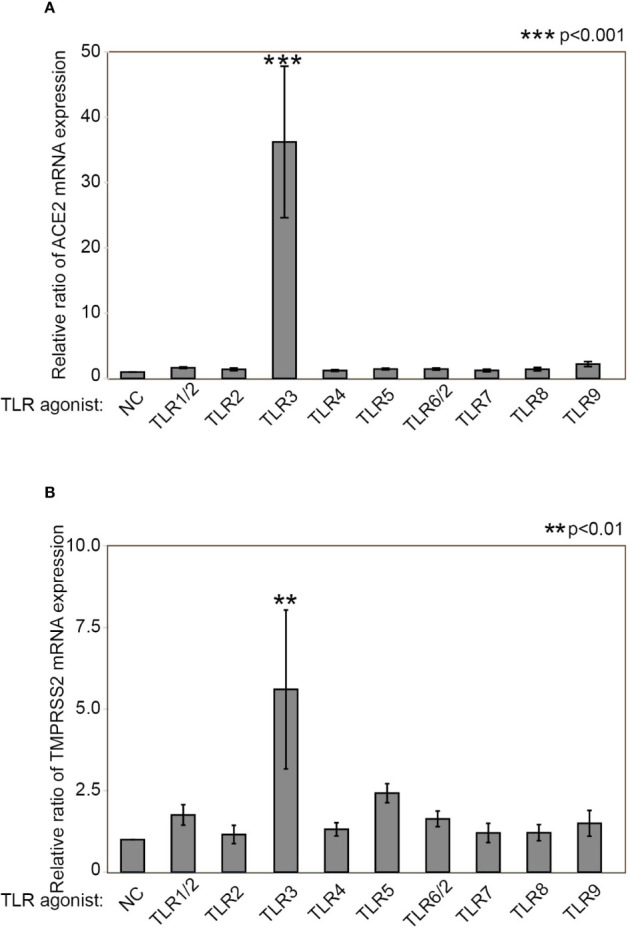
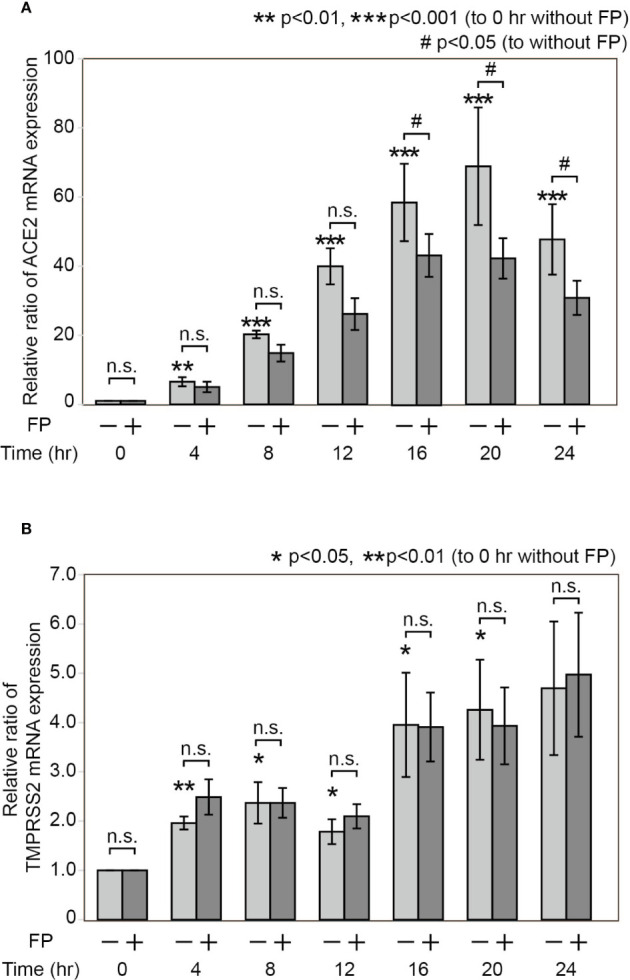
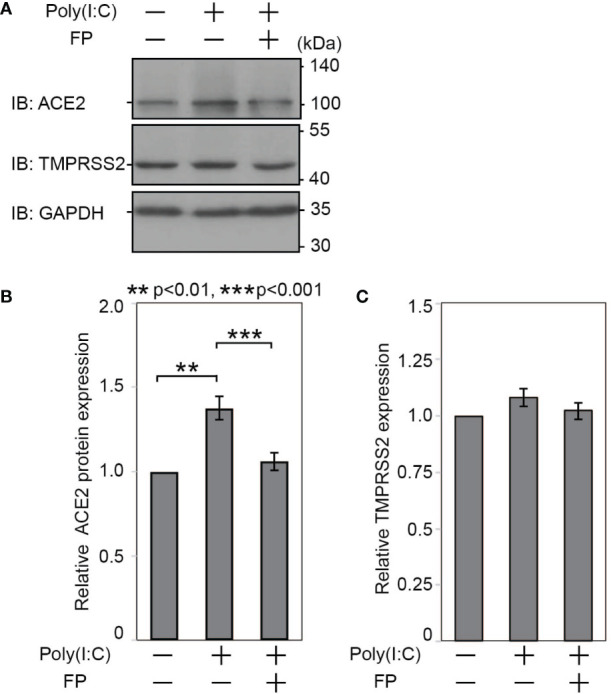
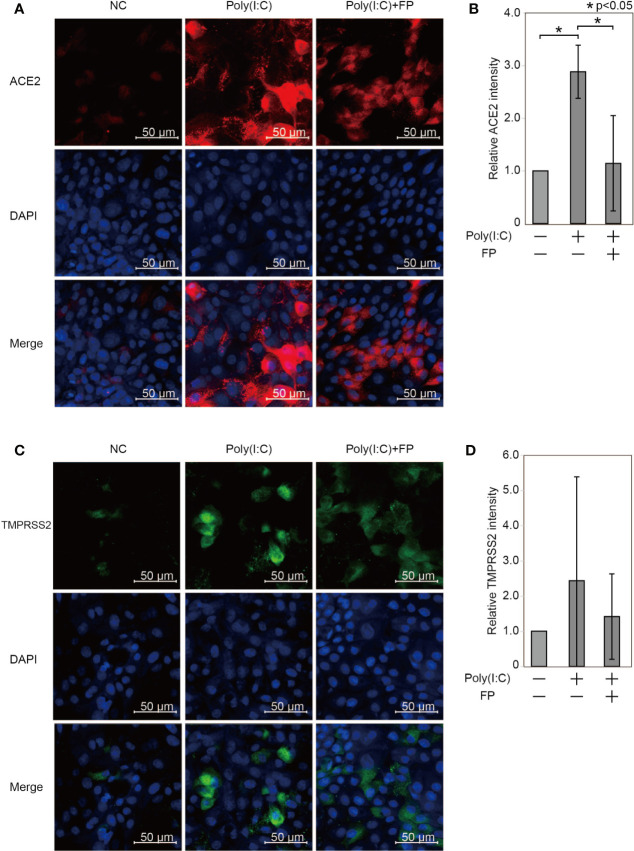
Among the TLR agonists, the TLR3 agonist Poly(I:C) significantly increased ACE2 and TMPRSS2 mRNA expression in HNECs (ACE2 36.212±11.600-fold change, p<0.0001; TMPRSS2 5.598±2.434-fold change, p=0.031). The ACE2 protein level was also increased with Poly(I:C) stimulation (2.884±0.505-fold change, p=0.003). The Poly(I:C)-induced ACE2 expression was suppressed by co-incubation with FP (0.405±0.312-fold change, p=0.044).
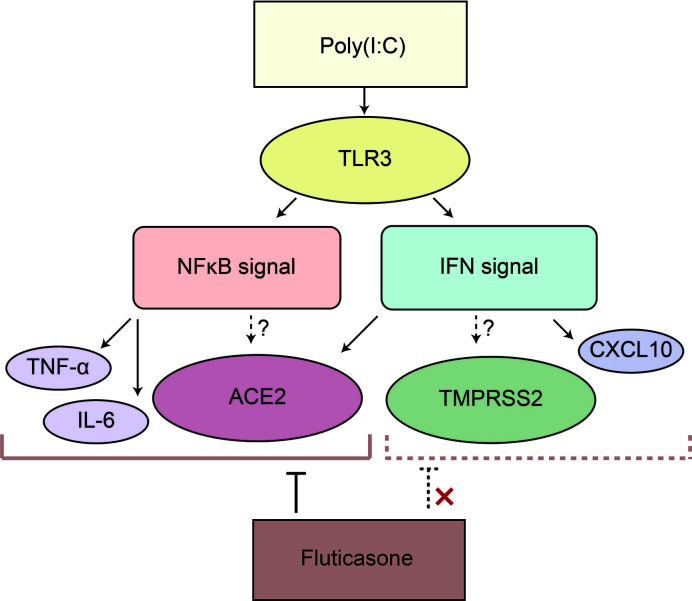
The activation of innate immune signals TLR3 promotes the expression of genes related to SARS-CoV2 cell entry in the nasal mucosa, although this expression is suppressed in the presence of FP. Further studies are required to evaluate whether FP suppresses SARS-CoV-2 viral cell entry.
自 2019 年首次发现以来,SARS-CoV-2 感染已在全球范围内迅速传播,并已被证明是一个紧迫而重要的健康问题。SARS-CoV-2 细胞进入依赖于宿主细胞表面的两种蛋白,即血管紧张素转换酶 2(ACE2)和跨膜蛋白酶丝氨酸 2(TMPRSS2)。鼻腔被认为是感染的初始部位之一,也是个体内部和个体之间传播的可能储库。然而,目前尚不清楚这些基因在鼻黏膜中的表达是如何受到调控的。
在这项研究中,我们研究了 ACE2 和 TMPRSS2 的表达是否受鼻黏膜固有免疫信号的影响。我们还研究了氟替卡松丙酸酯(FP),一种作为鼻内皮质类固醇喷雾使用的皮质类固醇,如何影响基因表达。
从鼻黏膜中采集原代人鼻上皮细胞(HNECs),用 Toll 样受体(TLR)激动剂和/或氟替卡松丙酸酯(FP)孵育,然后进行定量 PCR、免疫荧光和免疫印迹分析。
在 TLR 激动剂中,TLR3 激动剂 Poly(I:C) 显著增加 HNECs 中 ACE2 和 TMPRSS2 的 mRNA 表达(ACE2 为 36.212±11.600 倍变化,p<0.0001;TMPRSS2 为 5.598±2.434 倍变化,p=0.031)。ACE2 蛋白水平也随 Poly(I:C)刺激而增加(2.884±0.505 倍变化,p=0.003)。FP 共孵育抑制了 Poly(I:C)诱导的 ACE2 表达(0.405±0.312 倍变化,p=0.044)。
固有免疫信号的激活 - TLR3 促进了与 SARS-CoV2 细胞进入相关的基因在鼻黏膜中的表达,尽管在 FP 存在下这种表达受到抑制。需要进一步研究评估 FP 是否抑制 SARS-CoV-2 病毒细胞进入。