Bogowicz Paul, Curtis Helen J, Walker Alex J, Cowen Philip, Geddes John, Goldacre Ben
Population Health Sciences Institute, Baddiley-Clark Building, Newcastle University, Newcastle upon Tyne, UK.
The DataLab, Nuffield Department of Primary Care Health Sciences, University of Oxford, Oxford, UK.
BJGP Open. 2021 Aug 24;5(4). doi: 10.3399/BJGPO.2021.0020. Print 2021 Aug.
Antidepressants are commonly prescribed. There are clear national guidelines in relation to treatment sequencing. This study examines trends and variation in antidepressant prescribing across English primary care.
To examine trends and variation in antidepressant prescribing in England, with a focus on: monoamine oxidase inhibitors (MAOIs); paroxetine; and dosulepin and trimipramine. DESIGN & SETTIN: Retrospective longitudinal study using national and practice-level data on antidepressant items prescribed per year (1998-2018) and per month (2010-2019).
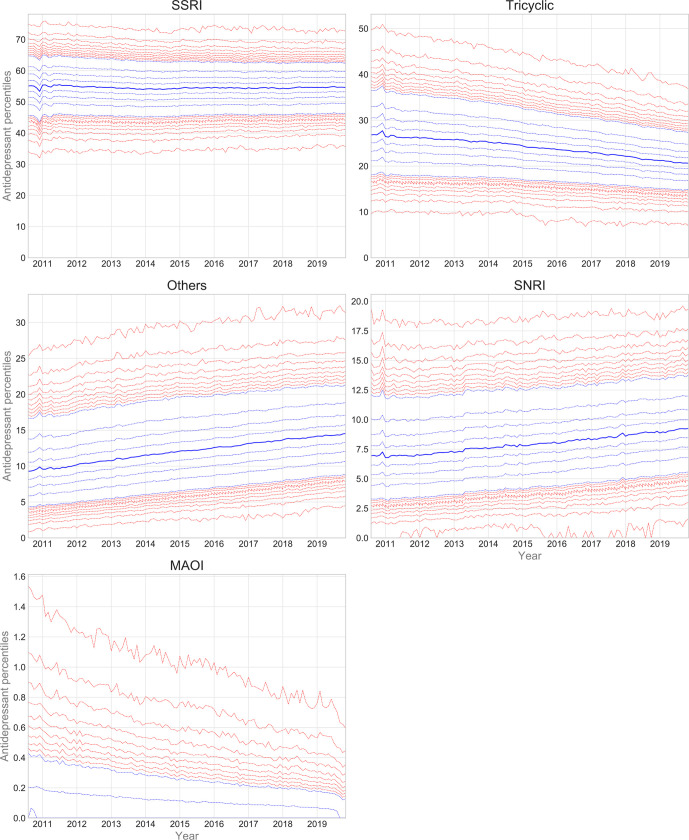
Class- and drug-specific proportions were calculated at national and practice levels. Descriptive statistics were generated, percentile charts and maps were plotted, and logistic regression analysis was conducted.
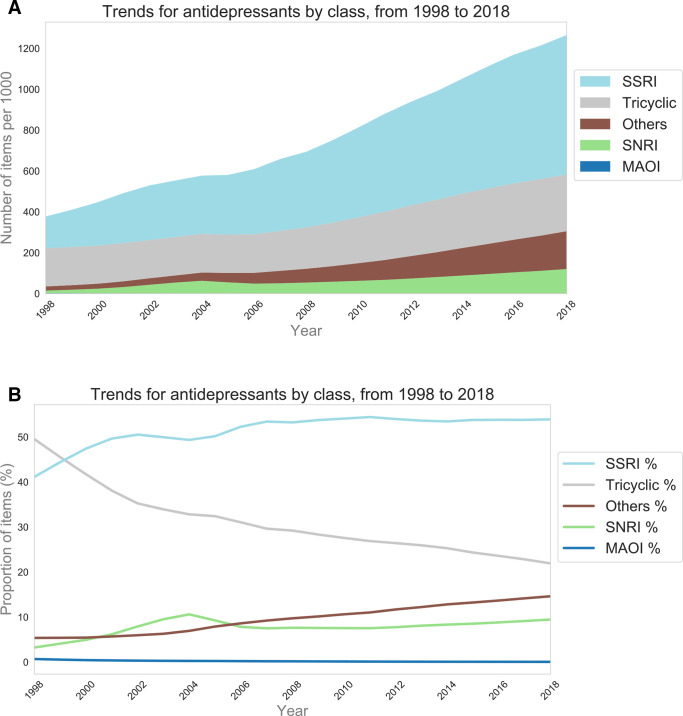
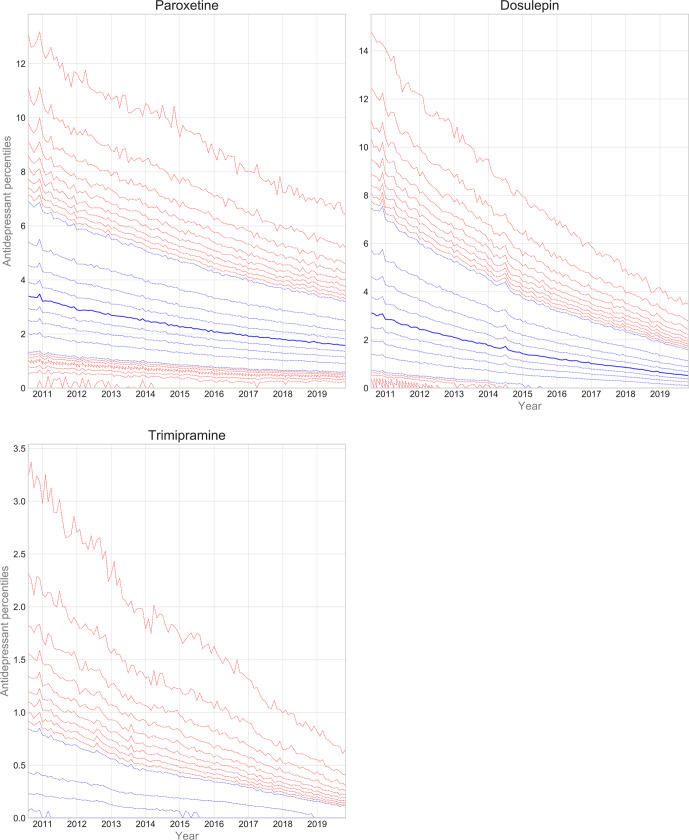
Antidepressant prescriptions more than tripled between 1998 and 2018, from 377 items per 1000 population to 1266 per 1000. MAOI prescribing fell substantially, from 0.7% of all antidepressant items in 1998 to 0.1% in 2018. There was marked variation between practices in past year prescribing of paroxetine (median practice proportion [MPP] = 1.7%, interdecile range [IDR] = 2.6%) and dosulepin (MPP = 0.7%, IDR = 1.8%), but less for trimipramine (MPP = 0%, IDR = 0.2%).
Rapid growth and substantial variation in antidepressant prescribing behaviour was found between practices. The causes could be explored using mixed-methods research. Interventions to reduce prescribing of specific antidepressants, such as dosulepin, could include review prompts, alerts at the time of prescribing, and clinician feedback through tools like OpenPrescribing.net.
抗抑郁药的处方很常见。在治疗顺序方面有明确的国家指南。本研究调查了英格兰基层医疗中抗抑郁药处方的趋势和差异。
调查英格兰抗抑郁药处方的趋势和差异,重点关注:单胺氧化酶抑制剂(MAOIs);帕罗西汀;以及多塞平与曲米帕明。设计与设置:回顾性纵向研究,使用每年(1998 - 2018年)和每月(2010 - 2019年)开具的抗抑郁药项目的国家和实践层面数据。
在国家和实践层面计算特定类别和药物的比例。生成描述性统计数据,绘制百分位图和地图,并进行逻辑回归分析。
1998年至2018年间,抗抑郁药处方增加了两倍多,从每1000人口377项增加到每1000人口1266项。MAOI的处方量大幅下降,从1998年所有抗抑郁药项目的0.7%降至2018年的0.1%。过去一年帕罗西汀的处方在各医疗机构之间存在显著差异(实践中位数比例[MPP]=1.7%,十分位数间距[IDR]=2.6%),多塞平也是如此(MPP = 0.7%,IDR = 1.8%),但曲米帕明的差异较小(MPP = 0%,IDR = 0.2%)。
发现各医疗机构之间抗抑郁药处方行为快速增长且差异很大。可通过混合方法研究来探究其原因。减少特定抗抑郁药(如多塞平)处方的干预措施可包括审查提示、处方时的警报,以及通过OpenPrescribing.net等工具提供临床医生反馈。