CMDB Graduate Program, Johns Hopkins University, Baltimore, Maryland, USA.
Department of Biology, Johns Hopkins University, Baltimore, Maryland, USA.
Bioessays. 2021 Jul;43(7):e2100042. doi: 10.1002/bies.202100042. Epub 2021 May 13.
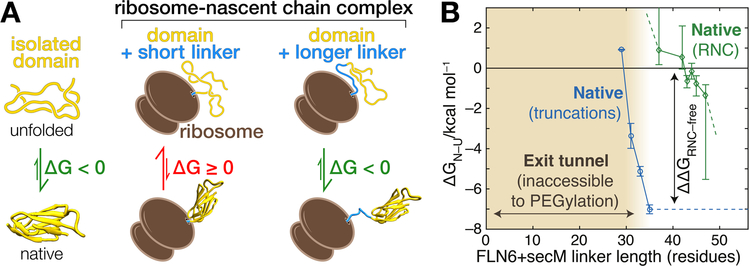
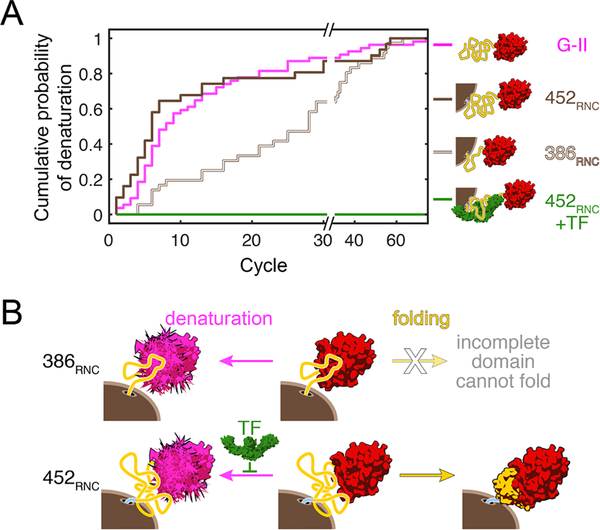
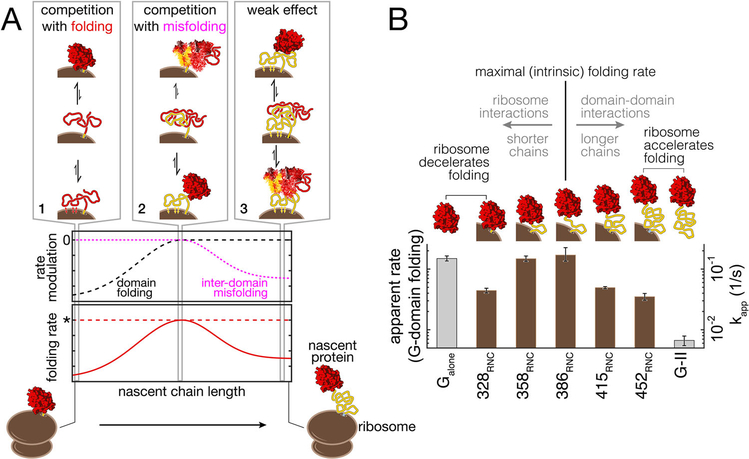
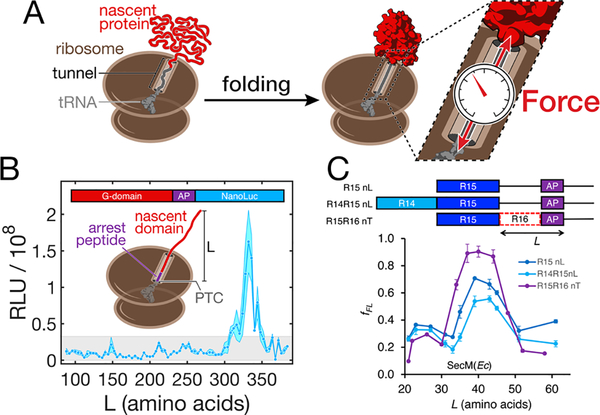
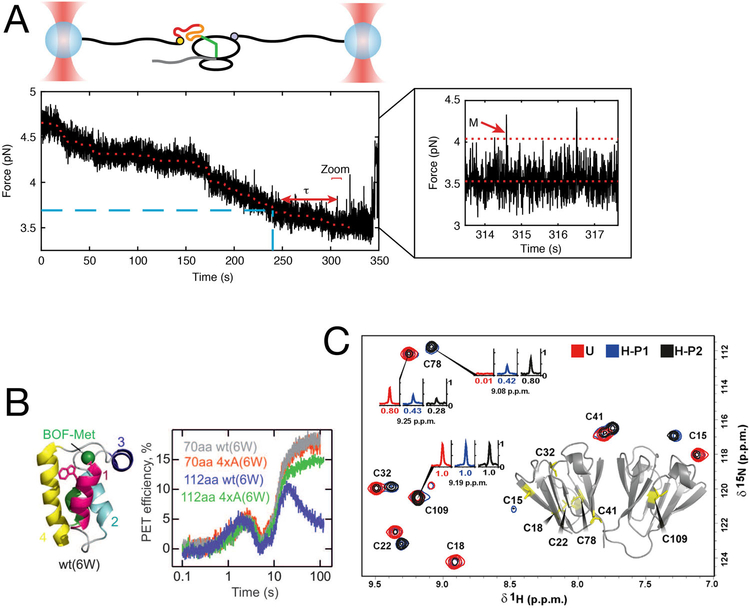
The coupling of protein synthesis and folding is a crucial yet poorly understood aspect of cellular protein folding. Over the past few years, it has become possible to experimentally follow and define protein folding on the ribosome, revealing principles that shape co-translational folding and distinguish it from refolding in solution. Here, we highlight some of these recent findings from biochemical and biophysical studies and their potential significance for cellular protein biogenesis. In particular, we focus on nascent chain interactions with the ribosome, interactions within the nascent protein, modulation of translation elongation rates, and the role of mechanical force that accompanies nascent protein folding. The ability to obtain mechanistic insight in molecular detail has set the stage for exploring the intricate process of nascent protein folding. We believe that the aspects discussed here will be generally important for understanding how protein synthesis and folding are coupled and regulated.
蛋白质合成与折叠的偶联是细胞蛋白质折叠中一个关键但尚未被充分理解的方面。在过去的几年中,人们已经能够在实验上跟踪和定义核糖体上的蛋白质折叠,揭示了影响共翻译折叠并将其与溶液中的重折叠区分开来的原理。在这里,我们强调了这些来自生化和生物物理研究的最新发现及其对细胞蛋白质生物发生的潜在意义。特别是,我们关注新生肽链与核糖体的相互作用、新生肽链内的相互作用、翻译延伸率的调节以及伴随新生肽链折叠的机械力的作用。以分子细节获得机械洞察力的能力为探索新生肽链折叠的复杂过程奠定了基础。我们相信,这里讨论的方面对于理解蛋白质合成和折叠是如何偶联和调节的将是普遍重要的。