Sun Linfeng, Wang Zhongrui, Jiang Jinbao, Kim Yeji, Joo Bomin, Zheng Shoujun, Lee Seungyeon, Yu Woo Jong, Kong Bai-Sun, Yang Heejun
Key Laboratory of Advanced Optoelectronic Quantum Architecture and Measurement, Ministry of Education, School of Physics, Beijing Institute of Technology, Beijing 100081, China.
Department of Energy Science, Sungkyunkwan University, Suwon 16419, Korea.
Sci Adv. 2021 May 14;7(20). doi: 10.1126/sciadv.abg1455. Print 2021 May.
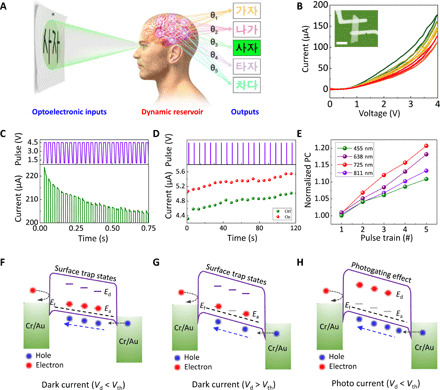
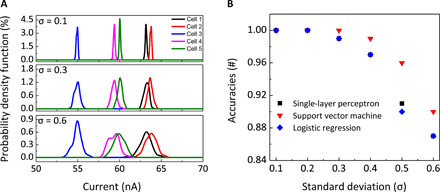
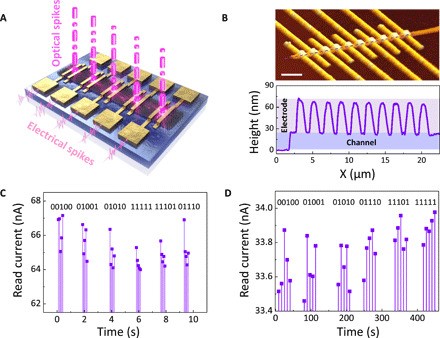
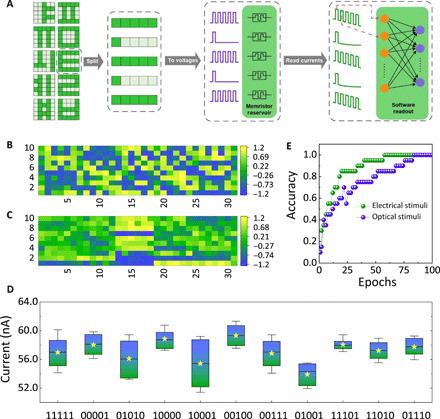
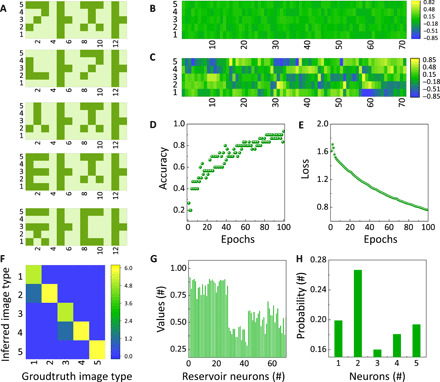
The dynamic processing of optoelectronic signals carrying temporal and sequential information is critical to various machine learning applications including language processing and computer vision. Despite extensive efforts to emulate the visual cortex of human brain, large energy/time overhead and extra hardware costs are incurred by the physically separated sensing, memory, and processing units. The challenge is further intensified by the tedious training of conventional recurrent neural networks for edge deployment. Here, we report in-sensor reservoir computing for language learning. High dimensionality, nonlinearity, and fading memory for the in-sensor reservoir were achieved via two-dimensional memristors based on tin sulfide (SnS), uniquely having dual-type defect states associated with Sn and S vacancies. Our in-sensor reservoir computing demonstrates an accuracy of 91% to classify short sentences of language, thus shedding light on a low training cost and the real-time solution for processing temporal and sequential signals for machine learning applications at the edge.
携带时间和顺序信息的光电信号的动态处理对于包括语言处理和计算机视觉在内的各种机器学习应用至关重要。尽管人们付出了巨大努力来模拟人类大脑的视觉皮层,但物理上分离的传感、存储和处理单元会带来大量的能量/时间开销和额外的硬件成本。传统循环神经网络在边缘部署时的繁琐训练进一步加剧了这一挑战。在此,我们报告了用于语言学习的传感器内储层计算。通过基于硫化锡(SnS)的二维忆阻器实现了传感器内储层的高维度、非线性和衰退记忆,该忆阻器独特地具有与Sn和S空位相关的双型缺陷状态。我们的传感器内储层计算在对语言短句进行分类时展示了91%的准确率,从而为低训练成本以及在边缘为机器学习应用处理时间和顺序信号的实时解决方案提供了思路。