• 文献检索
  • 文档翻译
  • 深度研究
  • 学术资讯
  • Suppr Zotero 插件Zotero 插件
  • 邀请有礼
  • 套餐&价格
  • 历史记录
应用&插件
Suppr Zotero 插件Zotero 插件浏览器插件Mac 客户端Windows 客户端微信小程序
定价
高级版会员购买积分包购买API积分包
服务
文献检索文档翻译深度研究API 文档MCP 服务
关于我们
关于 Suppr公司介绍联系我们用户协议隐私条款
关注我们

Suppr 超能文献

核心技术专利:CN118964589B侵权必究
粤ICP备2023148730 号-1Suppr @ 2026

文献检索

告别复杂PubMed语法,用中文像聊天一样搜索,搜遍4000万医学文献。AI智能推荐,让科研检索更轻松。

立即免费搜索

文件翻译

保留排版,准确专业,支持PDF/Word/PPT等文件格式,支持 12+语言互译。

免费翻译文档

深度研究

AI帮你快速写综述,25分钟生成高质量综述,智能提取关键信息,辅助科研写作。

立即免费体验

森林疟疾:印度疟疾控制和消除的主要障碍。

Forest malaria: the prevailing obstacle for malaria control and elimination in India.

机构信息

ICMR-National Institute of Malaria Research, Raipur, Chhattisgarh, India

ICMR-National Institute of Malaria Research, New Delhi, Delhi, India.

出版信息

BMJ Glob Health. 2021 May;6(5). doi: 10.1136/bmjgh-2021-005391.

DOI:10.1136/bmjgh-2021-005391
PMID:33990358
原文链接:https://pmc.ncbi.nlm.nih.gov/articles/PMC8127975/
Abstract

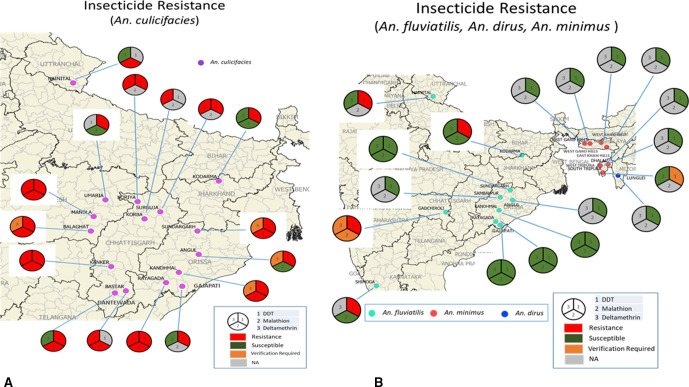
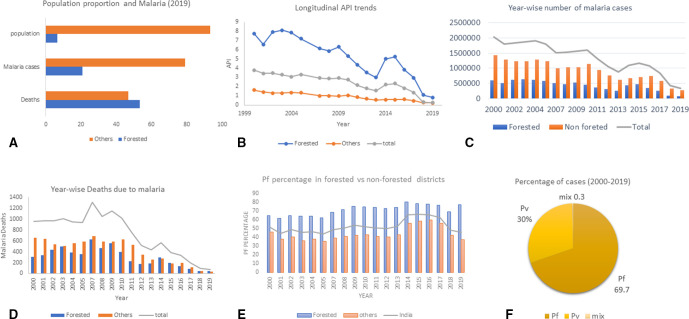
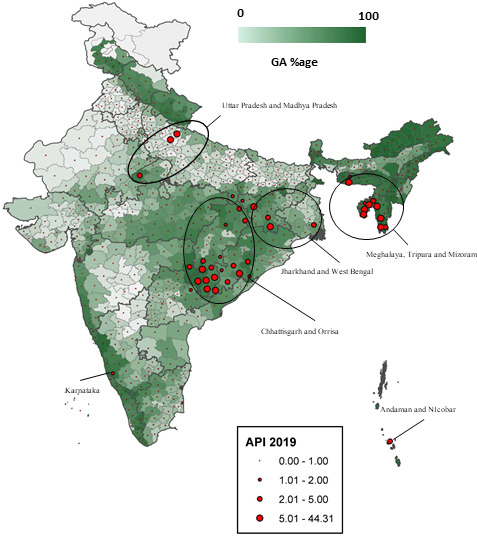
Despite the decrease in malaria mortality and morbidity, it remains a significant public health problem in India. India is targeting malaria elimination from the country by 2030. Different areas in India are in different phases of malaria elimination. The emerging resistance in vectors as well parasite have added necessity to accelerate the malaria elimination programme. Forested areas remain the foci for malaria transmission due to favourable human and environmental factors. Here, we analysed the longitudinal data from 2000 to 2019 to see the trends in forest malaria in India. Population living in forested areas are major malaria contributors. From 2000 to 2019, ~32% of malaria cases and 42% of malaria related deaths were reported from forested districts which represent only ~6.6% of the total Indian population. Increasing insecticide resistance, a high percentage of submicroscopic infections and challenging to test and treat communities are the crucial components of the prevailing obstacles of forested malaria. To achieve the elimination goal, efforts should be intensified with more resources diverted to the forested areas. Malaria control in forested areas will bring fruitful results for malaria control in India.

摘要

尽管疟疾的死亡率和发病率有所下降,但它仍是印度一个重大的公共卫生问题。印度的目标是到 2030 年消除该国的疟疾。印度不同地区处于消除疟疾的不同阶段。媒介和寄生虫的新出现的抗药性增加了加速消除疟疾方案的必要性。由于有利的人和环境因素,森林地区仍然是疟疾传播的焦点。在这里,我们分析了 2000 年至 2019 年的纵向数据,以了解印度森林疟疾的趋势。居住在森林地区的人口是疟疾的主要贡献者。2000 年至 2019 年,报告的森林地区疟疾病例约占 32%,疟疾相关死亡约占 42%,而森林地区仅占印度总人口的约 6.6%。不断增加的杀虫剂耐药性、高比例的亚临床感染以及难以对社区进行检测和治疗,是森林疟疾当前面临的主要障碍的关键组成部分。为了实现消除目标,应该加大投入更多资源到森林地区。在森林地区控制疟疾将为印度的疟疾控制带来丰硕成果。
https://cdn.ncbi.nlm.nih.gov/pmc/blobs/2dc4/8127975/a7b1325dd117/bmjgh-2021-005391f03.jpg
https://cdn.ncbi.nlm.nih.gov/pmc/blobs/2dc4/8127975/d24ac945bf67/bmjgh-2021-005391f01.jpg
https://cdn.ncbi.nlm.nih.gov/pmc/blobs/2dc4/8127975/80de05f57be4/bmjgh-2021-005391f02.jpg
https://cdn.ncbi.nlm.nih.gov/pmc/blobs/2dc4/8127975/a7b1325dd117/bmjgh-2021-005391f03.jpg
https://cdn.ncbi.nlm.nih.gov/pmc/blobs/2dc4/8127975/d24ac945bf67/bmjgh-2021-005391f01.jpg
https://cdn.ncbi.nlm.nih.gov/pmc/blobs/2dc4/8127975/80de05f57be4/bmjgh-2021-005391f02.jpg
https://cdn.ncbi.nlm.nih.gov/pmc/blobs/2dc4/8127975/a7b1325dd117/bmjgh-2021-005391f03.jpg

相似文献

1
Forest malaria: the prevailing obstacle for malaria control and elimination in India.森林疟疾:印度疟疾控制和消除的主要障碍。
BMJ Glob Health. 2021 May;6(5). doi: 10.1136/bmjgh-2021-005391.
2
Time to implement tailored interventions in Chhattisgarh, east-central India to reach malaria elimination.印度中东部恰蒂斯加尔邦需要实施有针对性的干预措施,以实现消除疟疾。
J Vector Borne Dis. 2024 Apr 1;61(2):151-157. doi: 10.4103/jvbd.jvbd_167_23. Epub 2024 Jun 6.
3
Novel Approaches to Control Malaria in Forested Areas of Southeast Asia.东南亚森林地区疟疾控制的新方法。
Trends Parasitol. 2019 Jun;35(6):388-398. doi: 10.1016/j.pt.2019.03.011. Epub 2019 May 7.
4
How can the complex epidemiology of malaria in India impact its elimination?印度疟疾的复杂流行病学情况如何影响其消除工作?
Trends Parasitol. 2023 Jun;39(6):432-444. doi: 10.1016/j.pt.2023.03.006. Epub 2023 Apr 6.
5
Study design and operational framework for a community-based Malaria Elimination Demonstration Project (MEDP) in 1233 villages of district Mandla, Madhya Pradesh.基于社区的疟疾消除示范项目(MEDP)在中央邦曼德拉区 1233 个村庄的设计和运作框架。
Malar J. 2020 Nov 16;19(1):410. doi: 10.1186/s12936-020-03458-4.
6
Time series analysis of malaria cases to assess the impact of various interventions over the last three decades and forecasting malaria in India towards the 2030 elimination goals.对疟疾病例进行时间序列分析,以评估过去三十年来各种干预措施的影响,并预测印度在 2030 年消除疟疾目标方面的疟疾情况。
Malar J. 2024 Feb 15;23(1):50. doi: 10.1186/s12936-024-04872-8.
7
Malaria in India: challenges and opportunities.印度的疟疾:挑战与机遇
J Biosci. 2008 Nov;33(4):583-92. doi: 10.1007/s12038-008-0076-x.
8
Malaria elimination: Using past and present experience to make malaria-free India by 2030.疟疾消除:利用过去和现在的经验在2030年前实现印度无疟疾
J Vector Borne Dis. 2019 Jan-Mar;56(1):60-65. doi: 10.4103/0972-9062.257777.
9
Malaria elimination in India and regional implications.印度消除疟疾及其区域影响。
Lancet Infect Dis. 2016 Oct;16(10):e214-e224. doi: 10.1016/S1473-3099(16)30123-2. Epub 2016 Aug 12.
10
[Current malaria situation in the Republic of Kazakhstan].[哈萨克斯坦共和国当前的疟疾形势]
Med Parazitol (Mosk). 2001 Jan-Mar(1):24-33.

引用本文的文献

1
Molecular Screening of spp. in Free-Living Ring-Tailed Coatis () and Nine-Banded Armadillos () in the Peruvian Amazon.秘鲁亚马逊地区野生环尾浣熊()和九带犰狳()中 spp. 的分子筛查
Animals (Basel). 2025 Aug 18;15(16):2413. doi: 10.3390/ani15162413.
2
Transfusion-transmitted spp. infections and safety challenges for malaria in the Indian subcontinent: a systematic review.印度次大陆输血传播的疟原虫感染及疟疾安全挑战:一项系统评价
Lancet Reg Health Southeast Asia. 2025 Jul 22;40:100641. doi: 10.1016/j.lansea.2025.100641. eCollection 2025 Sep.
3
The intersection of geography and sociocultural factors in malaria epidemiology: A study of 6 years (2018-2023) surveillance data from three districts of Maharashtra, India, with diverse landscape.

本文引用的文献

1
Malaria elimination in India requires additional surveillance mechanisms.印度消除疟疾需要额外的监测机制。
J Public Health (Oxf). 2022 Aug 25;44(3):527-531. doi: 10.1093/pubmed/fdab106.
2
Genotyping cognate Plasmodium falciparum in humans and mosquitoes to estimate onward transmission of asymptomatic infections.对人类和蚊子中的同源疟原虫进行基因分型,以估计无症状感染的传播。
Nat Commun. 2021 Feb 10;12(1):909. doi: 10.1038/s41467-021-21269-2.
3
Choosing interventions to eliminate forest malaria: preliminary results of two operational research studies inside Cambodian forests.
疟疾流行病学中地理因素与社会文化因素的交叉:对印度马哈拉施特拉邦三个具有不同地貌地区的6年(2018 - 2023年)监测数据的研究
Trop Parasitol. 2025 Jan-Jun;15(1):25-32. doi: 10.4103/tp.tp_52_24. Epub 2025 Apr 5.
4
Socioecological risk factors associated with Malaria in Pregnancy in an endemic state of India: a retrospective study.印度地方病流行区与妊娠疟疾相关的社会生态风险因素:一项回顾性研究。
BMJ Public Health. 2023 Sep 19;1(1):e000004. doi: 10.1136/bmjph-2023-000004. eCollection 2023 Nov.
5
Adverse pregnancy outcomes in maternal malarial infection: A systematic review and meta-analysis.孕产妇疟疾感染中的不良妊娠结局:一项系统评价和荟萃分析。
New Microbes New Infect. 2024 Aug 30;62:101474. doi: 10.1016/j.nmni.2024.101474. eCollection 2024 Dec.
6
Exploring the hidden mental health consequences of malaria beyond the fever.探索疟疾发热之外隐藏的心理健康后果。
Front Hum Neurosci. 2024 Jul 18;18:1432441. doi: 10.3389/fnhum.2024.1432441. eCollection 2024.
7
Forest-goers as a heterogeneous population at high-risk for malaria: a case-control study in Aceh Province, Indonesia.森林游客是疟疾高危异质人群:印度尼西亚亚齐省的病例对照研究。
Malar J. 2024 Jan 30;23(1):37. doi: 10.1186/s12936-024-04856-8.
8
Molecular speciation of Plasmodium and multiplicity of P. falciparum infection in the Central region of Ghana.加纳中部地区疟原虫的分子分型及恶性疟原虫感染的多样性
PLOS Glob Public Health. 2024 Jan 18;4(1):e0002718. doi: 10.1371/journal.pgph.0002718. eCollection 2024.
9
Malaria control - lessons learned from trends of Malaria indices over three decades in Karnataka, India.疟疾控制——从印度卡纳塔克邦三十年来疟疾指数趋势中吸取的经验教训。
Malar J. 2023 Nov 17;22(1):353. doi: 10.1186/s12936-023-04774-1.
10
Malaria in pregnancy in India: a 50-year bird's eye.印度妊娠疟疾:50 年的鸟瞰。
Front Public Health. 2023 Oct 19;11:1150466. doi: 10.3389/fpubh.2023.1150466. eCollection 2023.
选择干预措施消除森林疟疾:柬埔寨森林内两项实施性研究的初步结果。
Malar J. 2021 Jan 20;20(1):51. doi: 10.1186/s12936-020-03572-3.
4
For malaria elimination India needs a platform for data integration.为了消除疟疾,印度需要一个数据整合平台。
BMJ Glob Health. 2020 Dec;5(12). doi: 10.1136/bmjgh-2020-004198.
5
COVID-19 Mitigation Steps Provide a Blueprint for Malaria Control and Elimination.新冠缓解措施为疟疾防控和消除提供蓝图。
Am J Trop Med Hyg. 2020 Jul;103(1):28-30. doi: 10.4269/ajtmh.20-0394. Epub 2020 May 7.
6
Unlicensed medical practitioners in tribal dominated rural areas of central India: bottleneck in malaria elimination.印度中部部落主导的农村地区的无证行医者:消除疟疾的瓶颈。
Malar J. 2020 Jan 14;19(1):18. doi: 10.1186/s12936-020-3109-z.
7
Risk factor assessment for clinical malaria among forest-goers in a pre-elimination setting in Phu Yen Province, Vietnam.越南富安省消除前环境中森林工作者罹患临床疟疾的风险因素评估。
Malar J. 2019 Dec 20;18(1):435. doi: 10.1186/s12936-019-3068-4.
8
Biology and bionomics of malaria vectors in India: existing information and what more needs to be known for strategizing elimination of malaria.印度疟疾媒介的生物学和生态学:现有信息以及为制定消除疟疾策略需要了解的更多信息。
Malar J. 2019 Dec 3;18(1):396. doi: 10.1186/s12936-019-3011-8.
9
School-age Children as Asymptomatic Malaria Reservoir in Tribal Villages of Bastar Region, Chhattisgarh.学龄儿童是恰蒂斯加尔邦巴斯塔尔地区部落村庄无症状疟疾储存库。
Indian Pediatr. 2019 Oct 15;56(10):873-875.
10
Prevalence of afebrile malaria and development of risk-scores for gradation of villages: A study from a hot-spot in Odisha.无热疟疾的流行情况和村庄分级风险评分的制定:来自奥里萨邦热点地区的一项研究。
PLoS One. 2019 Sep 6;14(9):e0221223. doi: 10.1371/journal.pone.0221223. eCollection 2019.