Department of Biological Sciences, Okinawa Prefectural Institute of Health and Environment, 17-1 Kanekadan, Uruma-shi, Okinawa, 904-2241, Japan.
Regional Health Division, Department of Public Health and Medical Care, Okinawa Prefectural Government, 1-2-2 Izumizaki, Naha-shi, Okinawa, 900-8570, Japan.
Sci Rep. 2021 May 14;11(1):10365. doi: 10.1038/s41598-021-89872-3.
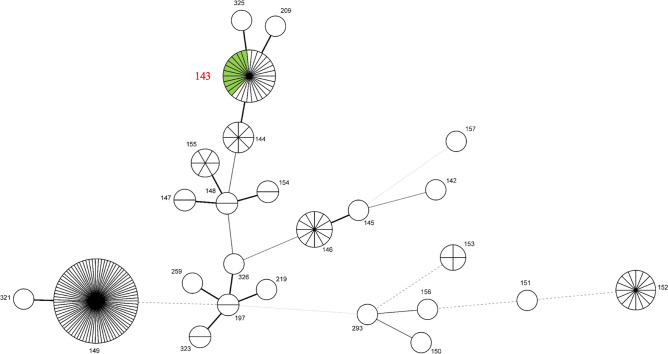
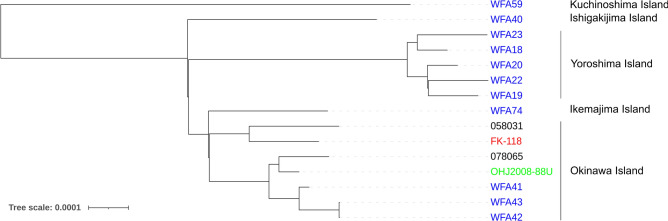
Leptospirosis is a zoonosis caused by pathogenic Leptospira spp. Cats have been reported to be infected with Leptospira spp. and shed the bacteria in the urine. However, the importance of cats as an infection source for humans remains unclear. In this study, Leptospira infection in cats in Okinawa Prefecture, Japan, where leptospirosis is endemic, was investigated by leptospiral antibody and DNA detection using microscopic agglutination test and nested PCR, respectively. Moreover, multilocus sequence typing (MLST) and whole genome sequencing (WGS) were conducted on the Leptospira borgpetersenii serogroup Javanica isolated from cats, black rats, a mongoose, and humans. Anti-Leptospira antibodies were detected in 16.6% (40/241) of the cats tested, and the predominant reactive serogroup was Javanica. The leptospiral flaB gene was detected in 7.1% (3/42) of cat urine samples, and their sequences were identical and identified as L. borgpetersenii. MLST and WGS revealed the genetic relatedness of L. borgpetersenii serogroup Javanica isolates. This study indicated that most seropositive cats had antibodies against the serogroup Javanica and that cats excreted L. borgpetersenii in the urine after infection. Further, genetic relatedness between cat and human isolates suggests that cats may be a maintenance host for L. borgpetersenii serogroup Javanica and a source for human infection.
钩端螺旋体病是一种由致病性钩端螺旋体属引起的人畜共患病。据报道,猫感染了钩端螺旋体属并从尿液中排出细菌。然而,猫作为人类感染源的重要性仍不清楚。在这项研究中,使用显微镜凝集试验和巢式 PCR 分别检测了日本冲绳县(钩端螺旋体病流行地区)猫的钩端螺旋体抗体和 DNA,对猫的钩端螺旋体感染进行了调查。此外,对从猫、黑鼠、食蟹獴和人分离的 Javanica 血清群伯氏钩端螺旋体进行了多位点序列分型(MLST)和全基因组测序(WGS)。在检测的 241 只猫中,有 16.6%(40/241)检测到抗 Leptospira 抗体,主要反应血清群为 Javanica。在 7.1%(3/42)的猫尿液样本中检测到了钩端螺旋体 flaB 基因,其序列相同,鉴定为 L. borgpetersenii。MLST 和 WGS 揭示了 Javanica 血清群伯氏钩端螺旋体分离株的遗传相关性。本研究表明,大多数血清阳性猫对 Javanica 血清群有抗体,感染后猫会从尿液中排出 L. borgpetersenii。此外,猫和人分离株之间的遗传相关性表明,猫可能是 Javanica 血清群伯氏钩端螺旋体的维持宿主,也是人类感染的来源。