Ambade Balram, Kurwadkar Sudarshan, Sankar Tapan Kumar, Kumar Amit
Department of Chemistry, National Institute of Technology, Jamshedpur, Jharkhand 831014 India.
Department of Civil and Environmental Engineering, California State University, Fullerton, 800 N. State College Blvd, Fullerton, CA USA.
Air Qual Atmos Health. 2021;14(7):1081-1095. doi: 10.1007/s11869-021-01004-y. Epub 2021 May 10.
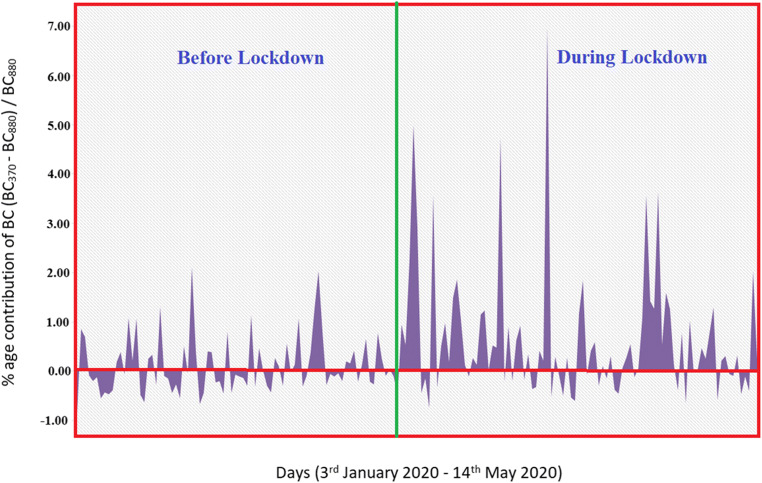
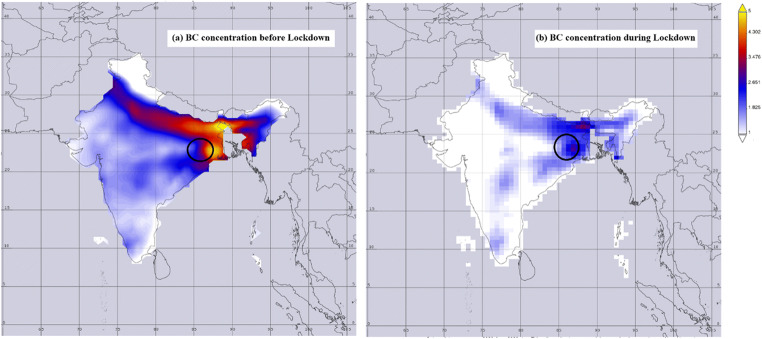
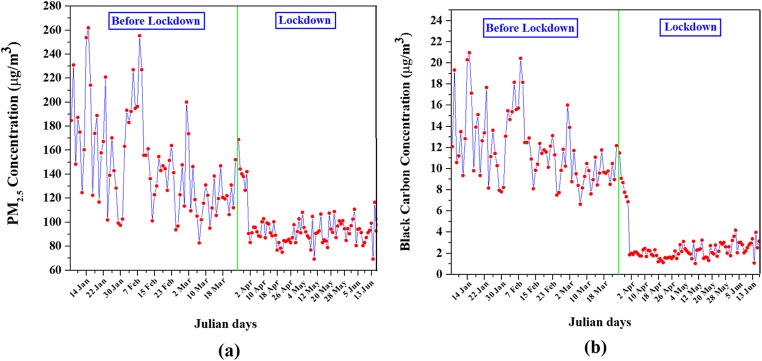
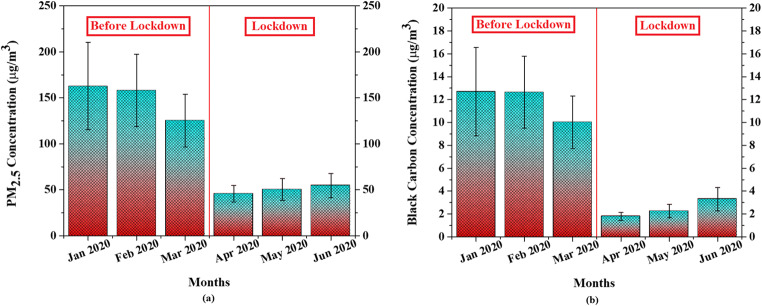
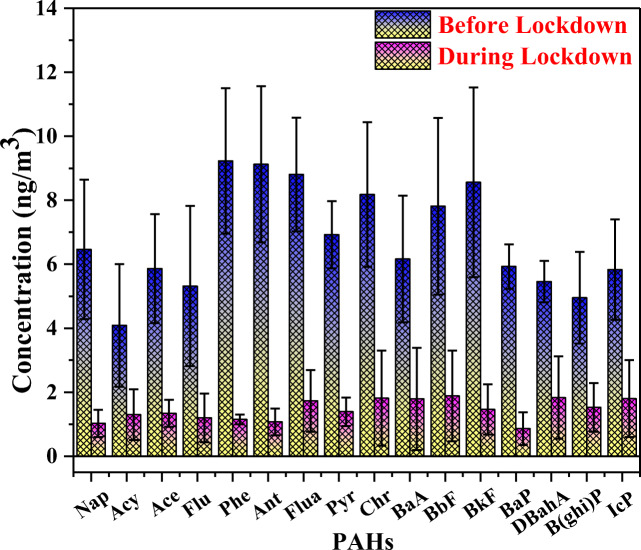
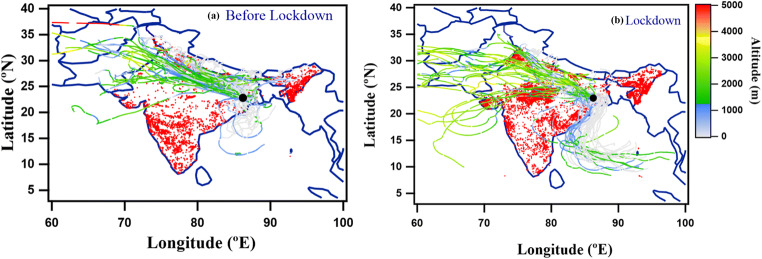
The global pandemic COVID-19 necessitated various responses throughout the world, including social distancing, use of mask, and complete lockdown. While these measures helped prevent the community spread of the virus, the resulting environmental benefits of lockdown remained mostly unnoticed. While many studies documented improvements in air quality index, very few have explored the reduction in black carbon (BC) aerosols and polycyclic aromatic hydrocarbons (PAHs) concentrations due to lockdown. In this study, we evaluated the changes in concentrations of BC, PAHs, and PM before and during the lockdown period. Our results show that lockdown resulted in a significant reduction in concentrations of these pollutants. The average mass concentration of BC, PAHs, and PM before the lockdown was 11.71 ± 3.33 μgm, 108.71 ± 27.77 ngm, and 147.65 ± 41.77 μgm, respectively. During the lockdown period, the concentration of BC, PAHs, and PM was 2.46 ± 0.95 μgm, 23.19 ± 11.21 ngm, and 50.31 ± 11.95 μgm, respectively. The diagnostic ratio analysis for source apportionment showed changes in the emission sources before and during the lockdown. The primary sources of PAHs emissions before the lockdown were biomass, coal combustion, and vehicular traffic, while during the lockdown, PAHs emissions were primarily from the combustion of biomass and coal. Similarly, before the lockdown, the BC mass concentrations came from fossil-fuel and wood-burning, while during the lockdown period, most of the BC mass concentration came from wood-burning. Human health risk assessment demonstrated a significant reduction in risk due to inhalation of PAHs and BC-contaminated air.
全球新冠疫情使得世界各地采取了各种应对措施,包括保持社交距离、佩戴口罩和全面封锁。虽然这些措施有助于防止病毒在社区传播,但封锁所带来的环境效益大多未被注意到。虽然许多研究记录了空气质量指数的改善情况,但很少有研究探讨封锁导致的黑碳(BC)气溶胶和多环芳烃(PAHs)浓度的降低。在本研究中,我们评估了封锁期间前后BC、PAHs和PM浓度的变化。我们的结果表明,封锁导致这些污染物的浓度显著降低。封锁前BC、PAHs和PM的平均质量浓度分别为11.71±3.33微克/立方米、108.71±27.77纳克/立方米和147.65±41.77微克/立方米。在封锁期间,BC、PAHs和PM的浓度分别为2.46±0.95微克/立方米、23.19±11.21纳克/立方米和50.31±11.95微克/立方米。源解析的诊断比值分析表明,封锁前后排放源发生了变化。封锁前PAHs排放的主要来源是生物质、煤炭燃烧和车辆交通,而在封锁期间,PAHs排放主要来自生物质和煤炭的燃烧。同样,在封锁前,BC质量浓度来自化石燃料和木材燃烧,而在封锁期间,大部分BC质量浓度来自木材燃烧。人体健康风险评估表明,由于吸入受PAHs和BC污染的空气,风险显著降低。