Wang Yongchao, Wang Jinjin, Zhu Dandan, Wang Yufei, Qing Guangchao, Zhang Yuxuan, Liu Xiaoxuan, Liang Xing-Jie
State Key Laboratory of Natural Medicines and Jiangsu Key Laboratory of Drug Discovery for Metabolic Diseases, Center of Drug Discovery, Center of Advanced Pharmaceutics and Biomaterials, China Pharmaceutical University, Nanjing 210009, China.
Laboratory of Controllable Nanopharmaceuticals, Chinese Academy of Sciences (CAS) Center for Excellence in Nanoscience and CAS Key Laboratory for Biomedical Effects of Nanomaterials and Nanosafety, National Center for Nanoscience and Technology, Beijing 100190, China.
Acta Pharm Sin B. 2021 Apr;11(4):886-902. doi: 10.1016/j.apsb.2021.03.007. Epub 2021 Mar 9.
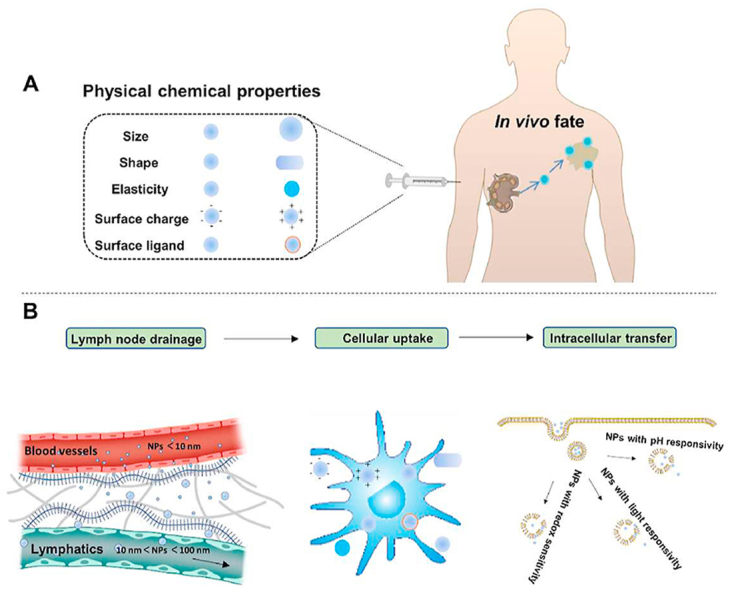
Current advances of immunotherapy have greatly changed the way of cancer treatment. At the same time, a great number of nanoparticle-based cancer immunotherapies (NBCIs) have also been explored to elicit potent immune responses against tumors. However, few NBCIs are nearly in the clinical trial which is mainly ascribed to a lack understanding of fate of nanoparticles (NPs) for cancer immunotherapy. NPs for cancer immunotherapy mainly target the immune organs or immune cells to enable efficient antitumor immune responses. The physicochemical properties of NPs including size, shape, elasticity and surface properties directly affect their interaction with immune systems as well as their fate and therapeutic effect. Hence, systematic analysis of the physicochemical properties and their effect on fate is urgently needed. In this review, we first recapitulate the fundamentals for the fate of NBCIs including physio-anatomical features of lymphatic system and strategies to modulate immune responses. Moreover, we highlight the effect of physicochemical properties on their fate including lymph nodes (LNs) drainage, cellular uptake and intracellular transfer. Challenges and opportunities for rational design of NPs for cancer immunotherapy are also discussed in detail.
免疫疗法的当前进展极大地改变了癌症治疗方式。与此同时,大量基于纳米颗粒的癌症免疫疗法(NBCIs)也已被探索,以引发针对肿瘤的有效免疫反应。然而,几乎没有NBCIs进入临床试验阶段,这主要归因于对用于癌症免疫治疗的纳米颗粒(NPs)的命运缺乏了解。用于癌症免疫治疗的NPs主要靶向免疫器官或免疫细胞,以实现有效的抗肿瘤免疫反应。NPs的物理化学性质,包括大小、形状、弹性和表面性质,直接影响它们与免疫系统的相互作用以及它们的命运和治疗效果。因此,迫切需要对物理化学性质及其对命运的影响进行系统分析。在这篇综述中,我们首先概述了NBCIs命运的基本原理,包括淋巴系统的生理解剖特征和调节免疫反应的策略。此外,我们强调了物理化学性质对其命运的影响,包括淋巴结(LNs)引流、细胞摄取和细胞内转运。还详细讨论了合理设计用于癌症免疫治疗的NPs所面临的挑战和机遇。