Melkamu Lydia, Berhe Resom, Handebo Simegnew
Department of Health Promotion and Behavioral Sciences, College of Medicine and Health Sciences, Bahir Dar University, Bahir Dar, Ethiopia.
Department of Health Education and Behavioral Sciences, Institute of Public Health, College of Medicine and Health Sciences, University of Gondar, Gondar, Ethiopia.
Diabetes Metab Syndr Obes. 2021 May 13;14:2145-2154. doi: 10.2147/DMSO.S306752. eCollection 2021.
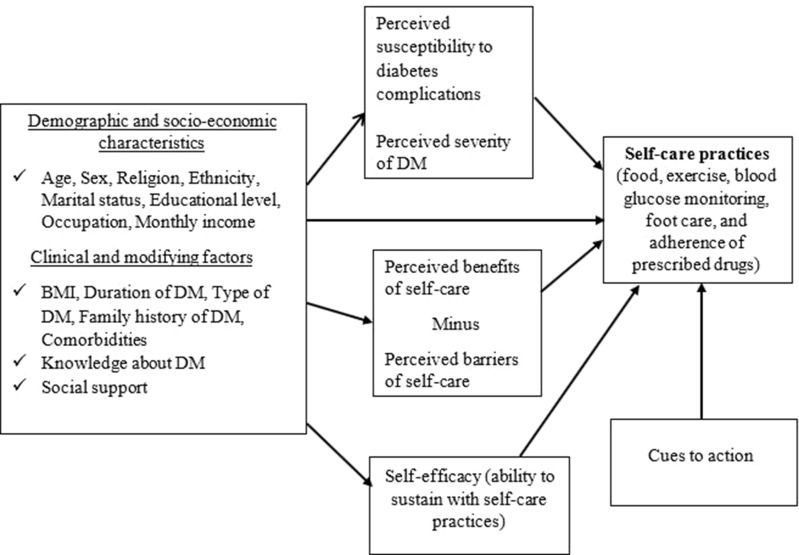
Poor lifestyle choices contribute to the continued growth of chronic illness and disability. Patients with diabetes require continuous self-care choices and management to minimize the short- and long-term impact of the disease. This study aimed at assessing the use of the health belief model to describe self-care practices among patients with diabetes.
An institutional-based cross-sectional study was conducted from February to March 2019 in Gondar City, Northwest Ethiopia. A total of 396 diabetics patients were selected using a systematic random sampling technique. Pretested, structured, and interview administered questionnaire was used for data collection. The collected data were analyzed using STATA 14. Bivariate and multivariate logistic regression models were fitted to identify the factors associated with self-care behavior. Adjusted odds ratio (AOR) with 95% confidence interval (CI) and p-values <0.05 were used to declare statistical association.
Health belief model described 48% of the variance in self-care practices of patients with diabetes. More than half (55.6%) of diabetic patients had good self-care practice. Of the participants, 45.8% and 49.9% had low perceived susceptibility and perceived severity, respectively. The strongest correlation was found between cues to action and perceived severity of health belief model constructs (P<0.001). Formal education, longer duration of diabetes, high social support, high perceived severity, and high self-efficacy contributed to good self-care practices, whereas comorbidities, high perceived benefit, and high perceived barrier were associated with poor self-care practices.
Self-care practice of diabetes patients in Gondar City was considerably low. Health professionals need to strengthen delivering tailored health messages on the benefit self-care practices and means of overcoming the potential barriers. Health communication programs are also better to consider for individuals with comorbidities, lack of social support, and lower education.
不良的生活方式选择导致慢性病和残疾持续增加。糖尿病患者需要持续进行自我护理选择和管理,以尽量减少该疾病的短期和长期影响。本研究旨在评估健康信念模型在描述糖尿病患者自我护理行为方面的应用。
2019年2月至3月在埃塞俄比亚西北部的贡德尔市进行了一项基于机构的横断面研究。使用系统随机抽样技术共选取了396名糖尿病患者。采用经过预测试、结构化的访谈问卷进行数据收集。收集的数据使用STATA 14进行分析。采用双变量和多变量逻辑回归模型来确定与自我护理行为相关的因素。使用调整后的比值比(AOR)及95%置信区间(CI)和p值<0.05来表明存在统计学关联。
健康信念模型解释了糖尿病患者自我护理行为中48%的差异。超过一半(55.6%)的糖尿病患者有良好的自我护理行为。在参与者中,分别有45.8%和49.9%的人感知易感性低和感知严重性低。在健康信念模型结构的行动线索与感知严重性之间发现了最强的相关性(P<0.001)。正规教育、糖尿病病程较长、社会支持高、感知严重性高和自我效能高有助于良好的自我护理行为,而合并症、感知益处高和感知障碍高与不良的自我护理行为相关。
贡德尔市糖尿病患者的自我护理行为相当低。卫生专业人员需要加强提供关于自我护理行为益处和克服潜在障碍方法的针对性健康信息。对于合并症患者、缺乏社会支持和教育程度较低的个体,也最好考虑开展健康传播项目。