Max Planck Institute for Chemistry, 55128 Mainz, Germany.
The Cyprus Institute, Climate and Atmosphere Research Center, 2121 Nicosia, Cyprus.
Int J Environ Res Public Health. 2020 Nov 3;17(21):8114. doi: 10.3390/ijerph17218114.
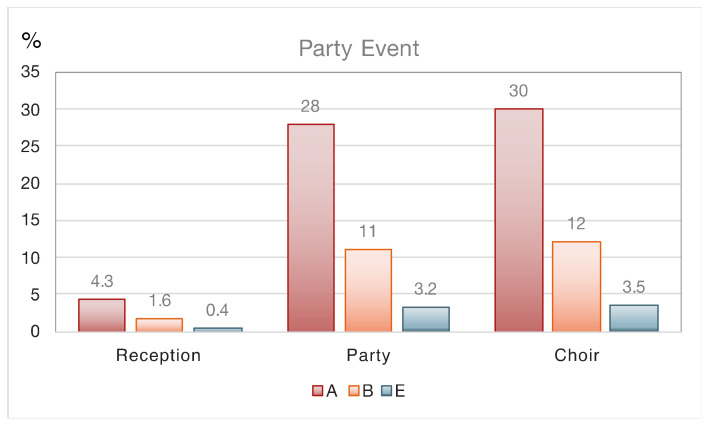
The role of aerosolized SARS-CoV-2 viruses in airborne transmission of COVID-19 has been debated. The aerosols are transmitted through breathing and vocalization by infectious subjects. Some authors state that this represents the dominant route of spreading, while others dismiss the option. Here we present an adjustable algorithm to estimate the infection risk for different indoor environments, constrained by published data of human aerosol emissions, SARS-CoV-2 viral loads, infective dose and other parameters. We evaluate typical indoor settings such as an office, a classroom, choir practice, and a reception/party. Our results suggest that aerosols from highly infective subjects can effectively transmit COVID-19 in indoor environments. This "highly infective" category represents approximately 20% of the patients who tested positive for SARS-CoV-2. We find that "super infective" subjects, representing the top 5-10% of subjects with a positive test, plus an unknown fraction of less-but still highly infective, high aerosol-emitting subjects-may cause COVID-19 clusters (>10 infections). In general, active room ventilation and the ubiquitous wearing of face masks (i.e., by all subjects) may reduce the individual infection risk by a factor of five to ten, similar to high-volume, high-efficiency particulate air (HEPA) filtering. A particularly effective mitigation measure is the use of high-quality masks, which can drastically reduce the indoor infection risk through aerosols.
病毒气溶胶在 COVID-19 空气传播中的作用一直存在争议。气溶胶通过感染主体的呼吸和发声传播。一些作者指出,这是主要的传播途径,而另一些作者则否认了这一途径。在这里,我们提出了一种可调节的算法,用于根据已发表的人类气溶胶排放、SARS-CoV-2 病毒载量、感染剂量和其他参数来估计不同室内环境的感染风险。我们评估了典型的室内环境,如办公室、教室、合唱团练习和接待/聚会。我们的结果表明,高传染性主体的气溶胶可以在室内环境中有效地传播 COVID-19。这个“高传染性”类别代表了大约 20%的 SARS-CoV-2 检测呈阳性的患者。我们发现,“超级传染者”,即检测呈阳性的前 5-10%的主体,加上未知比例的传染性较低但仍较高、气溶胶排放量较大的主体,可能会导致 COVID-19 集群(>10 例感染)。一般来说,积极的室内通风和普遍佩戴口罩(即所有主体都佩戴)可以将个体感染风险降低五到十倍,类似于大容量、高效率空气(HEPA)过滤。一种特别有效的缓解措施是使用高质量的口罩,这可以通过气溶胶大大降低室内感染风险。