• 文献检索
  • 文档翻译
  • 深度研究
  • 学术资讯
  • Suppr Zotero 插件Zotero 插件
  • 邀请有礼
  • 套餐&价格
  • 历史记录
应用&插件
Suppr Zotero 插件Zotero 插件浏览器插件Mac 客户端Windows 客户端微信小程序
定价
高级版会员购买积分包购买API积分包
服务
文献检索文档翻译深度研究API 文档MCP 服务
关于我们
关于 Suppr公司介绍联系我们用户协议隐私条款
关注我们

Suppr 超能文献

核心技术专利:CN118964589B侵权必究
粤ICP备2023148730 号-1Suppr @ 2026

文献检索

告别复杂PubMed语法,用中文像聊天一样搜索,搜遍4000万医学文献。AI智能推荐,让科研检索更轻松。

立即免费搜索

文件翻译

保留排版,准确专业,支持PDF/Word/PPT等文件格式,支持 12+语言互译。

免费翻译文档

深度研究

AI帮你快速写综述,25分钟生成高质量综述,智能提取关键信息,辅助科研写作。

立即免费体验

肝脏类器官:最新进展、局限性与潜力

Liver Organoids: Recent Developments, Limitations and Potential.

作者信息

Harrison Sean Philip, Baumgarten Saphira Felicitas, Verma Rajneesh, Lunov Oleg, Dejneka Alexandr, Sullivan Gareth John

机构信息

Hybrid Technology Hub-Center of Excellence, Institute of Basic Medical Sciences, University of Oslo, Oslo, Norway.

Department of Pediatric Research, Oslo University Hospital, Oslo, Norway.

出版信息

Front Med (Lausanne). 2021 May 5;8:574047. doi: 10.3389/fmed.2021.574047. eCollection 2021.

DOI:10.3389/fmed.2021.574047
PMID:34026769
原文链接:https://pmc.ncbi.nlm.nih.gov/articles/PMC8131532/
Abstract

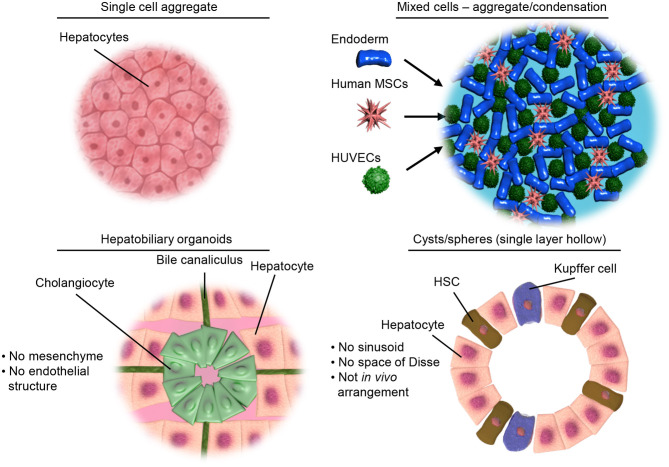
Liver cell types derived from induced pluripotent stem cells (iPSCs) share the potential to investigate development, toxicity, as well as genetic and infectious disease in ways currently limited by the availability of primary tissue. With the added advantage of patient specificity, which can play a role in all of these areas. Many iPSC differentiation protocols focus on 3 dimensional (3D) or organotypic differentiation, as these offer the advantage of more closely mimicking systems including; the formation of tissue like architecture and interactions/crosstalk between different cell types. Ultimately such models have the potential to be used clinically and either with or more aptly, in place of animal models. Along with the development of organotypic and micro-tissue models, there will be a need to co-develop imaging technologies to enable their visualization. A variety of liver models termed "organoids" have been reported in the literature ranging from simple spheres or cysts of a single cell type, usually hepatocytes, to those containing multiple cell types combined during the differentiation process such as hepatic stellate cells, endothelial cells, and mesenchymal cells, often leading to an improved hepatic phenotype. These allow specific functions or readouts to be examined such as drug metabolism, protein secretion or an improved phenotype, but because of their relative simplicity they lack the flexibility and general applicability of tissue culture. In the liver field these are more often constructed rather than developed together organotypically as seen in other organoid models such as brain, kidney, lung and intestine. Having access to organotypic liver like surrogates containing multiple cell types with like interactions/architecture, would provide vastly improved models for disease, toxicity and drug development, combining disciplines such as microfluidic chip technology with organoids and ultimately paving the way to new therapies.

摘要

源自诱导多能干细胞(iPSC)的肝细胞类型具有以目前受原代组织可用性限制的方式研究发育、毒性以及遗传和传染病的潜力。具有患者特异性这一额外优势,这在所有这些领域都能发挥作用。许多iPSC分化方案侧重于三维(3D)或器官型分化,因为这些具有更紧密模拟系统的优势,包括形成类似组织的结构以及不同细胞类型之间的相互作用/串扰。最终,此类模型有可能用于临床,并且可以与动物模型一起使用,或者更恰当地替代动物模型。随着器官型和微组织模型的发展,将需要共同开发成像技术以实现其可视化。文献中报道了多种被称为“类器官”的肝脏模型,从单一细胞类型(通常是肝细胞)的简单球体或囊肿到在分化过程中包含多种组合细胞类型(如肝星状细胞、内皮细胞和间充质细胞)的模型,这通常会导致改善的肝脏表型。这些模型允许检查特定功能或读数,如药物代谢、蛋白质分泌或改善的表型,但由于其相对简单性,它们缺乏组织培养的灵活性和普遍适用性。在肝脏领域,这些模型更多是构建而成,而不是像在脑、肾、肺和肠等其他类器官模型中那样通过器官型共同发育。获得包含多种具有类似相互作用/结构的细胞类型的器官型肝脏替代物,将为疾病、毒性和药物开发提供大大改进的模型,将微流控芯片技术等学科与类器官相结合,最终为新疗法铺平道路。
https://cdn.ncbi.nlm.nih.gov/pmc/blobs/2589/8131532/829bd9a9637b/fmed-08-574047-g0002.jpg
https://cdn.ncbi.nlm.nih.gov/pmc/blobs/2589/8131532/b26afc7467b3/fmed-08-574047-g0001.jpg
https://cdn.ncbi.nlm.nih.gov/pmc/blobs/2589/8131532/829bd9a9637b/fmed-08-574047-g0002.jpg
https://cdn.ncbi.nlm.nih.gov/pmc/blobs/2589/8131532/b26afc7467b3/fmed-08-574047-g0001.jpg
https://cdn.ncbi.nlm.nih.gov/pmc/blobs/2589/8131532/829bd9a9637b/fmed-08-574047-g0002.jpg

相似文献

1
Liver Organoids: Recent Developments, Limitations and Potential.肝脏类器官:最新进展、局限性与潜力
Front Med (Lausanne). 2021 May 5;8:574047. doi: 10.3389/fmed.2021.574047. eCollection 2021.
2
Generation of human liver organoids from pluripotent stem cell-derived hepatic endoderms.从多能干细胞衍生的肝内胚层生成人肝脏类器官。
PeerJ. 2020 Oct 19;8:e9968. doi: 10.7717/peerj.9968. eCollection 2020.
3
Generation of expandable human pluripotent stem cell-derived hepatocyte-like liver organoids.扩增型人多能干细胞来源的肝样类器官的生成。
J Hepatol. 2019 Nov;71(5):970-985. doi: 10.1016/j.jhep.2019.06.030. Epub 2019 Jul 9.
4
Liver Organoids: Formation Strategies and Biomedical Applications.肝类器官:形成策略与生物医学应用
Tissue Eng Regen Med. 2021 Aug;18(4):573-585. doi: 10.1007/s13770-021-00357-w. Epub 2021 Jun 16.
5
Generation of human induced pluripotent stem cell-derived liver buds with chemically defined and animal origin-free media.使用化学成分确定且无动物来源的培养基生成人诱导多能干细胞源性肝芽。
Sci Rep. 2020 Oct 21;10(1):17937. doi: 10.1038/s41598-020-73908-1.
6
Generation of Complex Syngeneic Liver Organoids from Induced Pluripotent Stem Cells to Model Human Liver Pathophysiology.从诱导多能干细胞生成复杂的同基因肝类器官模型以模拟人类肝脏病理生理学。
Curr Protoc. 2022 Mar;2(3):e389. doi: 10.1002/cpz1.389.
7
Improvements in Maturity and Stability of 3D iPSC-Derived Hepatocyte-like Cell Cultures.三维诱导多能干细胞衍生的肝细胞样细胞培养物成熟度和稳定性的改善。
Cells. 2023 Sep 27;12(19):2368. doi: 10.3390/cells12192368.
8
Paracrine signals regulate human liver organoid maturation from induced pluripotent stem cells.旁分泌信号调节诱导多能干细胞来源的人肝脏类器官成熟。
Development. 2017 Mar 15;144(6):1056-1064. doi: 10.1242/dev.142794.
9
Pluripotent stem cell-derived kidney organoids: An in vivo-like in vitro technology.多能干细胞衍生的肾脏类器官:一种类似体内环境的体外技术。
Eur J Pharmacol. 2016 Nov 5;790:12-20. doi: 10.1016/j.ejphar.2016.06.059. Epub 2016 Jul 1.
10
Do not keep it simple: recent advances in the generation of complex organoids.不要简单化:复杂类器官生成技术的最新进展。
J Neural Transm (Vienna). 2020 Nov;127(11):1569-1577. doi: 10.1007/s00702-020-02198-8. Epub 2020 May 8.

引用本文的文献

1
A Multi-Layered Framework for Modeling Human Biology: From Basic AI Agents to a Full-Body AI Agent.用于模拟人类生物学的多层框架:从基本人工智能代理到全身人工智能代理。
ArXiv. 2025 Aug 27:arXiv:2508.19800v1.
2
Biopolymers for Liver Tissue Engineering: A Systematic Review.用于肝组织工程的生物聚合物:系统综述
Gels. 2025 Jul 7;11(7):525. doi: 10.3390/gels11070525.
3
The 3C (Cell Culture, Computer Simulation, Clinical Trial) Solution for Optimizing the 3R (Replace, Reduction, Refine) Framework during Preclinical Research Involving Laboratory Animals.

本文引用的文献

1
Scalable production of tissue-like vascularized liver organoids from human PSCs.从人多能干细胞规模化生产类组织血管化的肝类器官。
Exp Mol Med. 2023 Sep;55(9):2005-2024. doi: 10.1038/s12276-023-01074-1. Epub 2023 Sep 1.
2
Characterizing the reproducibility in using a liver microphysiological system for assaying drug toxicity, metabolism, and accumulation.描述使用肝微生理系统测定药物毒性、代谢和积累的可重复性。
Clin Transl Sci. 2021 May;14(3):1049-1061. doi: 10.1111/cts.12969. Epub 2021 Apr 3.
3
Organoids to model liver disease.用于模拟肝脏疾病的类器官。
在涉及实验动物的临床前研究中优化3R(替代、减少、优化)框架的3C(细胞培养、计算机模拟、临床试验)解决方案。
ACS Pharmacol Transl Sci. 2025 Apr 9;8(5):1188-1204. doi: 10.1021/acsptsci.4c00661. eCollection 2025 May 9.
4
iPSC-Derived Liver Organoids as a Tool to Study Medium Chain Acyl-CoA Dehydrogenase Deficiency.诱导多能干细胞衍生的肝类器官作为研究中链酰基辅酶A脱氢酶缺乏症的工具
J Inherit Metab Dis. 2025 May;48(3):e70028. doi: 10.1002/jimd.70028.
5
Organoids-on-a-chip: microfluidic technology enables culture of organoids with enhanced tissue function and potential for disease modeling.芯片上的类器官:微流控技术可实现具有增强组织功能和疾病建模潜力的类器官培养。
Front Bioeng Biotechnol. 2025 Mar 11;13:1515340. doi: 10.3389/fbioe.2025.1515340. eCollection 2025.
6
Assessing fitness costs in malaria parasites: a comprehensive review and implications for drug resistance management.评估疟原虫的适合度代价:全面综述及对耐药性管理的启示
Malar J. 2025 Mar 1;24(1):65. doi: 10.1186/s12936-025-05286-w.
7
An original donor-dependent spheroid system for the prediction of idiosyncratic drug-induced liver injury risk.一种用于预测特异质性药物性肝损伤风险的原始供体依赖性球体系统。
In Vitro Model. 2023 Aug 15;2(6):281-295. doi: 10.1007/s44164-023-00057-w. eCollection 2023 Dec.
8
High-throughput platform for label-free sorting of 3D spheroids using deep learning.利用深度学习对三维球体进行无标记分选的高通量平台。
Front Bioeng Biotechnol. 2024 Dec 9;12:1432737. doi: 10.3389/fbioe.2024.1432737. eCollection 2024.
9
A platform for multimodal pooled genetic screens reveals regulators of liver function.一个用于多模态汇集基因筛选的平台揭示了肝功能的调节因子。
bioRxiv. 2025 Feb 17:2024.11.18.624217. doi: 10.1101/2024.11.18.624217.
10
Ex Vivo Tools and Models in MASLD Research.MASLD 研究中的离体工具和模型。
Cells. 2024 Nov 5;13(22):1827. doi: 10.3390/cells13221827.
JHEP Rep. 2020 Oct 22;3(1):100198. doi: 10.1016/j.jhepr.2020.100198. eCollection 2021 Feb.
4
Amino acid levels determine metabolism and CYP450 function of hepatocytes and hepatoma cell lines.氨基酸水平决定肝细胞和肝癌细胞株的代谢和 CYP450 功能。
Nat Commun. 2020 Mar 13;11(1):1393. doi: 10.1038/s41467-020-15058-6.
5
Fast and efficient generation of knock-in human organoids using homology-independent CRISPR-Cas9 precision genome editing.利用同源非依赖的 CRISPR-Cas9 精准基因组编辑技术快速有效地生成基因敲入人类类器官。
Nat Cell Biol. 2020 Mar;22(3):321-331. doi: 10.1038/s41556-020-0472-5. Epub 2020 Mar 2.
6
MINFLUX nanoscopy delivers 3D multicolor nanometer resolution in cells.MINFLUX 纳米显微镜可在细胞中实现 3D 多色纳米分辨率。
Nat Methods. 2020 Feb;17(2):217-224. doi: 10.1038/s41592-019-0688-0. Epub 2020 Jan 13.
7
Light-induced modulation of the mitochondrial respiratory chain activity: possibilities and limitations.光诱导的线粒体呼吸链活性调节:可能性和局限性。
Cell Mol Life Sci. 2020 Jul;77(14):2815-2838. doi: 10.1007/s00018-019-03321-z. Epub 2019 Oct 3.
8
Modelling human hepato-biliary-pancreatic organogenesis from the foregut-midgut boundary.从前肠-中肠交界处模拟人类肝胆胰发生。
Nature. 2019 Oct;574(7776):112-116. doi: 10.1038/s41586-019-1598-0. Epub 2019 Sep 25.
9
3D cell culture models and organ-on-a-chip: Meet separation science and mass spectrometry.3D 细胞培养模型和器官芯片:迎接分离科学和质谱分析。
Electrophoresis. 2020 Jan;41(1-2):56-64. doi: 10.1002/elps.201900170. Epub 2019 Sep 30.
10
Fast 3-D Imaging of Brain Organoids With a New Single-Objective Planar-Illumination Two-Photon Microscope.使用新型单物镜平面照明双光子显微镜对脑类器官进行快速三维成像
Front Neuroanat. 2019 Aug 20;13:77. doi: 10.3389/fnana.2019.00077. eCollection 2019.