Smart Lisa, Hughes Dez
School of Veterinary Medicine, College of Science, Health, Engineering and Education, Murdoch University, Murdoch, WA, Australia.
Department of Veterinary Clinical Sciences, Faculty of Veterinary and Agricultural Sciences, Melbourne Veterinary School, Werribee, VIC, Australia.
Front Vet Sci. 2021 May 7;8:661660. doi: 10.3389/fvets.2021.661660. eCollection 2021.
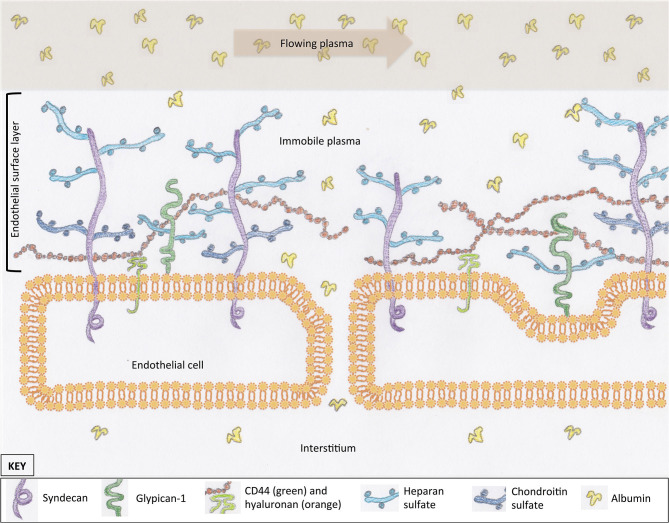
The goal of resuscitative fluid therapy is to rapidly expand circulating blood volume in order to restore tissue perfusion. Although this therapy often serves to improve macrohemodynamic parameters, it can be associated with adverse effects on the microcirculation and endothelium. The endothelial surface layer (ESL) provides a protective barrier over the endothelium and is important for regulating transvascular fluid movement, vasomotor tone, coagulation, and inflammation. Shedding or thinning of the ESL can promote interstitial edema and inflammation and may cause microcirculatory dysfunction. The pathophysiologic perturbations of critical illness and rapid, large-volume fluid therapy both cause shedding or thinning of the ESL. Research suggests that restricting the volume of crystalloid, or "clear" fluid, may preserve some ESL integrity and improve outcome based on animal experimental models and preliminary clinical trials in people. This narrative review critically evaluates the evidence for the detrimental effects of resuscitative fluid therapy on the ESL and provides suggestions for future research directions in this field.
复苏性液体疗法的目标是迅速扩充循环血容量,以恢复组织灌注。尽管这种疗法通常有助于改善宏观血流动力学参数,但它可能会对微循环和内皮产生不良影响。内皮表面层(ESL)在内皮上方提供了一层保护屏障,对于调节跨血管液体移动、血管舒缩张力、凝血和炎症至关重要。ESL的脱落或变薄会促进间质水肿和炎症,并可能导致微循环功能障碍。危重病的病理生理紊乱以及快速、大量的液体疗法都会导致ESL的脱落或变薄。基于动物实验模型和人体初步临床试验,研究表明限制晶体液(即“清亮”液体)的用量可能会保持ESL的一些完整性并改善预后。这篇叙述性综述批判性地评估了复苏性液体疗法对ESL产生有害影响的证据,并为该领域未来的研究方向提供了建议。