Department of Plant Breeding and Genetics, The University of Haripur 22620, Khyber, Pakhtunkhwa, Pakistan.
College of Life Sciences, Yan'an University, Yan'an, Shaanxi, China.
GM Crops Food. 2021 Dec 31;12(2):627-646. doi: 10.1080/21645698.2021.1921545. Epub 2021 May 25.
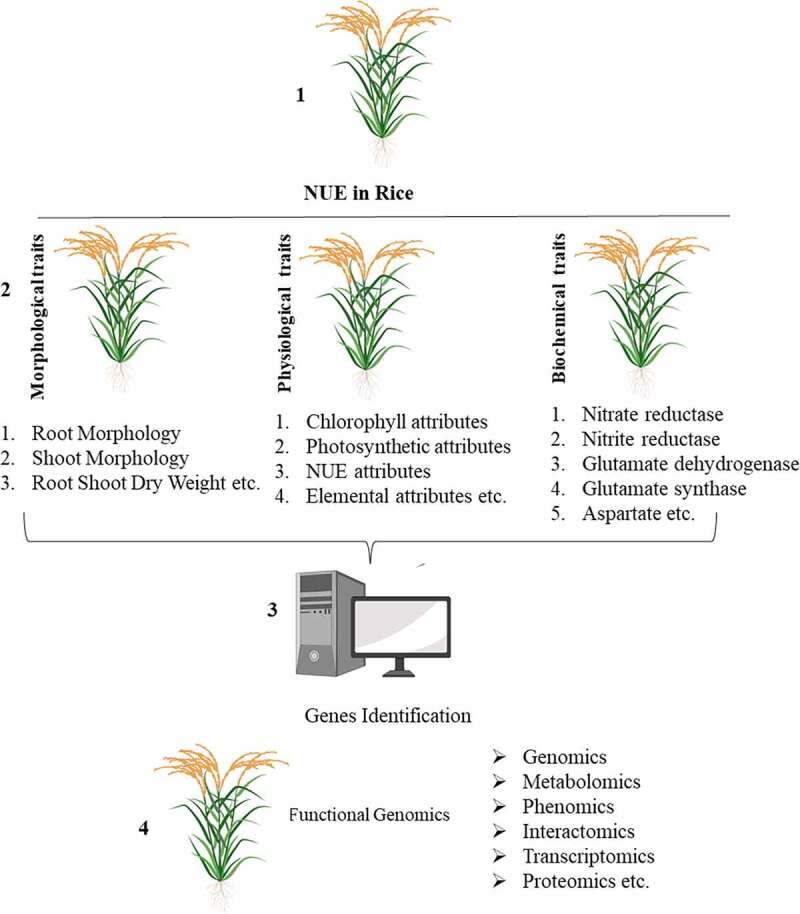
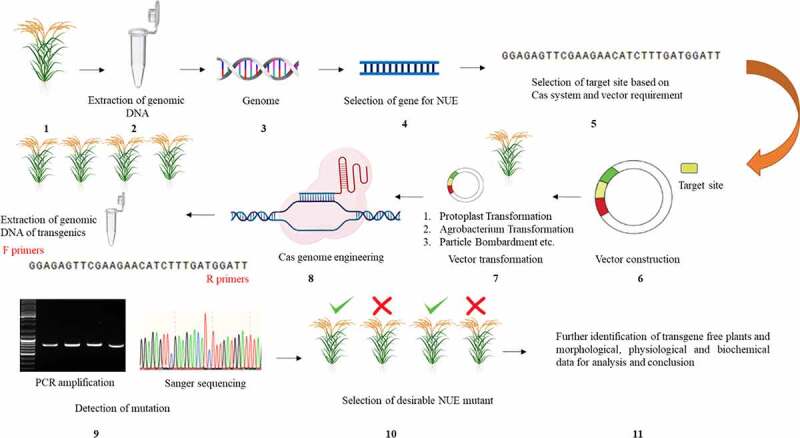
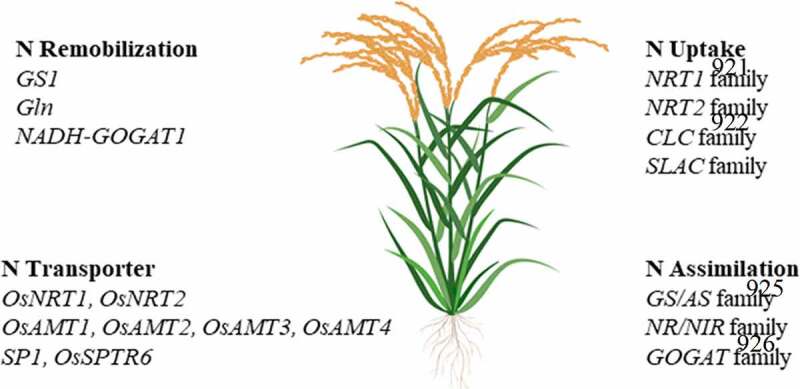
Recently, there has been a remarkable increase in rice production owing to genetic improvement and increase in application of synthetic fertilizers. For sustainable agriculture, there is dire need to maintain a balance between profitability and input cost. To meet the steady growing demands of the farming community, researchers are utilizing all available resources to identify nutrient use efficient germplasm, but with very little success. Therefore, it is essential to understand the underlying genetic mechanism controlling nutrients efficiency, with the nitrogen use efficiency (NUE) being the most important trait. Information regarding genetic factors controlling nitrogen (N) transporters, assimilators, and remobilizers can help to identify candidate germplasms via high-throughput technologies. Large-scale field trials have provided morphological, physiological, and biochemical trait data for the detection of genomic regions controlling NUE. The functional aspects of these attributes are time-consuming, costly, labor-intensive, and less accurate. Therefore, the application of novel plant breeding techniques (NPBTs) with context to genome engineering has opened new avenues of research for crop improvement programs. Most recently, genome editing technologies (GETs) have undergone enormous development with various versions from Cas9, Cpf1, base, and prime editing. These GETs have been vigorously adapted in plant sciences for novel trait development to insure food quantity and quality. Base editing has been successfully applied to improve NUE in rice, demonstrating the potential of GETs to develop germplasms with improved resource use efficiency. NPBTs continue to face regulatory setbacks in some countries due to genome editing being categorized in the same category as genetically modified (GM) crops. Therefore, it is essential to involve all stakeholders in a detailed discussion on NPBTs and to formulate uniform policies tackling biosafety, social, ethical, and environmental concerns. In the current review, we have discussed the genetic mechanism of NUE and NPBTs for crop improvement programs with proof of concepts, transgenic and GET application for the development of NUE germplasms, and regulatory aspects of genome edited crops with future directions considering NUE.
最近,由于遗传改良和合成肥料应用的增加,水稻产量有了显著提高。为了可持续农业,迫切需要在盈利能力和投入成本之间保持平衡。为了满足不断增长的农业社区的需求,研究人员正在利用所有可用资源来识别养分利用效率高的种质资源,但收效甚微。因此,了解控制养分效率的潜在遗传机制至关重要,其中氮利用效率(NUE)是最重要的性状。关于控制氮(N)转运蛋白、同化酶和再利用酶的遗传因素的信息可以通过高通量技术帮助鉴定候选种质资源。大规模田间试验为检测控制 NUE 的基因组区域提供了形态、生理和生化特性数据。这些特性的功能方面既耗时、昂贵、劳动密集,而且准确性较低。因此,新型植物育种技术(NPBTs)与基因组工程相结合的应用为作物改良计划开辟了新的研究途径。最近,基因组编辑技术(GETs)取得了巨大的发展,有各种版本的 Cas9、Cpf1、碱基和 Prime 编辑。这些 GETs 在植物科学中得到了广泛应用,用于开发新的性状,以确保粮食数量和质量。碱基编辑已成功应用于提高水稻的 NUE,这表明 GETs 具有开发具有更高资源利用效率的种质的潜力。由于基因组编辑被归类为转基因(GM)作物,NPBTs 在一些国家继续面临监管方面的挫折。因此,必须让所有利益相关者参与到 NPBTs 的详细讨论中,并制定统一的政策来解决生物安全、社会、伦理和环境问题。在当前的综述中,我们讨论了 NUE 的遗传机制和用于作物改良计划的 NPBTs,包括概念验证、转基因和 GET 应用于开发 NUE 种质资源,以及考虑到 NUE 的基因组编辑作物的监管方面。