Department of Internal Medicine, Hebei Medical University, Shijiazhuang, Hebei, China.
Department of Endocrinology, Hebei General Hospital, 348, Heping West Road, Shijiazhuang, Hebei, 050051, People's Republic of China.
Lipids Health Dis. 2021 May 25;20(1):54. doi: 10.1186/s12944-021-01483-z.
Nonalcoholic fatty liver disease (NAFLD) has become one of the most common chronic liver diseases worldwide. Triglyceride (TG) accumulation is central to NAFLD development. People now spend most of their day in the postprandial state, and the measurement of postprandial blood lipid concentration can make up for the lack of simple detection of fasting blood lipids. Postprandial triglyceride (PTG) is commonly used as a surrogate for postprandial blood lipid concentrations, and many studies have shown that PTG is a risk factor for NAFLD. The aim of the present study was to investigate the relationship between PTG concentration during oral fat tolerance testing (OFTT) and NAFLD.
A total of 472 Chinese adults, aged 25 to 65 years, were enrolled in the study. All the participants underwent OFTT. The serum concentrations of TG and other lipids were measured, and their relationships with NAFLD were analyzed.
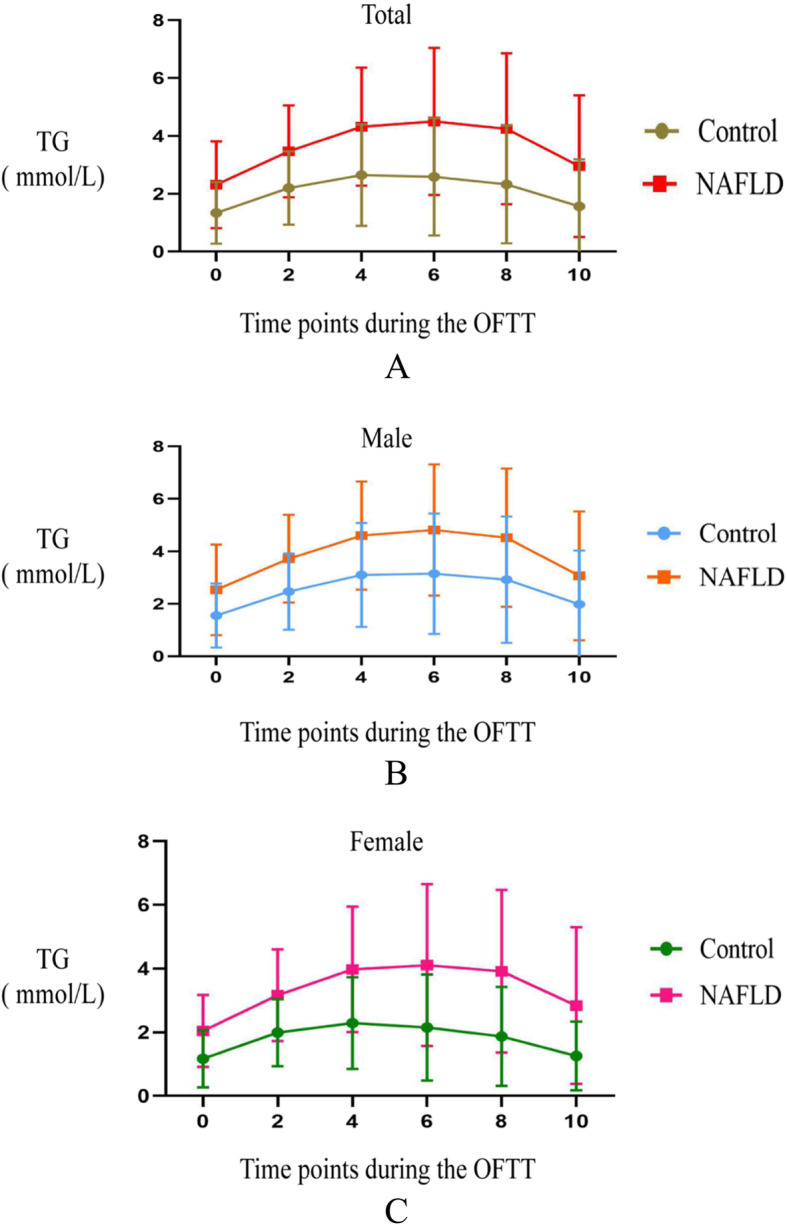
Of the 472 participants, 155 were diagnosed with NAFLD. The fasting and postprandial TG concentrations of the participants with NAFLD were higher than those of healthy participants (P < 0.05). The TG concentrations of the healthy participants peaked 4 h postprandially, whereas those of the participants with NAFLD peaked 6 h postprandially and reached higher peak values. Postprandial TG concentration was significantly associated with a higher risk of NAFLD.
High PTG is positively related to a higher risk of NAFLD, and the PTG concentrations of patients with NAFLD are higher than in healthy individuals, with a delayed peak. Therefore, 4-h PTG may represent a potential marker of NAFLD.
ChiCTR1800019514 .
非酒精性脂肪性肝病(NAFLD)已成为全球最常见的慢性肝病之一。甘油三酯(TG)积聚是 NAFLD 发展的核心。人们现在一天中的大部分时间都处于餐后状态,餐后血脂浓度的测量可以弥补单纯检测空腹血脂的不足。餐后甘油三酯(PTG)通常用作餐后血脂浓度的替代物,许多研究表明 PTG 是 NAFLD 的一个危险因素。本研究旨在探讨口服脂肪耐量试验(OFTT)中 PTG 浓度与 NAFLD 之间的关系。
共纳入 472 名年龄在 25 至 65 岁之间的中国成年人进行 OFTT。检测所有参与者的血清 TG 和其他脂质浓度,并分析其与 NAFLD 的关系。
在 472 名参与者中,有 155 人被诊断为 NAFLD。NAFLD 患者的空腹和餐后 TG 浓度高于健康对照组(P<0.05)。健康对照组的 TG 浓度在餐后 4 小时达到峰值,而 NAFLD 组在餐后 6 小时达到峰值,且峰值更高。餐后 TG 浓度与 NAFLD 的高风险显著相关。
高 PTG 与 NAFLD 的高风险呈正相关,NAFLD 患者的 PTG 浓度高于健康个体,且峰值延迟。因此,4 小时 PTG 可能是 NAFLD 的潜在标志物。
ChiCTR1800019514。