Institut de Neurosciences des Systèmes, Université Aix-Marseille, Institut ational de la Santé et de la Recherche Médicale Unité Mixte de Recherche 1106, Marseille F-13005, France
Rotman Research Institute, Baycrest Centre, Toronto, Ontario M6A 2E1, Canada.
eNeuro. 2021 Jul 6;8(4). doi: 10.1523/ENEURO.0475-20.2021. Print 2021 Jul-Aug.
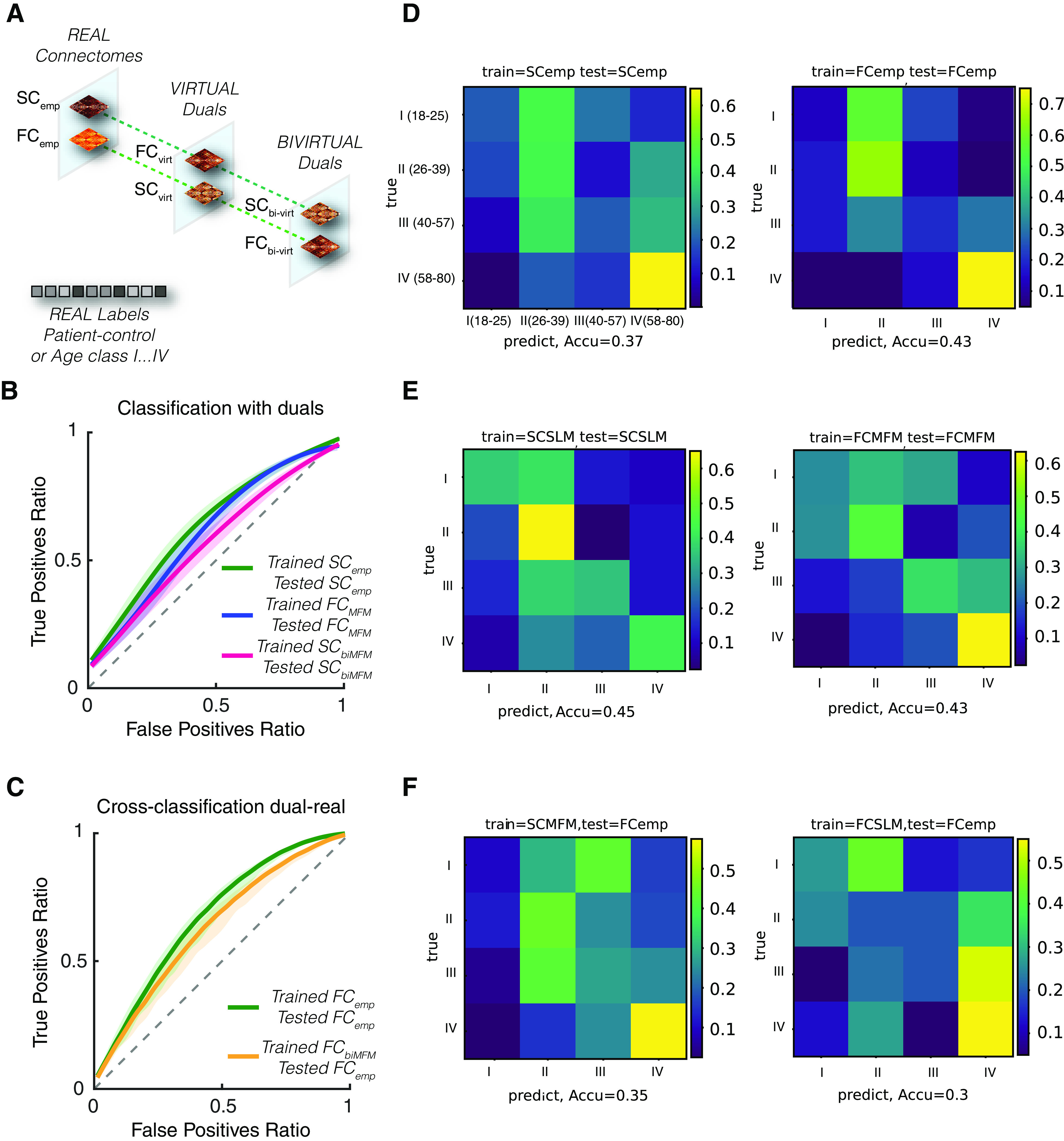
Large neuroimaging datasets, including information about structural connectivity (SC) and functional connectivity (FC), play an increasingly important role in clinical research, where they guide the design of algorithms for automated stratification, diagnosis or prediction. A major obstacle is, however, the problem of missing features [e.g., lack of concurrent DTI SC and resting-state functional magnetic resonance imaging (rsfMRI) FC measurements for many of the subjects]. We propose here to address the missing connectivity features problem by introducing strategies based on computational whole-brain network modeling. Using two datasets, the Alzheimer's Disease Neuroimaging Initiative (ADNI) dataset and a healthy aging dataset, for proof-of-concept, we demonstrate the feasibility of virtual data completion (i.e., inferring "virtual FC" from empirical SC or "virtual SC" from empirical FC), by using self-consistent simulations of linear and nonlinear brain network models. Furthermore, by performing machine learning classification (to separate age classes or control from patient subjects), we show that algorithms trained on virtual connectomes achieve discrimination performance comparable to when trained on actual empirical data; similarly, algorithms trained on virtual connectomes can be used to successfully classify novel empirical connectomes. Completion algorithms can be combined and reiterated to generate realistic surrogate connectivity matrices in arbitrarily large number, opening the way to the generation of virtual connectomic datasets with network connectivity information comparable to the one of the original data.
大型神经影像学数据集,包括结构连接(SC)和功能连接(FC)的信息,在临床研究中起着越来越重要的作用,它们为自动化分层、诊断或预测算法的设计提供了指导。然而,一个主要的障碍是特征缺失的问题[例如,对于许多受试者,缺乏同时的 DTI SC 和静息态功能磁共振成像(rsfMRI)FC 测量]。在这里,我们建议通过引入基于计算全脑网络建模的策略来解决缺失连接特征的问题。使用两个数据集,即阿尔茨海默病神经影像学倡议(ADNI)数据集和健康老龄化数据集,作为概念验证,我们通过使用线性和非线性脑网络模型的自洽模拟,展示了虚拟数据完成(即,从经验 SC 推断“虚拟 FC”或从经验 FC 推断“虚拟 SC”)的可行性。此外,通过进行机器学习分类(以分离年龄类别或控制组与患者),我们表明,在虚拟连接图上训练的算法可以实现与在实际经验数据上训练的算法相当的区分性能;同样,在虚拟连接图上训练的算法可以用于成功地对新的经验连接图进行分类。完成算法可以组合和重复使用,以生成任意数量的现实替代连接矩阵,为生成具有与原始数据可比的网络连接信息的虚拟连接组学数据集开辟了道路。