Qin Jiayuan, Feng Yu, Lü Xiaoju, Zong Zhiyong
Center of Infectious Diseases, West China Hospital, Sichuan University, Chengdu, Sichuan, China.
Division of Infectious Diseases, State Key Laboratory of Biotherapy, Chengdu, Sichuan, China.
mSystems. 2021 Jun 29;6(3):e0023721. doi: 10.1128/mSystems.00237-21. Epub 2021 May 26.
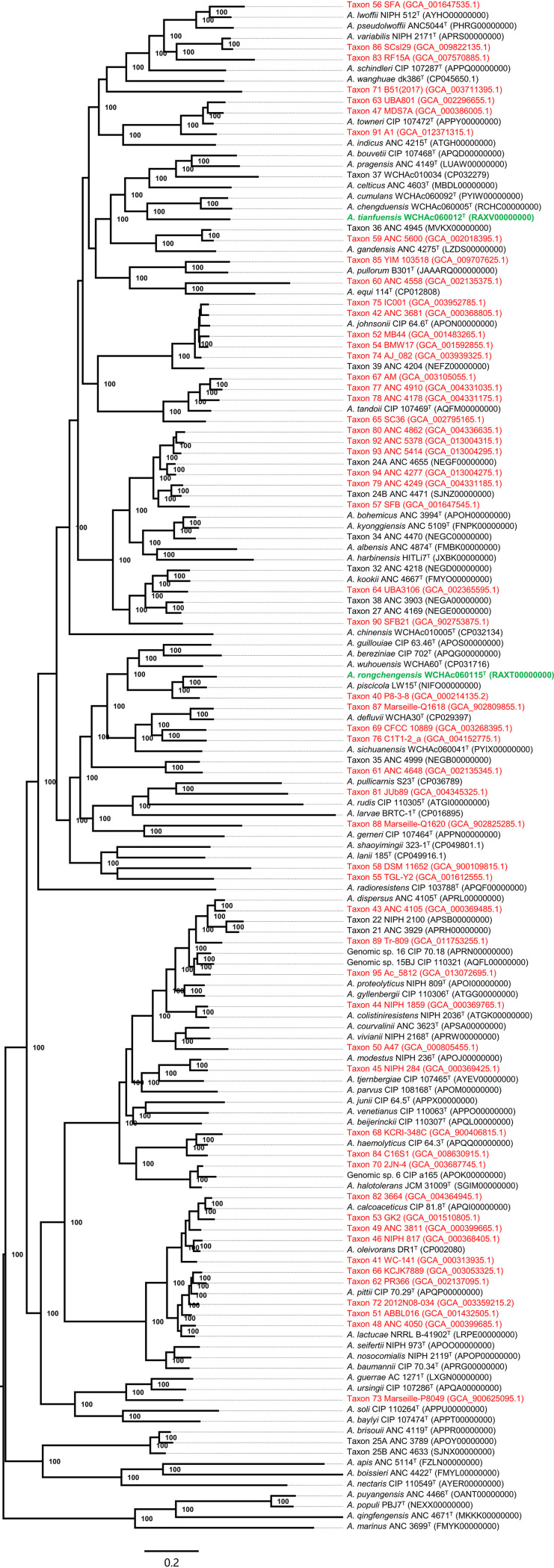
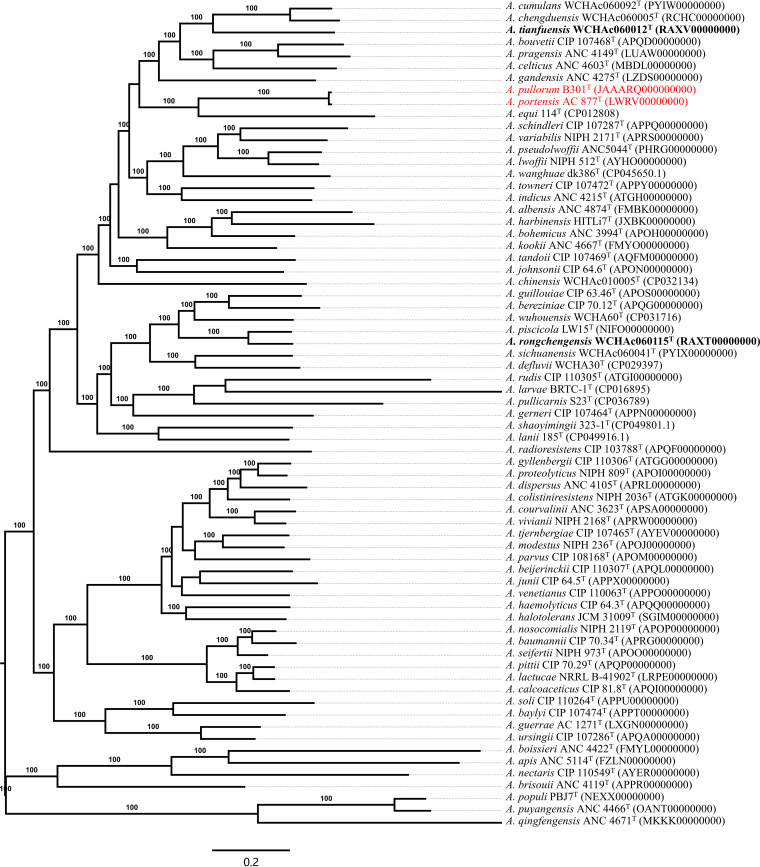
The genus Acinetobacter comprises species with ecological significance and opportunistic pathogens and has a complicated taxonomy. Precise species identification is a foundation for understanding bacteria. In this study, we found and characterized two novel Acinetobacter species, namely, Acinetobacter tianfuensis sp. nov. and Acinetobacter rongchengensis sp. nov., based on phenotype examinations and genome analyses of the two strains WCHAc060012 and WCHAc060115. The two strains had ≤89.69% (mean, 79.28% or 79.72%) average nucleotide identity (ANI) and ≤36.4% (mean, 20.89% or 22.19%) DNA-DNA hybridization (DDH) values compared with each other and all known Acinetobacter species. Both species can be differentiated from all hitherto known Acinetobacter species by a combination of phenotypic characteristics. We found that Acinetobacter pullorum B301 and Acinetobacter portensis AC 877 are actually the same species with 98.59% ANI and 90.4% DDH values. We then applied the updated taxonomy to curate 3,956 Acinetobacter genomes in GenBank and found that 6% of Acinetobacter genomes ( = 234) are required to be corrected or updated. We identified 56 novel tentative Acinetobacter species, extending the number of Acinetobacter species to 144, including 68 with species names and 76 unnamed taxa. We also found that ANI and the average amino acid identity (AAI) values among type or reference strains of all Acinetobacter species and taxa are ≥76.97% and ≥66.5%, respectively, which are higher than the proposed cutoffs to define the genus boundary. This study highlights the complex taxonomy of Acinetobacter as a single genus and the paramount importance of precise species identification. The newly identified unnamed taxa warrant further studies. Acinetobacter species are widely distributed in nature and are of important ecological significance and clinical relevance. In this study, first, we significantly update the taxonomy of Acinetobacter by reporting two novel Acinetobacter species, namely, Acinetobacter tianfuensis and Acinetobacter rongchengensis, and by identifying Acinetobacter portensis as a synonym of Acinetobacter pullorum. Second, we curated Acinetobacter genome sequences deposited in GenBank ( = 3,956) using the updated taxonomy by correcting species assignations for 6% ( = 234) genomes and by assigning 94 (2.4%) to 56 previously unknown tentative species (taxa). Therefore, after curation, we further update the genus Acinetobacter to comprise 144 species, including 68 with species names and 76 unnamed taxa. Third, we addressed the question of whether such a large number of species should be divided in different genera and found that Acinetobacter is indeed a single genus. Our study significantly advanced the taxonomy of Acinetobacter, an important genus with science and health implications.
不动杆菌属包括具有生态意义的物种和机会致病菌,其分类学较为复杂。准确的物种鉴定是了解细菌的基础。在本研究中,基于两株菌株WCHAc060012和WCHAc060115的表型检测和基因组分析,我们发现并鉴定了两个新型不动杆菌物种,即天府不动杆菌(Acinetobacter tianfuensis sp. nov.)和荣成不动杆菌(Acinetobacter rongchengensis sp. nov.)。与彼此以及所有已知不动杆菌物种相比,这两株菌株的平均核苷酸同一性(ANI)≤89.69%(平均值为79.28%或79.72%),DNA-DNA杂交(DDH)值≤36.4%(平均值为20.89%或22.19%)。通过表型特征的组合,这两个物种均可与所有迄今已知的不动杆菌物种区分开来。我们发现鸡拉不动杆菌B301(Acinetobacter pullorum B301)和波氏不动杆菌AC 877(Acinetobacter portensis AC 877)实际上是同一物种,其ANI值为98.59%,DDH值为90.4%。然后,我们应用更新后的分类法整理了GenBank中3956个不动杆菌基因组,发现6%(=234个)的不动杆菌基因组需要校正或更新。我们鉴定出56个新型暂定不动杆菌物种,使不动杆菌物种数量增加到144个,其中包括68个有物种名称的和76个未命名的分类单元。我们还发现,所有不动杆菌物种和分类单元的模式菌株或参考菌株之间的ANI值和平均氨基酸同一性(AAI)值分别≥76.97%和≥66.5%,高于提议的界定属界限的阈值。本研究突出了不动杆菌作为一个单一属的复杂分类学以及准确物种鉴定的至关重要性。新鉴定出的未命名分类单元值得进一步研究。不动杆菌物种在自然界中广泛分布,具有重要的生态意义和临床相关性。在本研究中,首先,我们通过报道两个新型不动杆菌物种,即天府不动杆菌和荣成不动杆菌,并将波氏不动杆菌鉴定为鸡拉不动杆菌的同义词,显著更新了不动杆菌的分类学。其次,我们使用更新后的分类法整理了GenBank中存放的不动杆菌基因组序列(=3956个),对6%(=234个)的基因组进行了物种归属校正,并将94个(2.4%)基因组归为56个先前未知的暂定物种(分类单元)。因此,整理后,我们进一步更新了不动杆菌属,使其包含144个物种,其中包括68个有物种名称的和76个未命名的分类单元。第三,我们解决了是否应将如此多的物种划分到不同属中的问题,发现不动杆菌确实是一个单一属。我们的研究显著推进了不动杆菌的分类学,不动杆菌属是一个对科学和健康具有重要意义的属。