Department of Gynaecology and Obstetrics, Aarhus University Hospital, Aarhus N, Denmark.
Department of Public Health Programmes, Randers Regional Hospital, Randers NO, Denmark.
PLoS One. 2021 Jun 1;16(6):e0250816. doi: 10.1371/journal.pone.0250816. eCollection 2021.
Cervical cancer screening (CCS) and human papillomavirus vaccination (HPVV) are effective measures against cervical cancer (CC). Attendance in HPVV and CCS provides the greatest protection, while combined non-attendance in HPVV and CCS provides little to no protection. It is hence concerning that some large ethnic minority groups show considerably lower HPVV and CCS attendance than other women-especially women from Middle-Eastern and North African (MENA) countries and Pakistan. Little is, however, known about the reasons for this low combined attendance pattern n.
To explore perceptions of and barriers to HPVV and CCS, among MENA and Pakistani women in Denmark.
Focus group interviews were conducted. Data was transcribed verbatim, and analysed using systematic text condensation.
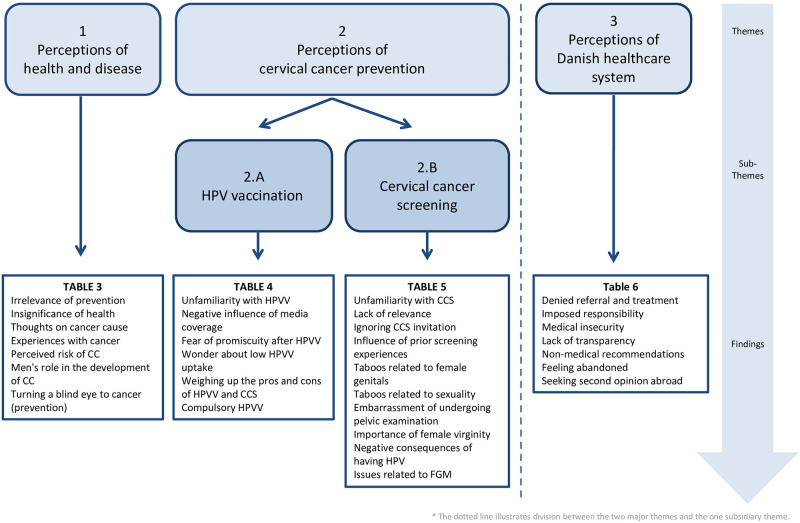
Seventeen long-term resident women originating from six major MENA countries and Pakistan were included. Mean age was 36 years. We found that these women, across different age groups and descent, had sparse knowledge and understanding about CC, and their perceived relevance of disease prevention was low. Compared to HPVV, their barriers to CCS were more fixed and often linked to socio-cultural factors such as taboos related to female genitals and sexuality. Moreover, they presented unmet expectations and signs of mistrust in the healthcare system. However, at the end of the interviews, participants became more attentive toward CC prevention, particularly toward HPVV.
Elements of insufficient knowledge and understanding of CC and its prevention were found among a group of MENA and Pakistani women. Their socio-cultural background further represents a barrier particularly towards CCS. Additionally, negative experiences and unmet expectations lessen their trust in the healthcare system. All of which underlines the need for new tailored CC preventive strategies for this group. Based on our findings we suggest that future studies develop and evaluate interventions aiming to improve HPVV and CCS, including user-involvement.
宫颈癌筛查(CCS)和人乳头瘤病毒疫苗接种(HPV)是预防宫颈癌(CC)的有效措施。接种 HPV 和 CCS 可提供最大的保护,而同时不接种 HPV 和 CCS 则几乎没有保护作用。因此,一些大型少数民族群体的 HPV 和 CCS 接种率明显低于其他女性,尤其是来自中东和北非(MENA)国家和巴基斯坦的女性,这令人担忧。然而,对于这种低联合接种模式的原因知之甚少。
探讨丹麦 MENA 和巴基斯坦女性对 HPV 和 CCS 的看法和障碍。
进行焦点小组访谈。数据逐字转录,并使用系统文本浓缩进行分析。
纳入了来自六个主要 MENA 国家和巴基斯坦的 17 名长期居住的女性。平均年龄为 36 岁。我们发现,这些女性来自不同的年龄组和血统,对 CC 的了解和认识甚少,对疾病预防的相关性认识较低。与 HPV 相比,她们对 CCS 的障碍更加固定,并且常常与社会文化因素有关,例如与女性生殖器和性有关的禁忌。此外,她们对医疗保健系统表现出未满足的期望和不信任的迹象。然而,在访谈结束时,参与者对 CC 预防,特别是对 HPV 的预防更加关注。
在一组 MENA 和巴基斯坦女性中发现了对 CC 及其预防的了解和认识不足的因素。她们的社会文化背景尤其构成了对 CCS 的障碍。此外,负面的经历和未满足的期望削弱了她们对医疗保健系统的信任。所有这些都强调了为这一群体制定新的针对性的 CC 预防策略的必要性。基于我们的发现,我们建议未来的研究开发和评估旨在提高 HPV 和 CCS 的干预措施,包括用户参与。