Center for Indonesia's Strategic Development Initiatives (CISDI), Jakarta 10350, Indonesia.
Centre for Health Economics & Policy Innovation, Imperial College Business School, London SW7 2AZ, UK.
Int J Environ Res Public Health. 2021 May 11;18(10):5048. doi: 10.3390/ijerph18105048.
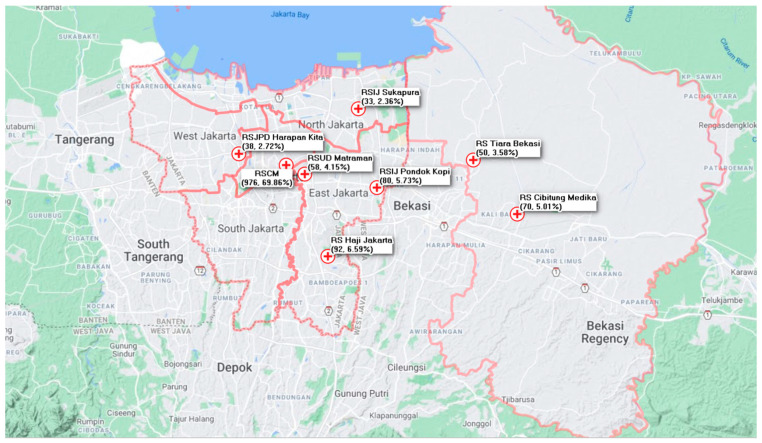
(1) Background: because of close contacts with COVID-19 patients, hospital workers are among the highest risk groups for infection. This study examined the socioeconomic and behavioral correlates of COVID-19 infection among hospital workers in Indonesia, the country hardest-hit by the disease in the Southeast Asia region. (2) Methods: we conducted a cross-sectional study, which collected data from 1397 hospital staff from eight hospitals in the Greater Jakarta area during April-July 2020. The data was collected using an online self-administered questionnaire and Reverse Transcription-Polymerase Chain Reaction (RT-PCR) tests. We employed descriptive statistics and adjusted and unadjusted logistic regressions to analyze the data of hospital workers as well as the subgroups of healthcare and non-healthcare workers. (3) Results: from a total of 1397 hospital staff in the study, 22 (1.6%) were infected. In terms of correlates, being a healthcare worker (adjusted odds ratio (AOR) = 8.31, 95% CI 1.27-54.54) and having a household size of more than five (AOR = 4.09, 1.02-16.43) were significantly associated with a higher risk of infection. On the other hand, those with middle- and upper-expenditure levels were shown to have a lower risk of infection (AOR = 0.06, 0.01-0.66). Behavioral factors associated with COVID-19 infection among healthcare and non-healthcare workers included knowledge of standard personal protective equipment (PPE) (AOR = 0.08, 0.01-0.54) and application of the six-step handwashing technique (AOR = 0.32, 0.12-0.83). (4) Conclusion: among hospital staff, correlates of COVID-19 infection included being a healthcare worker, household size, expenditure level, knowledge and use of PPE, and application of appropriate hand washing techniques.
(1) 背景:由于与 COVID-19 患者密切接触,医院工作人员属于感染风险最高的群体之一。本研究考察了印度尼西亚医院工作人员感染 COVID-19 的社会经济和行为因素,印度尼西亚是东南亚地区受该疾病影响最严重的国家。(2) 方法:我们进行了一项横断面研究,该研究于 2020 年 4 月至 7 月期间从大雅加达地区的 8 家医院收集了 1397 名医院工作人员的数据。数据是通过在线自我管理问卷和逆转录-聚合酶链反应(RT-PCR)测试收集的。我们采用描述性统计和调整及未调整的逻辑回归分析了医院工作人员以及医疗和非医疗工作人员的亚组数据。(3) 结果:在研究的 1397 名医院工作人员中,共有 22 人(1.6%)感染。在相关性方面,医疗工作者(调整后的优势比(AOR)=8.31,95%可信区间 1.27-54.54)和家庭规模超过五人(AOR=4.09,1.02-16.43)与更高的感染风险显著相关。另一方面,中高支出水平的人感染风险较低(AOR=0.06,0.01-0.66)。与医疗和非医疗工作者 COVID-19 感染相关的行为因素包括对标准个人防护设备(PPE)的了解(AOR=0.08,0.01-0.54)和六步洗手技术的应用(AOR=0.32,0.12-0.83)。(4) 结论:在医院工作人员中,COVID-19 感染的相关性因素包括医疗工作者、家庭规模、支出水平、PPE 的知识和使用以及适当的洗手技术的应用。