Pharmaceutical Research and Technology Institute, Kindai University, Osaka 577-8502, Japan.
Laboratory of Phytoprotection Science and Technology, Faculty of Agriculture, Kindai University, Nara 631-8505, Japan.
Int J Environ Res Public Health. 2021 May 6;18(9):4934. doi: 10.3390/ijerph18094934.
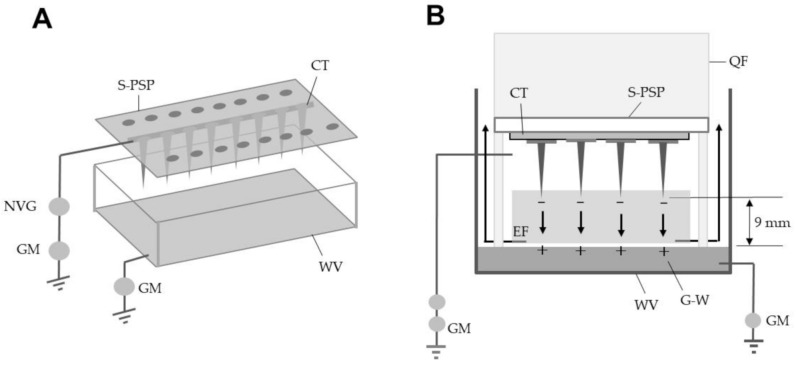
The purpose of this study was to develop a simple electrostatic apparatus to precipitate virus particles spread via droplet transmission, which is especially significant in the context of the recent coronavirus disease 2019 (COVID-19) pandemic. The bacteriophage φ6 of was used as a model of the COVID-19 virus because of its similar structure and safety in experiments. The apparatus consisted of a spiked, perforated stainless plate (S-PSP) linked to a direct-current voltage generator to supply negative charge to the spike tips and a vessel with water (G-water) linked to a ground line. The S-PSP and G-water surface were paralleled at a definite interval. Negative charge supplied to the spike tips positively polarised the G-water by electrostatic induction to form an electric field between them in which ionic wind and negative ions were generated. Bacteriophage-containing water was atomised with a nebuliser and introduced into the electric field. The mist particles were ionised by the negative ions and attracted to the opposite pole (G-water). This apparatus demonstrated a prominent ability to capture phage-containing mist particles of the same sizes as respiratory droplets and aerosols regardless of the phage concentration of the mist particles. The trapped phages were successfully sterilised using ozone bubbling. Thus, the present study provides an effective system for eliminating droplet transmission of viral pathogens from public spaces.
本研究旨在开发一种简单的静电设备,以沉淀通过飞沫传播的病毒颗粒,这在最近的 2019 年冠状病毒病(COVID-19)大流行背景下尤为重要。噬菌体 φ6 被用作 COVID-19 病毒的模型,因为其在实验中的结构相似且安全。该设备由一个带刺的、穿孔不锈钢板(S-PSP)组成,与直流电压发生器相连,为刺尖提供负电荷,以及一个与地线相连的盛水容器(G-water)。S-PSP 和 G-water 表面在一定的间隔内平行。通过静电感应,负电荷为 G-water 提供正极化,在它们之间形成一个电场,其中产生离子风并生成负离子。含有噬菌体的水用雾化器雾化并引入电场。雾粒被负离子电离,并被吸引到相反的电极(G-water)。该设备展示了一种显著的能力,可以捕获与呼吸飞沫和气溶胶大小相同的含有噬菌体的雾粒,而与雾粒中噬菌体的浓度无关。用臭氧鼓泡成功地对捕获的噬菌体进行了消毒。因此,本研究提供了一种有效系统,可以消除公共空间中病毒病原体的飞沫传播。